
This summer, New York City is considering supporting a two-year moratorium on AI in schools. This is a mistake. Not because AI is harmless, but because our kids are already using it every day.
Last week, it took just ten minutes for my four- and six-year-olds to talk a newly upgraded Alexa+ into saving custom voice profiles it was never supposed to let them make.
Thankfully, I was in the room to intercept the request and tell them not to try that again. But that lucky break reminded me of the importance of chaperoned AI use at this age. What would they have talked their way into if I hadn’t been there?
Here’s the part that everyone supporting this ban keeps forgetting: No matter what we do in schools, the AI is already in our homes.
That’s a major problem.
Today, I’m the founder of Build First, an AI learning lab where I help people gain agency to solve real problems with technology. But I didn’t start by running to venture capitalists. Instead, I ran into classrooms.
I've spent the past year working alongside teachers to build and introduce AI concepts to kindergarteners, middle schoolers, high school students, and college students across New York City.
In each classroom, I’ve been blown away by the thoughtful and critical feedback that kids gave regarding AI. They asked hard questions. They challenged concepts with questions that were tough to answer on the spot. The benefits to me as an AI founder have been profound.
High schoolers at the High School of Art and Design helped me reimagine my meerkat mascot (and even dreamed up wearable concepts) for the museum-explorer app I built for young kids. Neurodivergent learners at Tech Kids Unlimited found major security holes in features I’d already shipped, and elementary schoolers at Harlem Link Charter School sat in a circle with me, once a week for four weeks, working out how to tell when AI gets things wrong.
This is what it looks like to have a thoughtful public discourse on something as new and important as artificial intelligence. This is what we need to be teaching the next generation.
If they aren’t able to learn this in school, where will it happen?
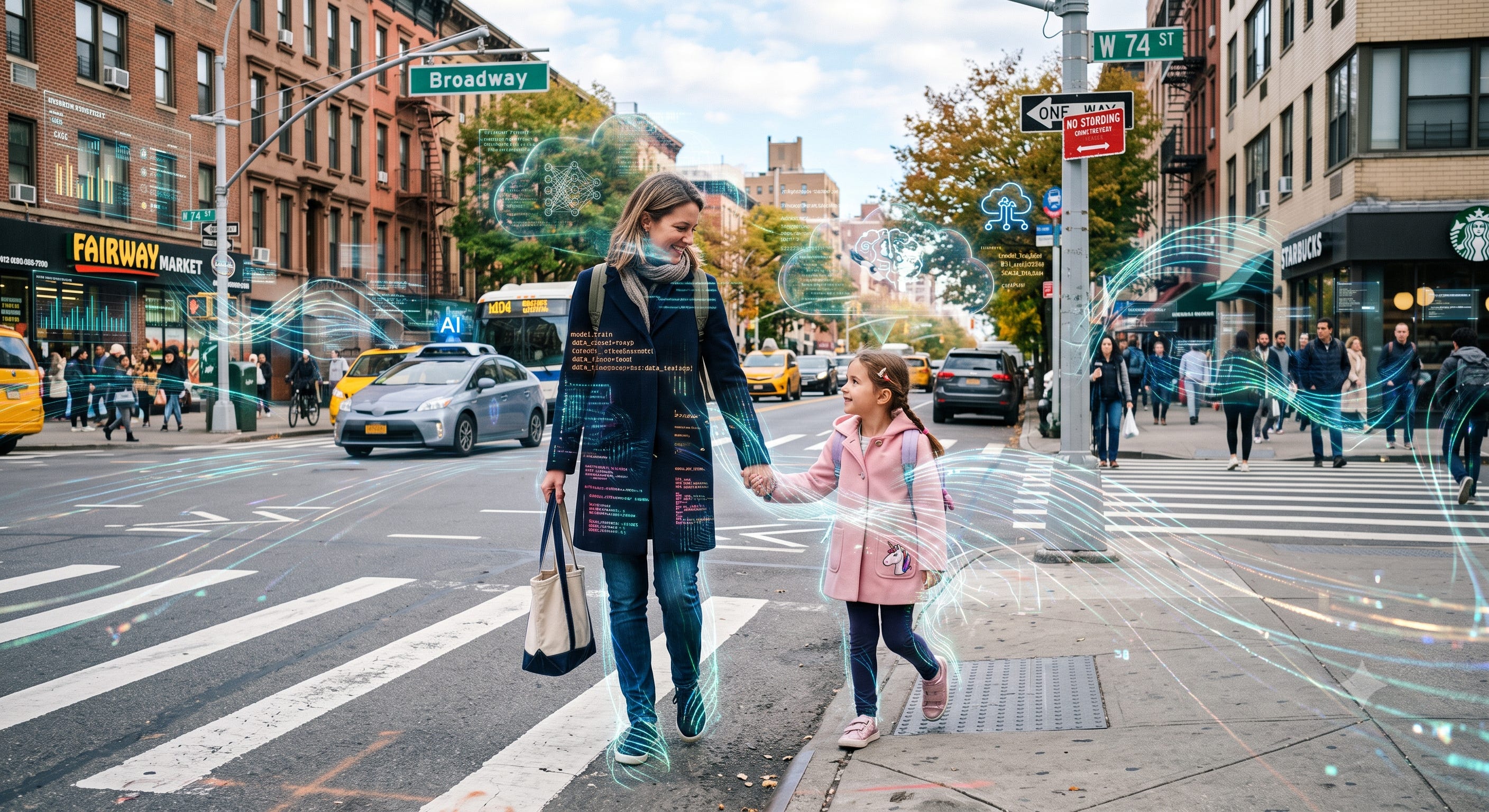
Artificial intelligence will be as ubiquitous to our kids as the Internet was to us, or as electricity was to the generation before that. That’s why I teach AI to my own kids (aged 4 and 6) the same way that I teach them how to cross streets in this city: Slowly, intentionally, and with adult supervision.
As Robin Hood’s CEO Richard Buery wrote yesterday, an AI moratorium will hurt kids more than it will help them. Without appropriate classroom guidance, students won’t be equipped to navigate the very real world of work.
The technology may be changing too fast for any human to keep up. But it’s unacceptable to opt out entirely. Because even if you ban it at school, at home, our kids will continue to talk to AI in isolated bedrooms and on living room tablets, even without a safety net.
The classroom is the one place where a trained educator can stand over their shoulder, question their prompts, and teach them how to think critically about the answers. Maybe that’s why the best teachers I know today are also the ones building tools for better classrooms tomorrow: Games to teach cybersecurity, chatbots to encourage better outcomes in math, even entire web apps or customized tools to augment administrative work.
Later today, I’m sitting down with a group of City College students who won an AI competition, helping them turn their prototype into something production-ready for a New York small business owner.
The winning team was an all-female group of aspiring builders and entrepreneurs. Before our 6-week AI Studio class, none of them had ever built an app before. But they built something so compelling that the business wants to implement it on their own going forward.
If we want tomorrow’s founders and technology leaders to look any different from the ones we have today, we must hand this generation every tool we’ve got.
But the tools that made their project possible literally didn’t exist two years ago. Imagine how far back we’ll push our kids if we enforce a two-year moratorium on AI right now.
We owe it to our kids to figure out AI alongside them. After all, we teach them how to navigate city life by crossing the street with them, not by keeping them inside until all the traffic clears.
No posts
Comments
Nothing yet. Say the first thing.
Sign in to join the conversation.