
“But the tax collector, standing far off, would not even look up to heaven, but was beating his breast and saying, ‘God, be merciful to me, a sinner!”
Luke 18:13
I’ll go ahead and admit this: when I was a kid going to church, I thought pastors had the easiest job in the world. I mean, who else gets to go to work once a week, get paid to pray, and talk about God in front a group of people for 20ish minutes? And most of the audience already believes in Jesus, so you don’t even have to be all that persuasive in your rhetoric!
Even as a seminarian, I remember fixating on all of the “stuff” that constitutes the role and office of a pastor. I knew that one of my primary gifts was preaching, but I never imagined it would become challenging.
Then came my first year of full-time solo ministry.
I began to grow fatigues by the perpetual rhythm of preparing for Sunday sermons.
And probably the most painstaking part of preaching is deciding what to focus on what to leave out (or save for another message). The Word of God is so breathtaking and fascinating that it can become almost painful to set aside observations, insights, and historical details.
But every sermon requires choices.
For every minute preached, there is often an hour—or more—of preparation involving prayer and in-depth study of the text. And so often, there are things left of the cutting-room floor that deserve a closer look but simply won’t fit into the allotted time on a Sunday morning.
This past week, we looked at the parable of the Pharisee and the tax collector in Luke 18. The primary focus of the message was the contrast between self-righteousness and humility.
However, there is one word in the tax collector’s prayer that I think deserves a second glance.
That word is merciful.
Most English translations render his prayer this way:
“God, be merciful to me, a sinner.”
Most of us read those words and see a man who is direct and self-aware. He’s asking for compassion and forgiveness, right?
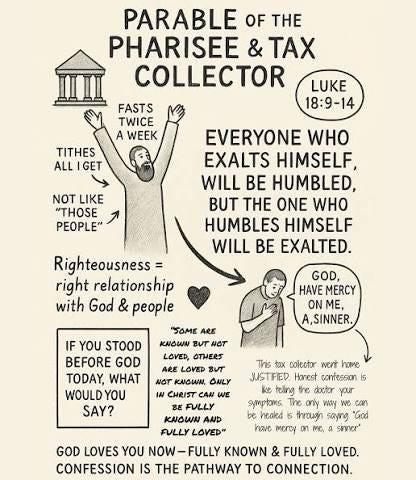
Well, what if I told you that the Greek offers us something even more profound?
The verb used here is hilaskomai.
What’s particularly interesting is that this specific use of the verb only appears twice in the New Testament: here in Luke 18:13 and again in Hebrew 2:17.
This is where studying Scripture in its original language becomes fascinating because this particular verb carries the weight of atonement, reconciliation, and the removal of guilt.
The tax collector isn’t simply saying, “God, look at me and take pity on me.”
He’s saying something closer to this:
“God, I know I am a sinner, and I can do nothing about my sinfulness, but You can.”
And that distinction makes all the difference.
The tax collector isn’t merely burdened by a guilty conscience or weight down by shame.
He understands that sin has severed his communion with God.
There are no excuses.
No defense.
And unlike the Pharisee, he doesn’t compare himself to anyone else.
He simply throws himself before the Lord and pleads for the mercy that only God can provide.
The people listening to Jesus tell this parable would almost certainly have connected this language to the sacrificial system established in the Old Testament.
Animals offered.
Blood shed.
Atonement made.
This was how the debt of sin was addressed.
The tax collector’s prayer points beyond the temple and toward the cross.
And that’s one of the reasons I love this parable so much.
The tax collector, like those listening to Jesus, knew nothing of God’s plan to rescue him through the redemptive work of Christ on Good Friday.
He had no knowledge of the empty tomb.
All he knew—and what Jesus was emphasizing for his listeners—was this:
He could not save himself.
That’s the great irony of this parable.
The Pharisee—the resident theologian—enters the temple filled with nothing but hubris and he leaves totally unchanged.
But the known sinner leaves completely justified.
The man with the religious credentials and impressive resume completely misses the point.
The man with nothing but a tarnished reputation and a desperate prayer walks away covered in grace.
Why has the simple prayer of the tax collector endured for centuries?
Because it’s honest.
It’s humble.
And it’s a prayer every one of us can pray.
“God, be merciful to me, a sinner.”
Maybe that’s exactly what Jesus wanted us to remember.
Perhaps that was the point of the parable all along.
We don’t approach God because we’re impressive, because we’ve proven our worth, or because we’ve figured everything out.
We come because we know we need God to do for us what only God can accomplish.
Comments
Nothing yet. Say the first thing.
Sign in to join the conversation.