
Shortly before the grand opening of Community First! Village, a group of Catholic deacons from the Diocese of Austin came to pray over the pad sites where each tiny house or RV would sit. Because my husband and I were already living on-site, we joined the white-robed men as they moved in pairs from place to place, praying divine protection over each future home.
As part of their prayers, the deacons sprinkled holy water over each site. My Baptist upbringing gave me no category for this practice, but I was struck by the strangeness of the act, the physicality of it — it reinforced the seriousness of the Village’s endeavour: not merely to provide housing, but to provide a place where men and women who have been despised and rejected can find true belonging.
Bethany Joy's Substack is a reader-supported publication. To receive new posts and support my work, consider becoming a free or paid subscriber.
It was a risky endeavor, to be sure. No one imagined that hundreds of people with active addictions, lifelong mental illnesses, and traumatic histories would naturally settle into a cozy little neighborhood. In fact, we expected disputes, outbursts, health crises, and erratic behavior, and prepared ourselves—as much as one can prepare—for those outcomes. As employees and missional residents (I was both at different times during my years there), we received training in de-escalation, how to call 911 for someone experiencing a mental health crisis, first-aid training, supporting others through grief, and much more. We set up a neighborhood watch to keep drug dealers off the property, and actively invited the police to visit, so they would have a foundational knowledge of the people and place when they were called — and we knew they would have to be called sooner or later.
In one way, this preparation was not sufficient: I was still bewildered, for example, when my neighbor Lana told me that the government had filled her house with worms, or when Penny was bellowing in the street, threatening to dash her coffee maker to the ground. And what can ever really prepare you for the first time you touch a neighbor’s body and find it cold?
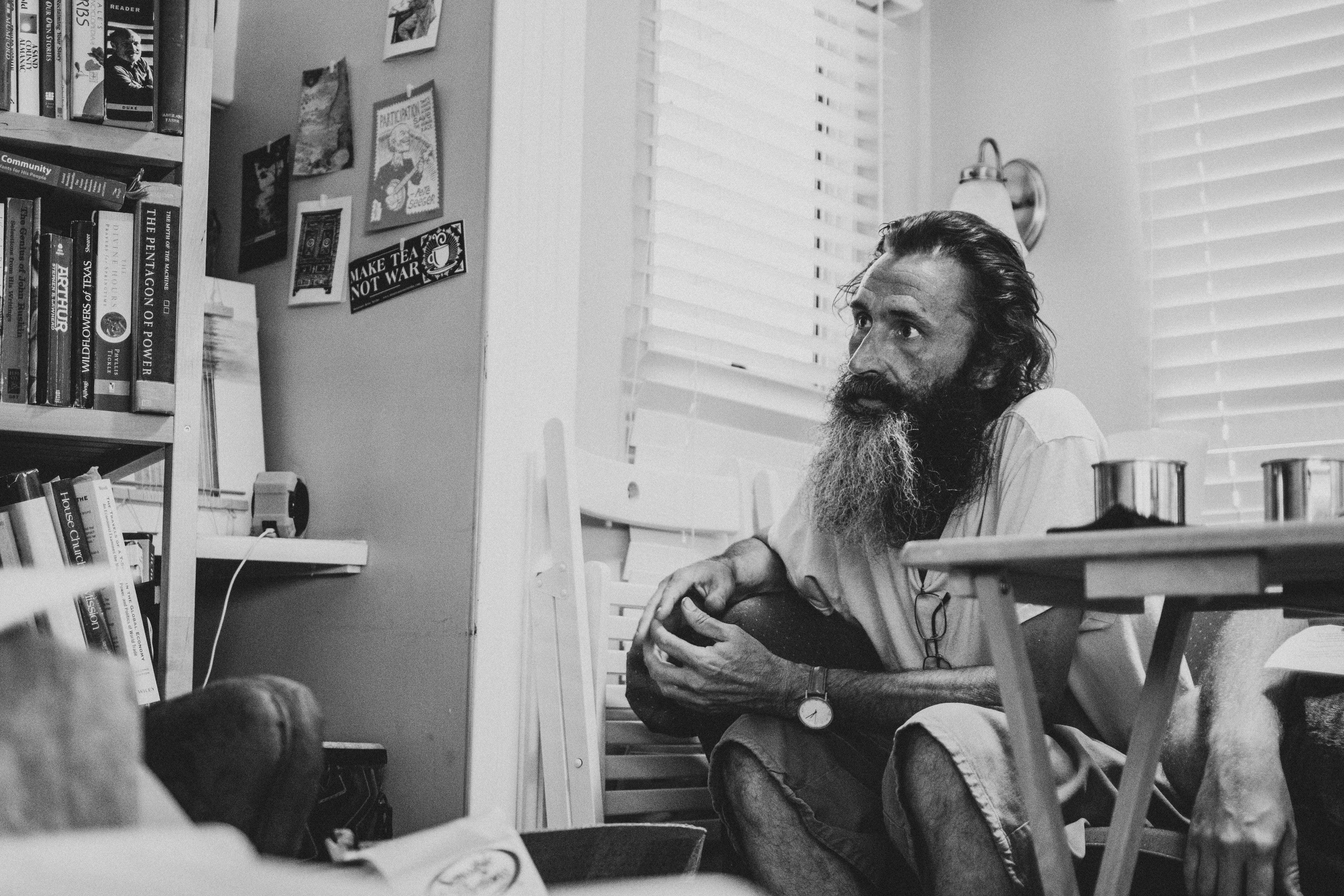
Yet in another way, these constant practices of prayer, training, conversation, and troubleshooting, accomplished something powerful: it made me face the reality of risk in any act of hospitality to my neighbors, and called me to be watchful and courageous even on the most ordinary of days. And not only me—everyone who called the Village home, who worked or volunteered, had to reckon with the risks of what we were doing. That sounds sobering, but the reality was that, by naming and taking responsibility for those risks together, we drove away so much fear.
When Lana was spiraling into her delusion, I had a script of questions I could ask her, and numbers I knew I could call if she grew worse. When Penny was yelling, I had someone by my side to offer her a hot cup of coffee, which cured her rage in an instant. And when I found my neighbor had passed away in her sleep, I faced that sorrow in the sunlight, surrounded by a whole crowd who waited with me as the paramedics tended the body, who made tea and sang songs and didn’t leave me until my husband was home.
It’s strange to say, but lately I’ve been pining for those wild, holy days.
As my husband often reminds me, I wasn’t always happy at the Village. I spent much of my time there grieving the career I had left when I moved cross-country, adjusting to life in 300-square feet, and mourning the miscarriages of our first two children. But for all that, I was rarely afraid.
This recognition is remarkable, because ever since leaving the Village and returning to conventional neighborhoods and churches, fear and dread have dogged my steps. I used to think this was simply because I feel so much more alone out here in the world— that I’m not living in a community with clear lines of membership and responsibility. That’s certainly part of the problem. But it wasn’t just “life together” that drove away fear: it was the shared and open reckoning with the ever-present reality of scary things such as health crises or bad behavior among our neighbors. This recognition led, in turn, to open discussions about how to handle such events when they came.
The Gospel work of loving the stranger magnifies uncertainty of all kinds, and in my own home, I’m constantly thinking about how to anticipate and bind those risks. For example, my husband and I discuss how long we could allow an indigent guest to stay in our guest room, and what it would look like to help them transition when their stay was done; best practices when children are here without their parents; which neighbors to send the children to if I get hurt; where to stash first-aid supplies inside and out. I recently dismantled our trampoline (much to my children’s dismay), because I had noticed that visiting teens were not heeding my call to temper their jumping when younger children on the trampoline with them. I could have stopped inviting the rowdy teens over; instead I removed the thing that was making their visits riskier.
That’s all well and good, but what about grappling with hospitality and risk within a church body? Within a local congregation, the opportunities for radical hospitality are so much greater than within a nuclear family or individual home, but the risks are correspondingly more complex.
Unfortunately, the scripts for discussing risk as a church body are pretty limited. In my lifetime of weekly church attendance across three denominations, I’ve only ever experienced congregational discussions about risk in two categories: 1) child safety, and 2) active shooters during worship.
Our own church, like many others, requires all staff and church members who serve with children to undergo training (including annual refreshers) about preventing and recognizing child abuse within the context of church ministries. As sobering as these trainings can be, they are a good model for confronting risk in that they gather church members together, teach participants to watch for certain red flags and patterns, and provide clear action steps.
But what about empowering a congregation to face
a family whose adult son begins exhibiting early signs of mental illness
a visitor from a vastly different socio-economic class than the rest of the congregation
a group of unchurched teenagers who begin attending without their parents
a new member with physical disabilities
a refugee mother who has arrived in the US with her children, while her husband is stuck in a camp overseas
Some of the risks from these scenarios involve potential physical harm, while others are more subtle: cross-cultural misunderstandings, class-based silos and cliques among members, or the burnout of a small group of clergy or members trying to care for a guest with profound needs.
For most churches, the situations I list above are rare — and that, beloved, is part of the problem. Our churches (the buildings, the programming, the people) are so poorly equipped for true hospitality that we don’t get a lot of weekly practice welcoming visitors who don’t match the congregation’s dominant demographic. And let’s not deceive ourselves: we lack the buildings, programmings, and practices of hospitality not because “the times are bad,” but because we have collectively failed to build, program, and plan with hospitality in mind. How do we reconcile this failure with Christ’s clear instructions in Luke 14?
“When you host a dinner or a banquet, do not invite your friends or brothers or relatives or rich neighbors. Otherwise, they may invite you in return, and you will be repaid. But when you host a banquet, invite the poor, the crippled, the lame, and the blind, and you will be blessed. Since they cannot repay you, you will be repaid at the resurrection of the righteous.” (Luke 14:12-14)
Few churches really know how to do this, and the homogeneity of our worship makes it more difficult to deal with challenges and risks when they present themselves; the reality of “stranger danger” reinforces wide and easy path, viz. sticking with our own kind.
There is, of course, a real limit to the kind of danger a congregation should allow. If a man shows up with a gun, bar the gate and call the cops. If a teen is stealing from the offering plates and refuses to repent, it might be time to send him away. And if my schizophrenic friend is having an extreme crisis, I’m going to call professional help and check him into a specialized treatment facility.
But on the days when the schizophrenic friend is doing okay, when the voices are only murmuring and he’s not agitated, I want to bring him to church with me. And I need a church that knows how to love him and me well as we worship our God together.
I don’t know the answer to all these questions, but I know that I am more afraid doing ministry among affluent, suburban churches than I ever was in a village of addicts and madmen. If I imagine what would calm my fears, I think it would look something like this:
A congregational affirmation of hospitality. The Gospel is clear about our obligations to the poor and the stranger, but there must be a collective will to do this good work, and confidence in the power of Christ to carry it forward. Discipleship and evangelism would meet in rich sermons, Bible studies, and songs that make the hearts of a congregation long to see the blind, lame, lost, and strange gathered with them around Christ’s table.
Preaching that names dangers regularly and honestly, with neither hysteria nor false optimism. This is the work of being saved from sin, after all — let’s get into the nuts and bolts of being a people who bear witness to Christ’s victory over the ways of death. If the church has an influx of teens attending without their parents, then let’s hear discussions from the pulpit—not just to the youth group volunteers— about how to give them rides safely, expectations about adult:teen ratios, etc. Name the dangers and name the practices that keep those dangers at bay.
Training from experts in their fields on how to be advocates and defenders of one another: mentorship training, first-aid training, de-escalation, conflict resolution, abuse prevention (not just for children), and more. If there is a language service or large international population, then add cross-cultural training to that list. These shouldn’t be optional classes, but part of the required membership track.
A council of Guardians, both clergy and lay, who would meet regularly to review the church’s property and programming, identifying patterns of risk and problem-solving best practices.
Prayer. So much prayer. Specific prayers. Round-the-clock prayer. Prayer shared by all the churches members, at appointed hours and over specific areas and people in the church.
For all my bullet-points, I admit that I am more bewildered than ever. I long to sit at a table that looks like Christ’s, but the risk of that meal feels heavier than ever. And yet, when tempted to despair, I turn my memory to those white-robed deacons and their holy water. After we had finished visiting each home site, we stopped at one of the highest points in the Village, looking down over what would become the strangest neighborhood in the city, and one of the deacons said, “Let’s sing! Let’s sing “Amazing Grace!” Our voices rose together through the late-summer air, “Through many dangers, toils, and snares, I have already come / Tis grace has brought me safe thus far, and grace shall lead me home.”
Bethany Joy's Substack is a reader-supported publication. To receive new posts and support my work, consider becoming a free or paid subscriber.
Comments
Nothing yet. Say the first thing.
Sign in to join the conversation.