
The conflation of “career” and “vocation” is a problem. For the first decade of adulthood, I had the luxury of ignoring this problem; I was one of the privileged few who was able to spend my post-high school years studying a subject that I loved, and then was able to get paid to do the thing I felt like I was made to do.
I did this work “heartily, as to the Lord” (Colossians 3:23), bolstered by years of conferences and books that celebrated Christian vocation in terms not so different from the secular admonitions to “follow your bliss” or to “do what you love and you’ll never work a day.” That was all well and good when I was secure in daily work I relished, but it did not prepare me for the Great Disruption.
In my case the first Great Disruption was fundamentally good: marriage. Then came miscarriages, then children, then a series of unsettled years. For others the Disruptions are more harrowing - job loss, declining health, family crisis, imprisonment, pandemic, war. And of course, for many people around the world, the opportunity to pursue a passion as one’s daily work is unattainable.
I recently attended a conference that included Christians from around the world, and between sessions I found myself waiting in line at the conference-center coffee shop with a bishop from an African nation. He asked how he could pray for me, and I immediately asked,
“Have you ever seen a woman spinning thread?”
He nodded. Sudanese by birth, in his homeland he had often seen women spinning cotton, taking a loose cloud of fibers and skillfully drawing from a strong, thin thread that could be woven or sewn into fabric.
“Yes, yes I have seen this. How can I pray for you?” the bishop asked, clasping both of his hands around mine.
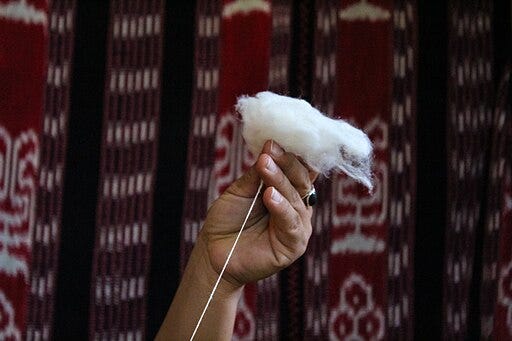
“For the past decade,” I said, “I have felt like a woman whose thread keeps breaking. I’ll start to draw it out and my hand falters, or something comes along and cuts the strand. I long to make something sure and strong and beautiful for my Lord.”
This act of spinning thread has long been my personal emblem of vocation. When you are making thread, of course, you want a nice, long strand so you can create durable garments. But for several years I have felt like I’m just producing fragments: an essay here, a short-term job there, a craft picked up and set down again because the baby insists on playing with the threads. And never the same swift, clean joy I felt when embedded in my chosen career.
This season has driven me to pursue what I call the durable vocations — essential callings that are resilient in the face of changing circumstances or abilities. For a Christian, prayer is the most fundamental of these. When terrible fears accost me (for example, that I might one day become paralyzed), one of my comforts is recognizing that even in such a state, I could still pray, defending the weak from evil, tracing the lines of God’s kingdom with holy imagination, and participating actively with God in the re-creation of the world.
Is hospitality also one of these durable vocations? For a mother, certainly, it has proven to be, because the basic practices of hospitality can be joined more or less seamlessly with the essential duties of motherhood: creating a safe, stable home; preparing meals, spending time outside, etc. (which reminds me, I should probably write a whole essay on hospitality and motherhood, no?).
The call of hospitality also changes our relationship to interruptions. When I am engaged in deep work (for example, writing an essay like this!), I become quite hostile to interlopers. (Years ago, while I was working on an article, my mother, who was visiting from out of town, innocently asked what time we would be having lunch. “Must we always be eating in this house?!” was my churlish reply).
When I lived at the Village, I quickly learned that even in my office or at my desk, I was likely to be interrupted frequently. Our homeless neighbors would amble into the office, looking for coffee, snacks, or conversation. They would sit down and begin making conversation about the weather, or neighborhood gossip, oblivious to the what those of us “at work” were trying to do. Eventually, I realized that welcoming these neighbors was in fact a large part of the work I was there to do, and re-organized my day so that my deep work happened early in the morning, leaving the more flexible tasks for the times of day when visitors were likely.
These practices have served me well as the mother of young children (my eldest is six, my youngest two), as well as the host of a home where I want my neighbors to be able to knock on the door anytime (though of course, living as I do in a conventional American neighborhood, this happens too rarely).
Hospitality is also durable in the seasons when we become the strangers. In many ancient languages, the term for hospitality refers not merely to “the act of hosting,” but to the participation of both host and guest in an experience of mutual responsibility. We might feel better about the seasons in which we, abundant and “at home,” are able to welcome others, but we are still practicing hospitality during the seasons in which we are the needy guests, learning what it means to receive with gratitude, to bless our hosts, and to leave at the proper time.
In fact, that is very much how I felt when the bishop from across an ocean asked if he could pray for me: although he was the “stranger in a strange land,” he, joyfully at home in the presence of our Lord, invited me into the strong house of his prayer, blessing my family, calling God’s protection and wisdom to surround us.
As I’ve reflected on this encounter, my frustration with my pocketful of fragments has given way to another, much older image: an icon of the Annunciation. The earliest Christian artists imagined that was Mary was spinning thread at the moment the angel Gabriel arrived. According to tradition, she was making thread she would weave into curtains for the Temple. Her craft is already an emblem of hospitality—she’s sustaining the house in which God was thought to dwell. But artists have included her red thread for thousands of years because the instant Mary said “yes” to God, she was inviting the God is the universe into the small house of her body, creating a home for the Most High.
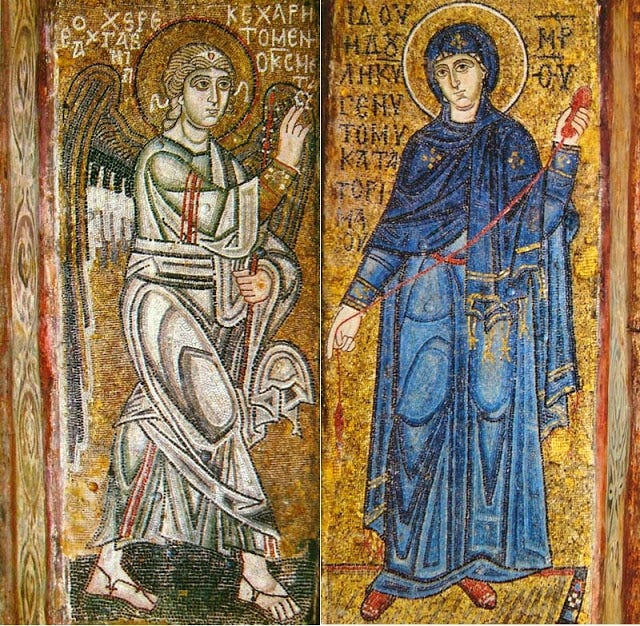
Perhaps this is my answer: that to the extent that our hospitality as host or guest is a form of prayer, then it is in fact a durable vocation, continuous and beautiful in spite of many disruptions. Perhaps, like Mary, there is a way to offer both our homes and our wanderings to the God who longs to dwell with us.
No posts
Comments
Nothing yet. Say the first thing.
Sign in to join the conversation.