
By some mysterious working of the Substack algorithm, my two-year-old essay on leaving Community First! Village has received a flurry of comments and re-stacks over the last few days. Feeling nostalgic, I re-read it myself, pondering what light it might give to our efforts in hospitality two years later.
I wrote in that our departure from Community First! Village—a permanent supportive housing community for the homeless—was motivated largely by our conviction that “we needed to return to the places where radical welcome is hard and uncertain, and find a way to translate the wisdom of the Village into the realities of suburban neighborhoods and comfortable churches.”
As I’ve reflected on the last four years, "hard and uncertain” hardly covers it, and I think maybe I need to start a series on all the experiments in hospitality that haven’t worked (let me know if that sounds interesting or instructive).
But if I’ve learned anything in our post-Village life, it’s that you just have to keep going, even if it feels like a slog (“For us, there is only the trying. The rest is not our business,” says T.S. Eliot). I don’t feel like I have a coherent strategy or even clear vision about where we are going in all this — but we keep going. In that spirit, I want to share two of the experiments we’re offering to God this spring, with hopes that they will deepen the roots of our welcome.
Redeemer Parish Gardens
The premise: put gardens in the front yards of our church members, and supply them with plants that produce hard-to-find international crops.
Why do this?
Although my husband and I worked for years among the chronically homeless, our primary work in North Carolina has been with refugee and immigrant communities. From our friends in these communities we have learned that there are many delicious vegetables and herbs—cassava, intore, Tulsi, and many more— that are difficult to source in an ordinary supermarket, and expensive to buy from specialty shops. And so we’re empowering people to grow these hard-to-find crops, harvest them, and then literally bring them to the church altar as an offering, where they can be collected and distributed at local community centers.
We’re piloting this effort with twelve families this spring. Our Farm to Flourish crew—American-born and refugee teens from our church—installs the gardens along with the host families. The plants aren’t even in the ground yet, but we’ve been hearing from families that their neighbors have gone out of their way to stop and chat during the installations, and have been excited to hear about the project. Sometimes I worry that “radical-welcome-through-gardening” makes us a kind of one-trick pony, but you know what? It’s a good trick, and we’re going to keep doing it.
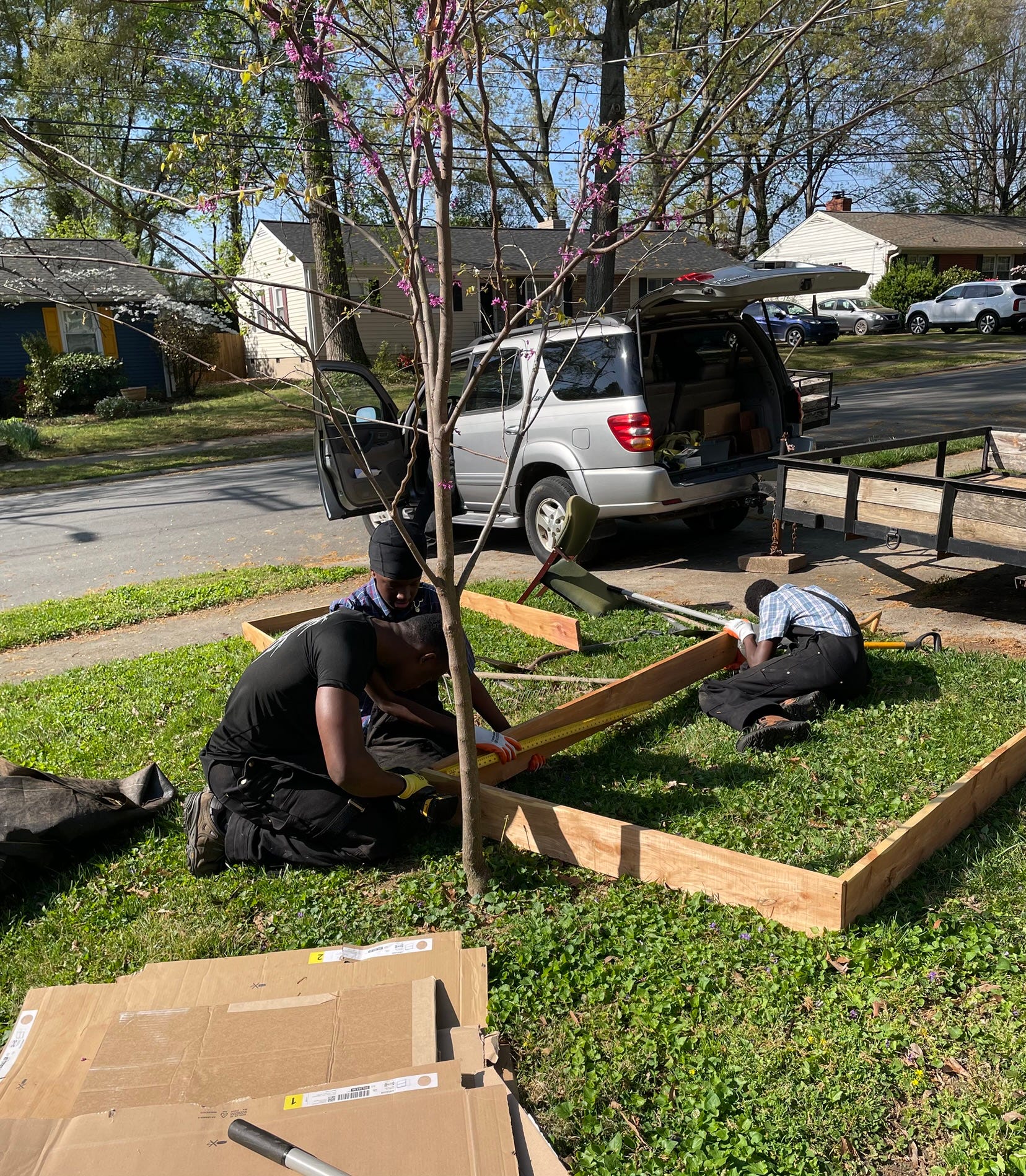
Right now this program feels like a fresh wind. I’m so grateful that our church has a farm on-site (running it is my husband’s job, after all), but despite my decade+ in high-church settings, I’m still a low-church Baptist at heart. I don’t want to create a program that people outsource their involvement to: I want priests and prophets in every front yard around town.
Sunday Stories
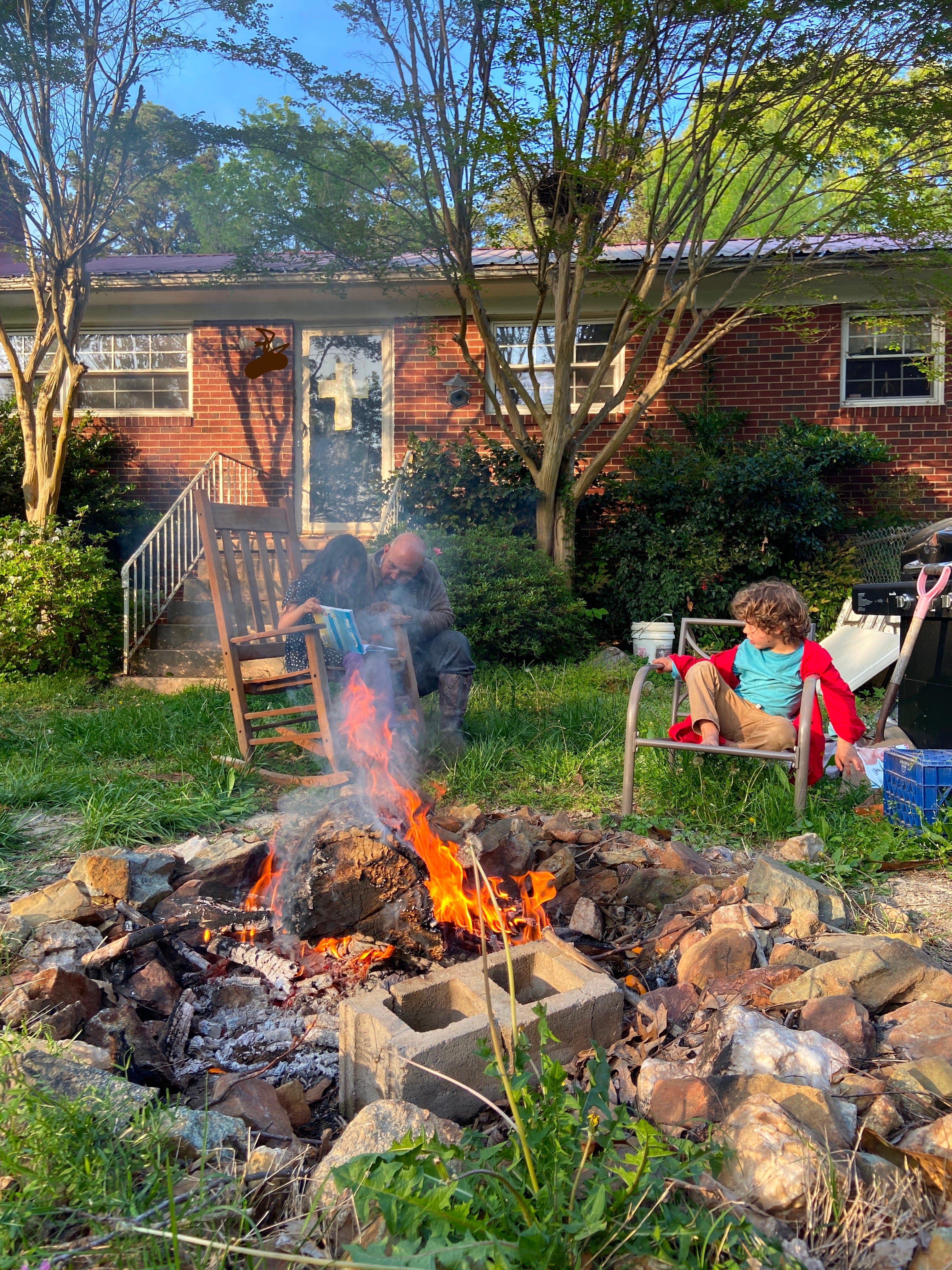
The premise: a campfire in the front yard every Sunday night. The only rule is that you come with ears to hear or with a story to share.
For the last two years I have worked on the staff of the teen empowerment program my husband runs as part of the church’s farm program, but as the demands of our own children’s schooling ramps up, I’m re-centering my attention and energy on our own home. Our children are now 7, 5, and 2. The oldest is completing her second year of “hybrid” homeschooling, which means she attends her school twice a week, and the school sends “homeday work” that we complete together on three other days. And so my house is always messy, I feel like I’m hardly in our garden at all, and I haven’t made a decent loaf of bread in two years.
BUT, I recently read Martin Shaw’s Liturgies of the Wild, and it stirred something in me. My children know that something is wrong when Mama is too sad or tired to tell a story, yet that’s how I’ve felt for much of the last two years. Shaw’s book reminded me that storytelling is actually one of our most powerful ways to take hold sorrow and give her a proper name, and to find joy in her strange games of hide-and seek.
And so we’ve started a new practice — Sunday evenings, right before bed, we light a small campfire in the front yard and tell stories. That’s really the only rule — that this is a time for telling stories, not for small talk or discourse, but for stories. This new anchor in our week has given me something to invite people into with ease and joy. No you don’t need to bring anything, I say, only ears to hear or a story to share.
In the four or five weeks we’ve done this, our guests have included: our widowed neighbor, my parents, the granddaughter of our neighbor. Stories have included fairy tales, recollections of “how my daddy taught me to catch a worm for fishing,” and Bible stories.
Only the Spirit knows what fruit (if any) these efforts will bring. But they smell sweet, and we give thanks for the faith and hope to keep trying.
What experiments in hospitality are you trying this spring?
No posts
Comments
Nothing yet. Say the first thing.
Sign in to join the conversation.