
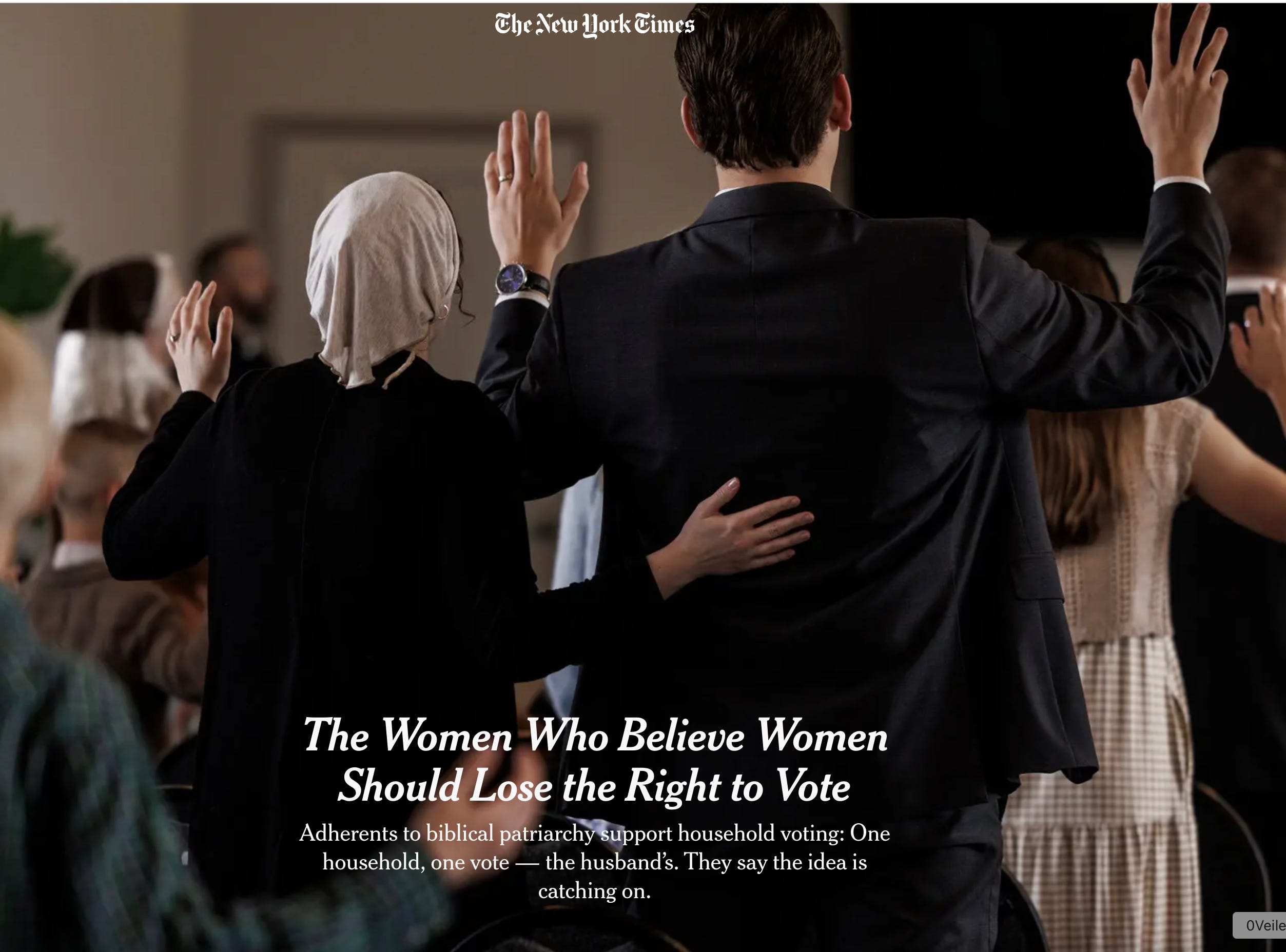
Yesterday I was quoted in the New York Times in an article by Vivian Yee. (I also was quoted in People magazine this week, it turns out, but that is for a different story.) Yee reached out to me after reading The Making of Biblical Womanhood. She wanted to know what I thought about “biblical patriarchy” (a.k.a. complementarian theology on steroids). As we talked, the conversation turned toward an idea gaining momentum in biblical patriarchy circles: repealing the 19th Amendment. This is what I told her.
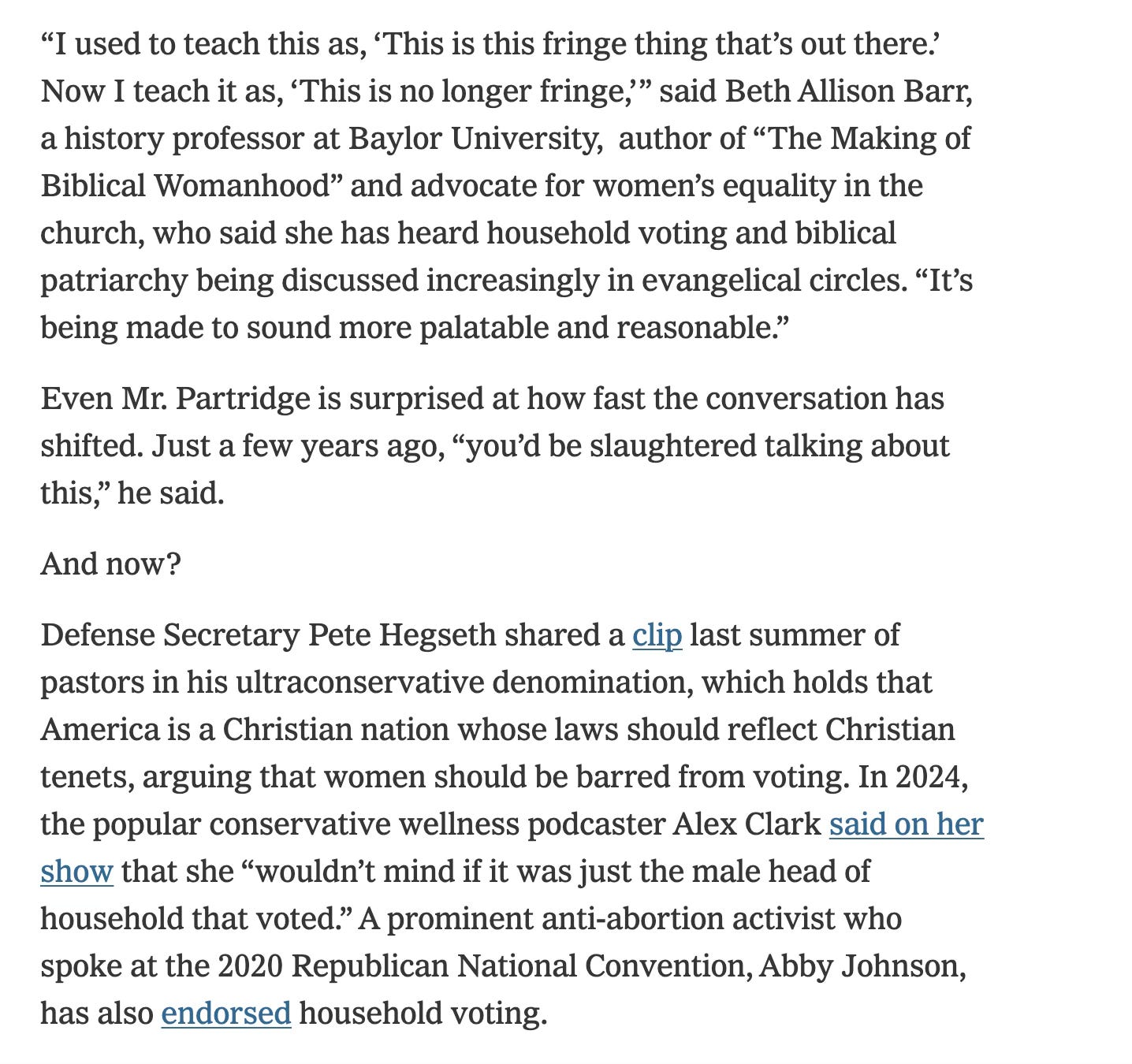
If you haven’t read Yee’s article yet, I encourage you to do so. She explains the link between biblical patriarchy and the anti-suffrage movement. “For supporters, household voting stems intuitively from what they call biblical patriarchy,” she writes. “In patriarchal marriages, husbands hold ultimate authority, with wives in “submission.” Women should submit to the authority of husbands not only in the home and church, but in the political world, too. They should cede their vote to the male head of their household.
Yee interviews Tia Levings, who has lived under biblical patriarchy and knows first hand how the “household vote” movement is attempting to deprive women of our constitutional right to vote. Yee also interviews one of the loudest voices within the anti-suffrage and biblical patriarchy community: Dale Partridge himself.
I don’t think I knew who Dale Partridge was before 2022.
2022 was the year I stepped down from being an Associate Dean in the Graduate School at Baylor University and returned to my home department as the James Vardaman Professor of History. During the time I had been in the Graduate School, the College of Arts & Sciences had revised the core curriculum. History, under the capable leadership of our now chair Julie deGraffenried, helped design a new course as a proposal for the core. It was accepted and is now required for A&S students. The course framework is brilliant: History 1300: The U.S. in Global Perspective. Designed as an introduction to U.S. history, it focuses on different themes (varying from professor to professor) that show how a “distinctly American society developed within larger patterns of world history”.
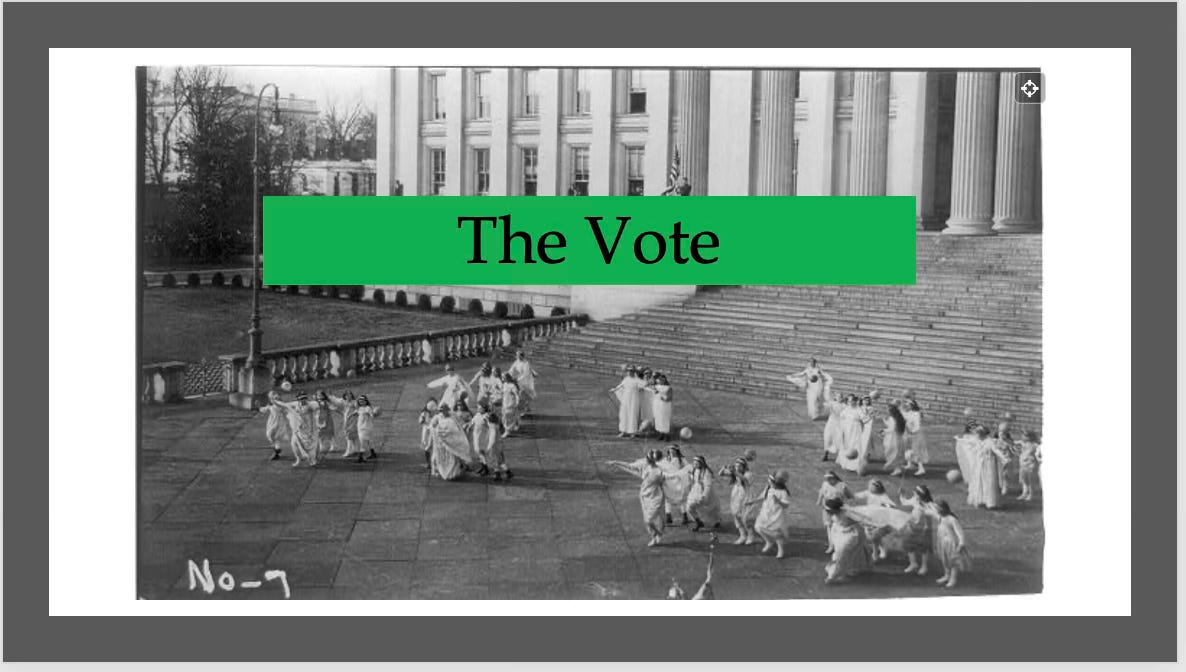
2022 was the first year I had to create a syllabus for this course. I was slated to teach it for the first time in Spring 2023. I chose the theme of suffrage, titling my course “Votes for Women”. As a European scholar, I felt most equipped to teach American history through the lens of women’s history. “Votes for Women” would allow me to teach to my strengths by comparing U.S. suffrage with U.K. suffrage, contextualizing both within a global human rights framework.
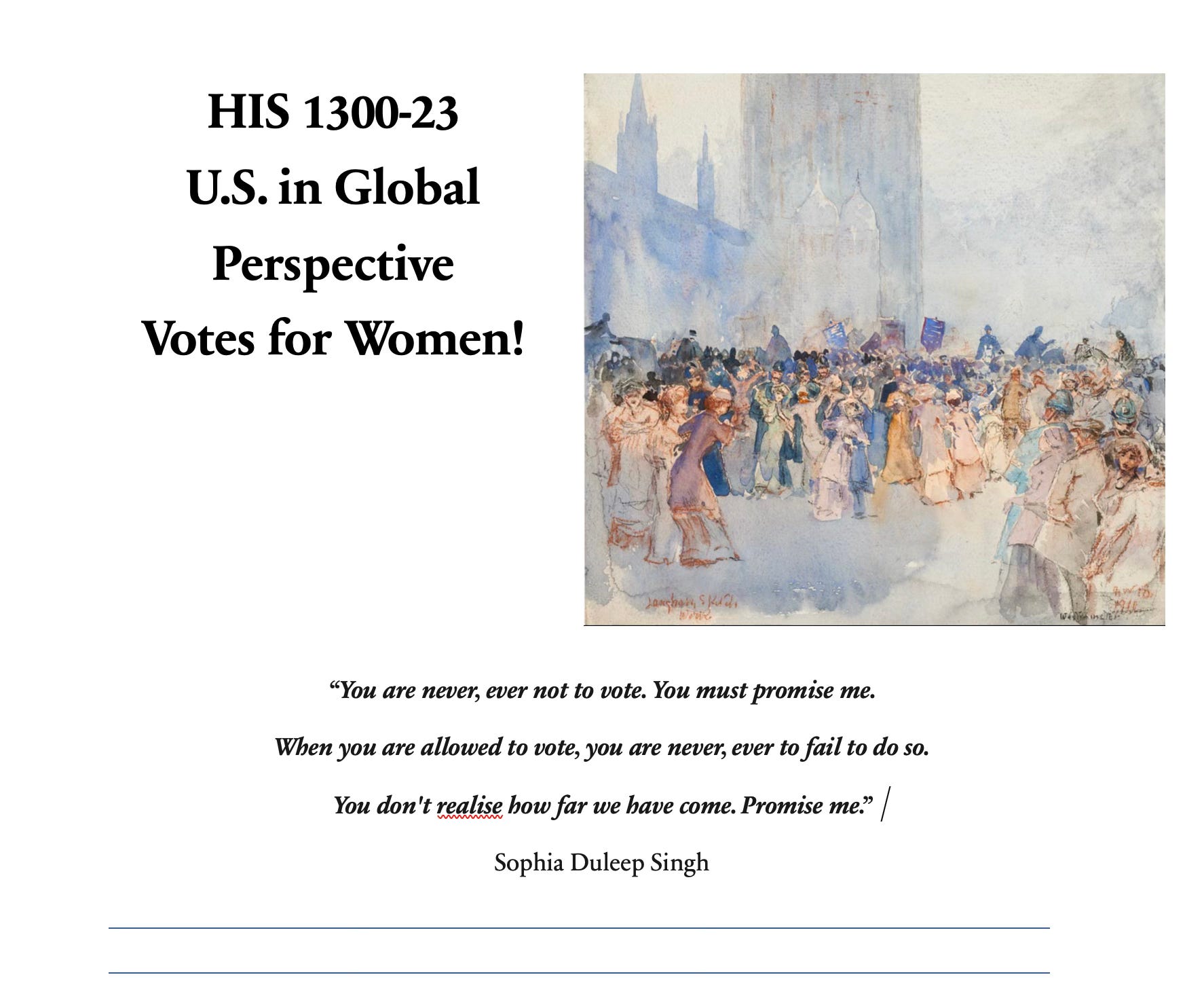
I knew that teaching the history of suffrage would be important. What I have learned is that teaching the history of suffrage during a historical moment when the rights of American citizens are being eroded and when voices are trying to convince women to cede their right to vote is more important than I could have imagined.
Take, for example, this week as the 14th amendment took center stage during Supreme Court hearings over Trump’s challenge to birthright citizenship. One of the key parts of my class is learning constitutional amendments, such as the 14th and 15th amendments. By the end of the semester, students should be able to recite these to me and discuss the historical context of their origins and significance for Americans. Which means my students are prepared to understand the import of both Trump’s challenge and the Supreme Court’s decision when it is made.
By teaching the historical reality of the suffrage movement, my student’s learn that women’s desire for suffrage is not a product of “radical liberal leftists” who hate men and motherhood. It is a product of women who believed they were fully human, understanding that in a democracy, women should have the full rights of citizens just like men. It is a product of upper middle class women who saw the cost of political disenfranchisement for not only themselves but for working class women and wanted to help. It is a product of husbands, fathers, and male allies who valued the women working beside them and believed women should have a voice in making the laws that governed them.
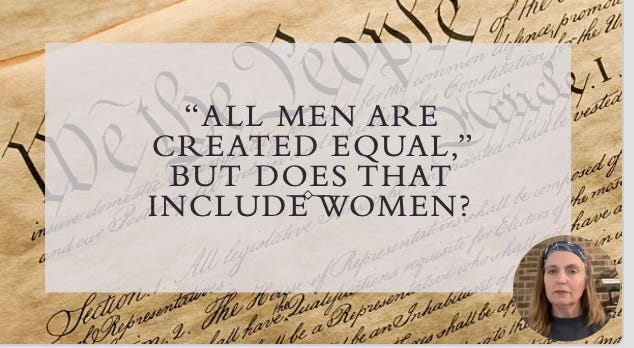
From Abigail Adams asking her husband to “remember the ladies” to Sojourner Truth’s declaration that “I am a Woman’s Rights” to Sophia Duleep Singh’s refusal to pay her taxes without representation, women have always realized the gravity of being excluded from the language of citizenship.
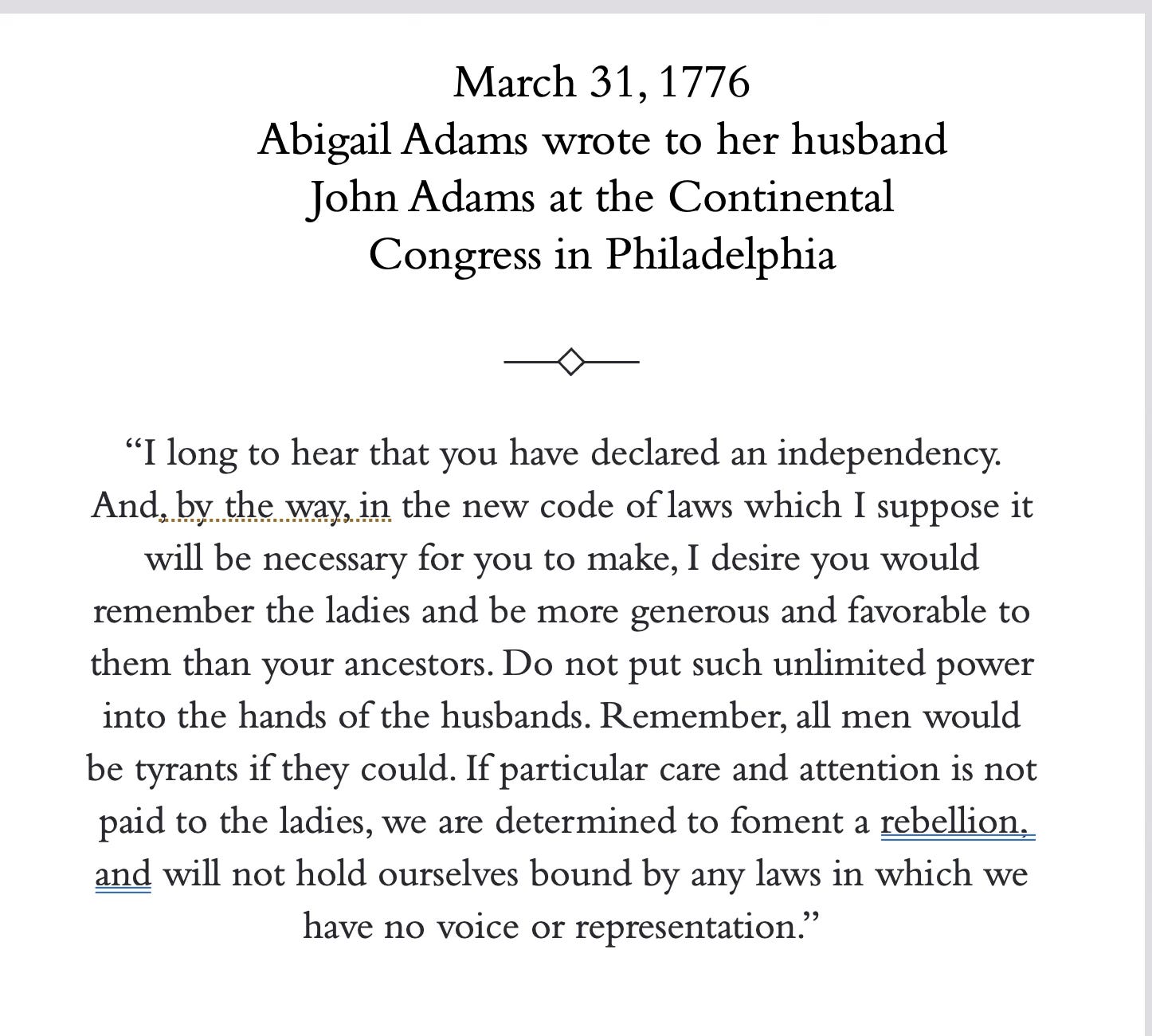
My students learn what life was like for women before the vote. Women who lacked the ability to own their wages, to control their own property, to even claim parental rights over their children. I see their faces as they realize how recently it was that women gained the ability to take out credit in their own names or not get fired from jobs when they got married and/or pregnant. I hear their conversations as they learn how women were sexually assaulted, beaten up, and force-fed during attempts to get suffrage bills on the floor for votes in Parliament and Congress. I see understanding in their eyes when we discuss the conundrum of how women were to get the right to vote when they lacked the vote. How could women get the government to listen to them when they had no voice in that government?
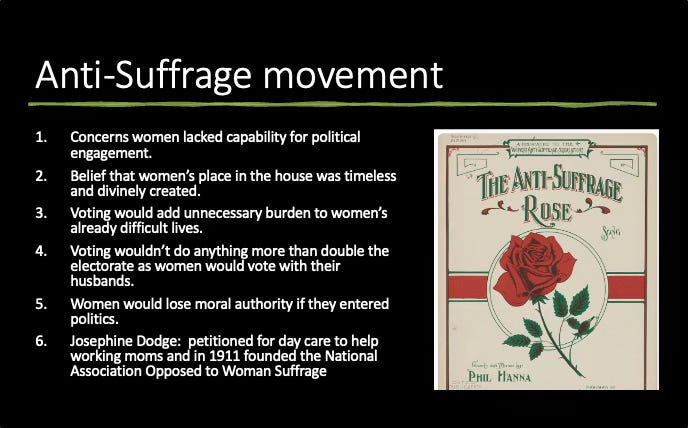
My students also learn about women who fought against the vote. I want them to have empathy for the women who stood with Emmeline Pankhurst, crying “deeds not words.” But I want them to have empathy for the women who opposed suffrage, too. To understand why women feared the vote, why women perceived suffrage as anti-male, and how women could fight for women’s right to education while simutaneously fighting against the vote. I want my students to see the continuities between women who fought against the vote in 1912 and women who reject their right to vote today. I want them to understand what is at stake for women without dehumanizing those who oppose women’s full citizenship rights.
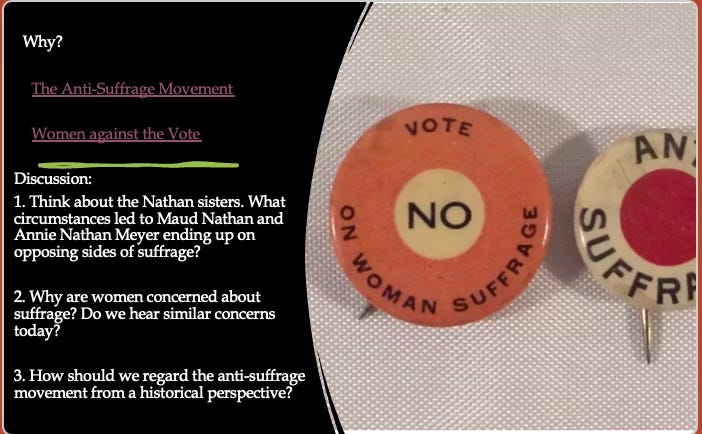
This was the conversation in my class yesterday: why women fought against the vote. How surprised I was to sit down at my computer shortly after and see a social media post tagging me in the article, “The Women Who Believe Women Should Lose the Right to Vote.” It isn’t everyday that your class lecture is mirrored by a NYTimes article that quotes you.
Which brings me back to Dale Partridge. I didn’t know who he was before I taught HIS 1300. I learned. The first slide in my first lecture now features Dale Partridge. Most of my students find his comment shocking. Not all of them. Some of them have heard similar sentiments first hand.
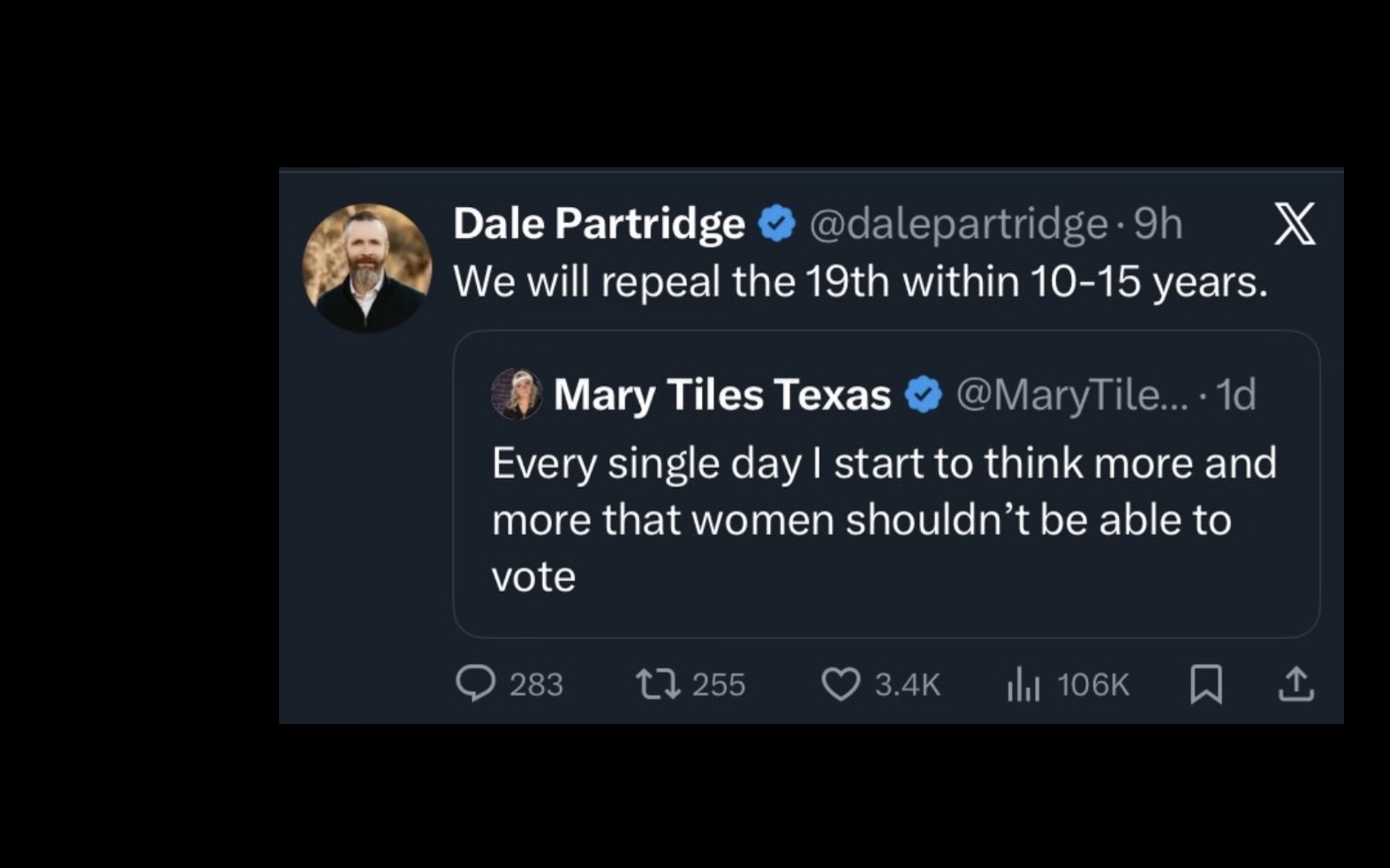
Despite Partridge’s optimism, I don’t think that the 19th Amendment will be repealed. Jill Lepore’s newest book, We The People, explains the challenges of amending our constitution. (I recommend it, by the way.) Partridge and his ilk won’t convince enough people to garner enough votes in enough states to remove women’s right to vote.
That’s not what worries me.
What worries me are the women who think Partridge’s confident declaration is reasonable. The women who have forgotten why the vote matters. The women who never learned why the vote mattered to begin with.
Sometimes, when I read the news, it doesn’t feel like I can do much to help.
But the reality is I can.
I can teach.
Comments
Nothing yet. Say the first thing.
Sign in to join the conversation.