
I’ve been thinking about this post for almost a year.
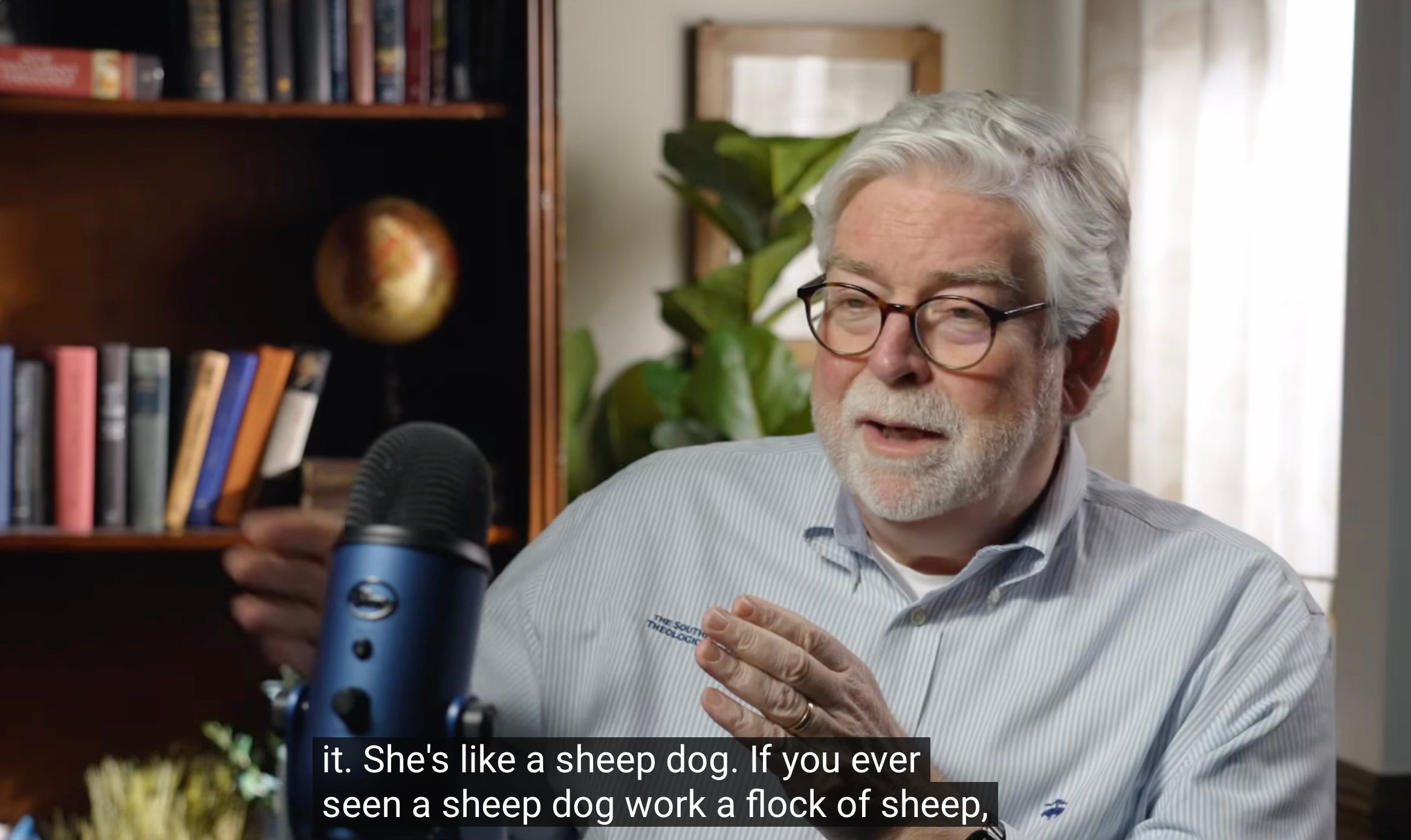
Last spring, a woman sent me a podcast episode title, “A Pastor’s Wife Role in Ministry,” at the Pastor Well podcast with Hershel York. York is a self-described pastor-scholar and Dean of the School of Theology at the Southern Baptist Theological Seminary in Louisville, Kentucky. For those not in the Southern-Baptist-know, Al Mohler serves as president of this seminary.
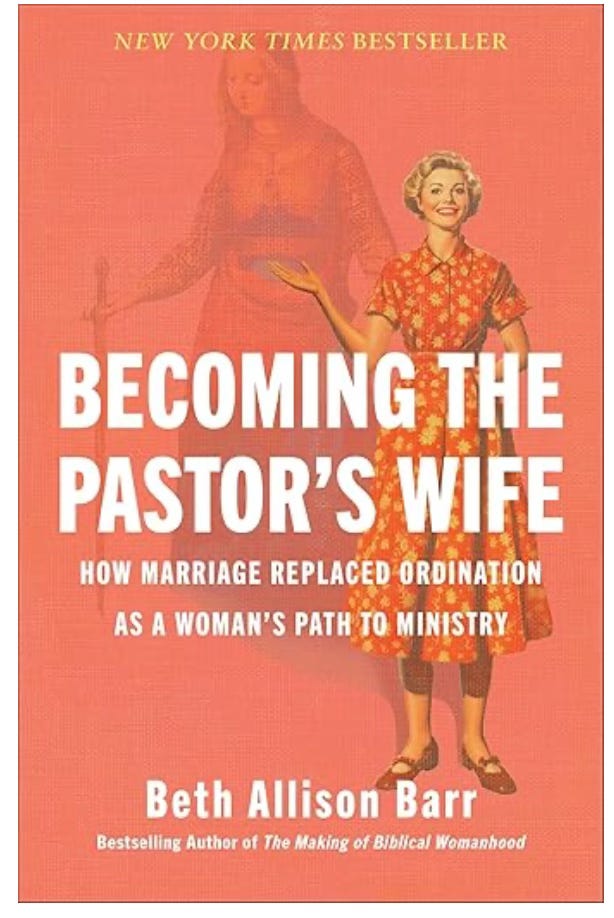
Marginalia with Beth Allison Barr is a reader-supported publication. To receive new posts and support my work, consider becoming a free or paid subscriber.
York posted this podcast on May 12, 2025, two months after the publication of my most recent book, Becoming the Pastor’s Wife: How Marriage Replaced Ordination as a Woman’s Path to Ministry. I find this interesting because, shortly after the book published, I received comments ranging from “this isn’t the 90s; we don’t treat women like this anymore” to “this never happened to my wife, and I have been a pastor for 30 years” etc. etc. ”
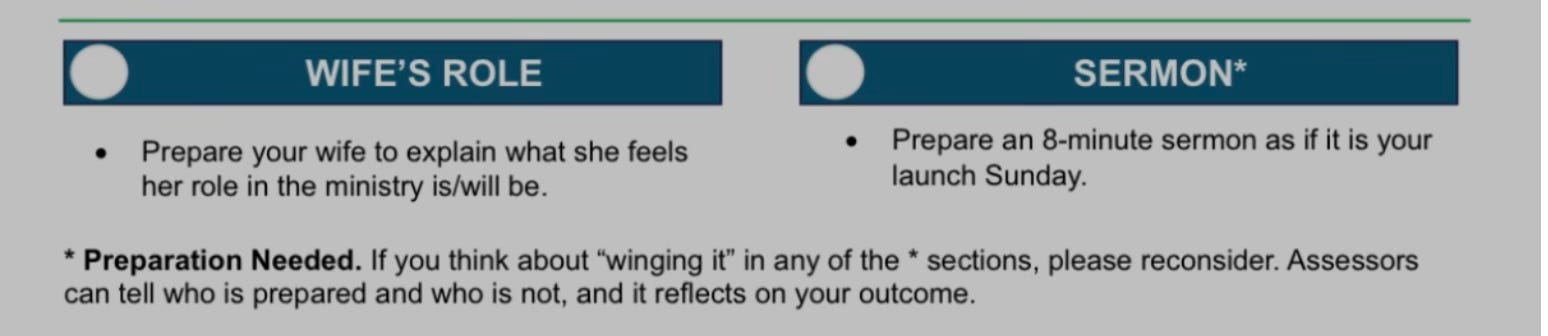
(As a side note, I actually got plopped into a Baptist pastor/pastor’s “spouse” group by someone who clearly hadn’t googled me and sent me instructions like this—screenshot below. This was also only two months after Becoming released, hitting the New York Times bestseller list. While the worksheets often used the word “spouse”, they reverted to “wife” revealing their role expectations.)
Again, for those not in the Southern-Baptist-know, Southern Baptists are the largest Protestant denomination in North America (still). Their influence in modern politics, especially propelling the agenda of the religious right, is significant. The reason I keep talking about the SBC isn’t because I have a personal grudge against them. I don’t, actually, despite what a reviewer of Becoming the Pastor’s Wife claimed. (See my footnote below.)
The reason I keep talking about the SBC is because how much they have influenced North American culture, especially concerning gender roles. Take, for example, Southern Seminary’s YouTube channel, on which the video for the podcast I am discussing is posted, has 334,000 subscribers. The video itself has received more than 7,000 views, 179 thumbs up and 0 thumbs down. The only comment states, “Well explained. Thanks and God bless you.”
This isn’t a staggering amount of views. But when you put it into a teaching perspective, it is more sobering. York is the Dean of the School of Theology and he posted this episode on the primary seminary channel (and his podcast is hosted by the seminary). Which means the perspective he teaches in this episode does not conflict with what the seminary is teaching. We can assume that many of those 7000 viewers (not to mention those who listened to the podcast as well as those who learned at Southern Seminary) are in ministry. Which means that they are taking this view and teaching it to their churches. From this perspective, 1 view potentially impacts an entire congregation. Even if only half of those 7000 viewers are in ministry, that is still potentially 3500 congregations. Most SBC churches are under 150 members, and if only 70ish of those are regular attenders, a conservative estimate for those potentially influenced by the teachings of this podcast could be around 245,000 people. That’s a conservative estimate.
So, let’s return to that podcast/Youtube video. Here is some of the transcript, and I am starting after a little after the 5:06 mark:
…So, as husband and wife, it’s not like you’ve got your own, you each have your own silo. No, she is a part of my ministry. God’s called me to be the shepherd. She as my helpmate is helping me do that. Tanya had a remarkable gift that she could see people drifting. And you know, I know this a it’s a terrible analogy. I apologize for it in advance, but uh she’s heard me use it. She’s like a sheep dog. If you ever seen a sheep dog work a flock of sheep, the sheep start bolting one way and that sheep dog goes in and goes on the other side, gets them back in. That’s exactly what Tanya did….And that’s what I need cuz I can be so caught up in sermon building and teaching and seminary life or whatever. I needed her with an ear to the ground hearing the vibrations of what’s coming and say, “Oh, here’s what we need to do.”
And man, it was just a remarkable gift… It just deepened our relationship uh our mutual commitment to the Lord and to each other. It left no room for anyone else to come in between us….So, this is where you just tell your wife, man, I want to use you in the best possible way. Talk to her about it. Ask her what what would you like to do that would be helpful in the ministry? How can we do this together? Pray together. serve the Lord together. And man, when you when you have this team member that is committed to you for life and now committed with you in ministry, it’s going to help you. It’s going to take your pastoring to a whole another level. And indeed, you’ll pastor well.
York does say that not all ministry marriages have to work this way. It is okay for your wife to have her own career, if that is what the couple deems best.
Yet, York emphasizes that ministry works best when husband and wife are in it together. The pastor job is too big to do alone; it really isn’t a one person job. A pastor pastors best when his wife helps him pastor. Just remember that she isn’t a pastor. She is the pastor’s helper. Or, as York describes her, the sheep dog to the shepherd.

Please note that York acknowledges this is a “terrible analogy.”
Please note that he uses it anyway.
The YouTube channel of the flagship seminary of the largest and most influential Protestant denomination in North America teaches that a pastoral marriage works best when ““you have this team member that is committed to you for life and now committed with you in ministry, it’s going to help you. It’s going to take your pastoring to a whole another level.” It describes the pastor-husband as a shepherd and the pastor’s wife as a sheep dog. A shepherd shepherd’s best when his sheep dog does part of the work for him.

So what does this have to do with feminism?
Feminism, in the Southern Baptist world, represents original sin for women. As the ESV told us so for too many years, Eve’s curse is to resist the leadership of Adam. Just listen to how a guest author, who spoke at Southern, explained feminism in an article posted on the seminary website:
“Feminism is not relegated to women in corner offices, man-haters, and television pundits. It’s staring at us every morning when we put on our make-up. Feminism, while birthed as an ideology with the suffragists, is actually an idea of the oldest kind, an idea that reared its head when Eve believed the lie of Satan that God’s Word really wasn’t good, and especially not for her.”
Feminism is the lie Eve believed that she didn’t need God. It tells women, the author continued, that they can “call the shots,” that their identity is their own (not found in a man nor in God), that they should “scoff” at people committed to family, that they can “boy-bash” and “man-hate,” that you can put off “God’s good design for marriage and children” in pursuit of a career, and that you should resist “when a man offers to help you with something you feel completely capable of handling yourself.”
“Like Eve before me, I want to be the master of my own destiny. But like Eve, there is hope for this accidental feminist. The promised seed, Christ, crushes every sin that so easily entangles—including feminism. And while I won’t fully be free from my anti-authoritarian heart until that final day, I take great hope in the fact that the God who shined light into my darkened life that December day will bring me all the way home until I’m finally and completely made new.”
Whew. Did you hear the conflation of “anti-authoritarian” with sin? If godliness is obedience and submission to male authority, then feminism is anti-God because it offers women freedom and equality. If sin is self-reliance and the refusal to recognize authority, then feminism is sin.
Are you beginning to see how the pastor’s wife fits into a discussion of feminism? Think about York’s description of the shepherd and his sheep dog.

The pastor’s wife stands in stark contrast to feminism. Instead of pursuing her own career, she puts the ministry of her husband first. Instead of trying to call her own shots, she submits and obeys. Instead of trying to be the shepherd, she is content to herd the sheep.
As I wrote in Becoming the Pastor’s Wife, “my white evangelical and Southern Baptist tradition has used the pastor’s wife role to enshrine biblical womanhood as the only godly role for women. Because the pastor’s wife role provides an acceptable way in complementarian theology for women to serve in ministry, it has been weaponized to condemn women’s ordination and exclude women from pastoral positions.”

Why do we fear feminism?
Could it be, at least in part, because the largest Protestant denomination in North America has cast feminism as original sin and provided a godly alternative model of womanhood that supports male leadership?
I’ll let you think about it.
(and if you haven’t read Becoming the Pastor’s Wife because you don’t think pastors’ wives are that important; you should think again…)
Footnote: I don’t have a personal grudge against the SBC. For those who read The Making of Biblical Womanhood, it wasn’t an SBC church that fired my husband. I tried to make this clear in interviews, and you will note I never mentioned the church in MBW. Yes, I grew up SBC and my husband was ordained SBC, but we have not been in an SBC church since we left North Carolina. As for accusations that MBW is a revenge-piece, I didn’t publish MBW until 2021; my husband was fired in 2016. I was well past anger and understood how what had happened to my family was part of a larger problem in North American evangelicalism that was spreading globally. As I said in a hometown interview in 2021:

“Even though a lot of the book took place with my experiences here, it wasn’t written to attack any places here,” she said. “It was written to address this large system that we see among conservative evangelical churches.”
In fact, she’s been careful not to name her former church or its members in her book.
“I actually worked really hard in the book to not bring too much of Waco explicitly into it,” she said. “But now that I’ve hit the national and international stage, you know, journalists are good at their jobs and they can dig [things] up. So, it’s been connected in ways that I didn’t intend.”
Marginalia with Beth Allison Barr is a reader-supported publication. To receive new posts and support my work, consider becoming a free or paid subscriber.
Comments
Nothing yet. Say the first thing.
Sign in to join the conversation.