
Welcome to this week’s Beta Update 👋
*Note: You’re receiving this update because you previously registered for a Beta University–hosted or co-hosted event via our Luma calendar and opted in to receive communications from the hosts.
The fund for the agent-native era.
The Llama Beta Fellowship is our commitment to this generation. Twenty founders. Up to $2M per company. $40M committed to this batch alone. The Fellowship isn’t just capital — it’s a curated room where the operators, engineers, and category leaders shaping the agent-native era gather to help these twenty ship. From Fellowship, teams graduate into our early-stage portfolio; through late-stage SPVs, they gain exposure to the category leaders they’re building alongside.
Investing where conviction begins.
Saturday 8/29 Qoder X Beta Fund Agent Factory Hackathon
Panel from TinyFish Co-Founder, Character.ai and Qoder
4 tracks build on top of Qoder with more than $1500 Cash Prize
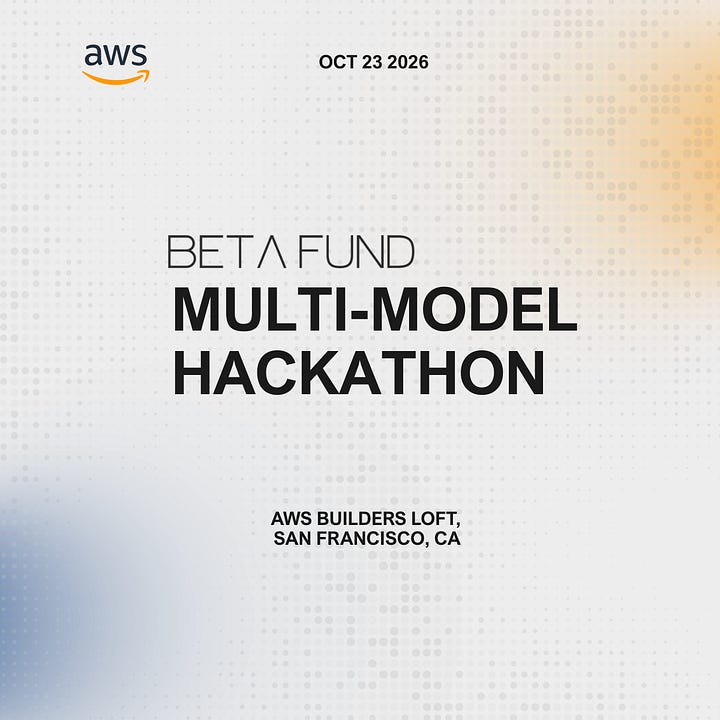
Friday 10/23 AWS Builders Loft X Beta Fund Multi-Model Hackathon
“The constraint of physical AI right now is not algorithm capability. It’s the density of the underlying communication infrastructure.”
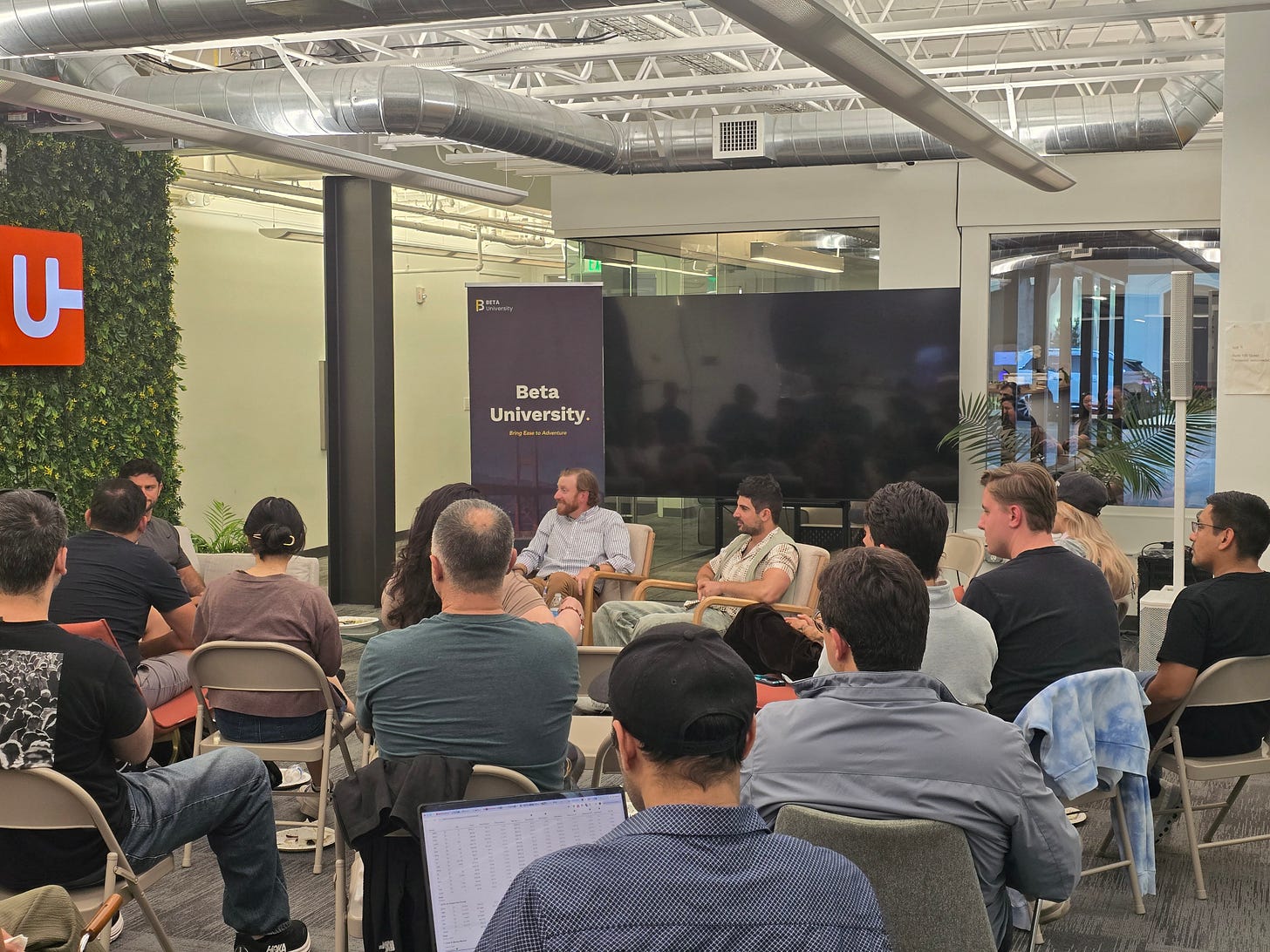
Eric co-founded Zinar in 2017 with a group of Stanford GSB classmates, Stanford PhDs, and a guest lecturer. 9 years, 70 people, three sites, and a Series A led by Steve Jervis (early Tesla and SpaceX board) later, he was sitting in a closed session with us on Aug 13, making a claim that a lot of the room hadn’t heard framed this cleanly: the ceiling on physical AI is not the model. It’s the radio layer underneath.
The argument, in short. The global 5G rollout was sold as a bandwidth story. Very little of its actual value has been extracted, because bandwidth is not what physical AI needs. What it needs is sub-meter positioning, nanosecond timing, and the ability to sense and coordinate across every radio-equipped device in a physical space. Every existing Wi-Fi router is already a latent sensor. Every 5G tower is a latent coordinator. Zinar’s stack turns that latent capacity into a working layer without any new hardware. 1-meter accuracy indoors, 30 cm best case, 100x more accurate than any standard telco 5G positioning on the market. Live paid deployments in Japanese construction, a Tokyo underground excavator project, and multi-robot logistics parks. They are the only Cisco-verified high-performance Wi-Fi positioning provider, with SoftBank and KDDI as integration partners as operator-side 5G matures.
The technical differentiation matters here, because it explains why the incumbent stack can’t backfill the gap. GPS is end-side and dies indoors. UWB solves accuracy but requires new tags, new anchors, new install cycles. Consumer Wi-Fi sensing (think Xfinity’s in-home presence detection) tells you whether a body is in a room, not where. Standard 5G positioning leans on signal strength or angle of arrival, both of which collapse in complex multipath environments. Zinar uses phase-based waveform analysis at the network side, plugged into existing controller APIs to read CSI data. Self-calibrating nodes, no pre-scene survey, no terminal modification. Software-only, deployed in weeks.
Roselli was blunt about why this bottleneck is going to bite harder than most founders expect. The US has sparse sensor and waveform coverage compared to a place like Tokyo, where density is already there. Infrastructure hesitancy is real, and he compared it to the multi-year lag on EV charger buildout: the tech is ready, the will to invest is not. Meanwhile the algorithmic wave keeps pushing forward. Robots are getting smarter and cheaper. Developer talent is growing. What’s missing is the substrate for a hundred of them to coordinate in one physical space without stepping on each other. He also pointed at the imprint stacking problem inside robots that lean too heavily on visual positioning: repeated visual localization generates massive stored history and slows operation over time. The industry keeps building bigger brains for individual agents when the actual leverage is in giving the fleet a shared, real-time map.
His definition of physical AI, which we’ve been sitting with all week: “the real-time digital twin of space.” Not a matrix-level realistic simulation. Just enough spatial and behavioral data to enable safe human-robot collaboration and coordinated agentic operations. He argues most builders today are focused on the egocentric data problem (what does the robot see) when the real leverage is in the shared-space problem (what does the fleet see, together).
Join the Builders Club, the official Discord hub for future Beta Fund Hackathons.
We are centralizing a high-signal community of founders and engineers. This isn’t just another chat server—it is the direct pipeline to our investment team and ecosystem partners.
What’s on the line:
Direct Investment: On-the-spot investment checks for exceptional projects.
Hardware & Capital: High-tier prizes including Cash, Mac Minis, and more.
GTM Support: Direct access to Beta Fund’s resources to help you scale and move from hack to startup.
If you are building at the edge, join us to connect with mentors, find co-founders, and secure the backing your project needs.
Cheers,
Beta University Team
No posts
Comments
Nothing yet. Say the first thing.
Sign in to join the conversation.