
In the next 6 days, we are gearing up for our biggest and boldest season of Growth Titans. This time, we are going no hold barred.
Get access to the detailed investment memo along with the detailed rationale if you attend any of the sessions in Growth Titans of Q1. This is also applicable to all early bird registrations.
On to today’s post.
I run concentrated active money for a living. My book has beaten the Nifty 500 by nearly nine points a year over the last five. So when I tell you that chasing the highest return is the surest way to end up with a mediocre one, take it as the opposite of a sales pitch.
Your fund can compound at 15 percent while you earn 9. The three points you lost were not taken by the market. You handed them over yourself, one switch at a time. That gap is the entire game, and almost nobody optimises for it.
Every investor obsesses over the wrong number. You screen for the fund that did 32 percent last year. You line up CAGRs across fact sheets like you are picking a horse. But the CAGR on the fact sheet is the return the fund earned. It is not the return you will earn. Those are two different numbers, and the distance between them is where fortunes quietly leak away.
Persistence beats performance. A return you actually keep, compounding uninterrupted for twenty years, buries a higher return you chase, tax, and abandon halfway. The best portfolio is rarely the one with the highest headline number. It is the one you were able to sit still inside.
The fund you are chasing is already past its best
Start with the number that pulled you in. Last year’s top-quartile performer has a poor record of staying there. SPIVA’s persistence data is brutal on this point: winners rotate, and the fund that tops a one-year chart rarely tops the next.
The reason is mechanical, not mystical. The fund did 32 percent because one sector or one style was in favour, and styles mean-revert. By the time it tops the one-year table and lands on your screen, you are buying the peak of its cycle. You switch in, the style turns, and you underperform the very average you were trying to beat. Then you switch again.
This is not bad luck. It is the guaranteed result of ranking funds by their most recent number.
Now the arithmetic, because this stops being an opinion
Take two investors. Both start with 10 lakh. Both have twenty years.
Investor A owns one boring fund that compounds at 12 percent and never touches it. After twenty years: about 96 lakh.
Investor B chases. He hops between funds that averaged a headline 15 percent. But between the switching, the mistimed entries, the taxes and the cash sitting idle, his realised return is 9 percent. After twenty years: about 56 lakh.
A owned the “worse” fund. A finished 40 lakh ahead.
Three points of CAGR, surrendered to behaviour, cost more than the entire starting corpus. Nobody sold Investor B a bad fund. He sold himself a bad outcome.
And I have been kind to Investor B
I have not fully counted what churn costs in India.
Every switch is a taxable event. Redeem an equity fund inside a year and you pay 20 percent short-term capital gains, plus a 1 percent exit load on most schemes. Hold longer and you still pay 12.5 percent on gains above 1.25 lakh. Each switch resets your compounding base to a smaller, post-tax number. Do it five times across a decade and you have quietly handed a slice of your corpus to the exchequer for the privilege of underperforming.
Then there is the gap itself. The days you sit in cash between exiting one fund and entering the next. The SIP you paused because the market “felt toppy.” The lump sum you finally deployed only after the rally was three quarters done. None of this appears on a fact sheet. All of it appears in your account.
The active-versus-passive debate is the wrong debate
Here is the reframe, and it is not the one people expect from an active manager.
The index fund does not win because the Nifty is magic. It wins because it removes the decision. There is no star manager to lose faith in, no style to chase, no quarterly ranking to react to. The product an index fund actually sells is not the return. It is the boredom. And boredom is what lets compounding run.
Which means the thing to optimise for was never the vehicle. It is your own capacity to leave it alone.
Friction is a feature
This is why the barriers help.
An ELSS lock-in that stops you redeeming in a panic is not a constraint. It is a circuit breaker. A good distributor or advisor whose real job, on the worst day of the cycle, is to talk you out of the sell button is not a cost. He is the reason you still have a position left to compound. Not opening the app is a strategy. Every wall between you and the redeem button is quietly earning you basis points.
The 30 percent year is a trap dressed as a triumph. It inflates your expectations, it pulls fresh money in at the top, and it tempts you to raise your risk right before the reversion. The 12 percent that never stops is the one that actually makes you rich, and it makes you rich precisely because it is dull enough to ignore.
The market pays the patient out of the account of the impatient. The fact sheet tells you what the fund returned. Your behaviour decides how much of it you keep.
Pick the number you can hold. Then do the hardest thing in this business: nothing.
If this reframed how you think about your own switching, restack it. Someone on your feed is about to chase last year’s winner.

More about Growth Titans of Q1
What is new?
We are increasing the coverage universe on new age internet and platform stocks - something we have received multiple requests on. In the past we have done quick coverages on Eternal, Physicswallah, Nykaa, PayTM, Groww. We expand that list to also include Lenskart, Meesho, Urban Company, Firstcry.
What remains the same?
We start with the basic macro check - what is happening globally, how is India placed and where do we see things moving in the future. This sets the context for what lies ahead. This helps us in thinking through a lot of things which generally is absent when you do bottoms up analysis.
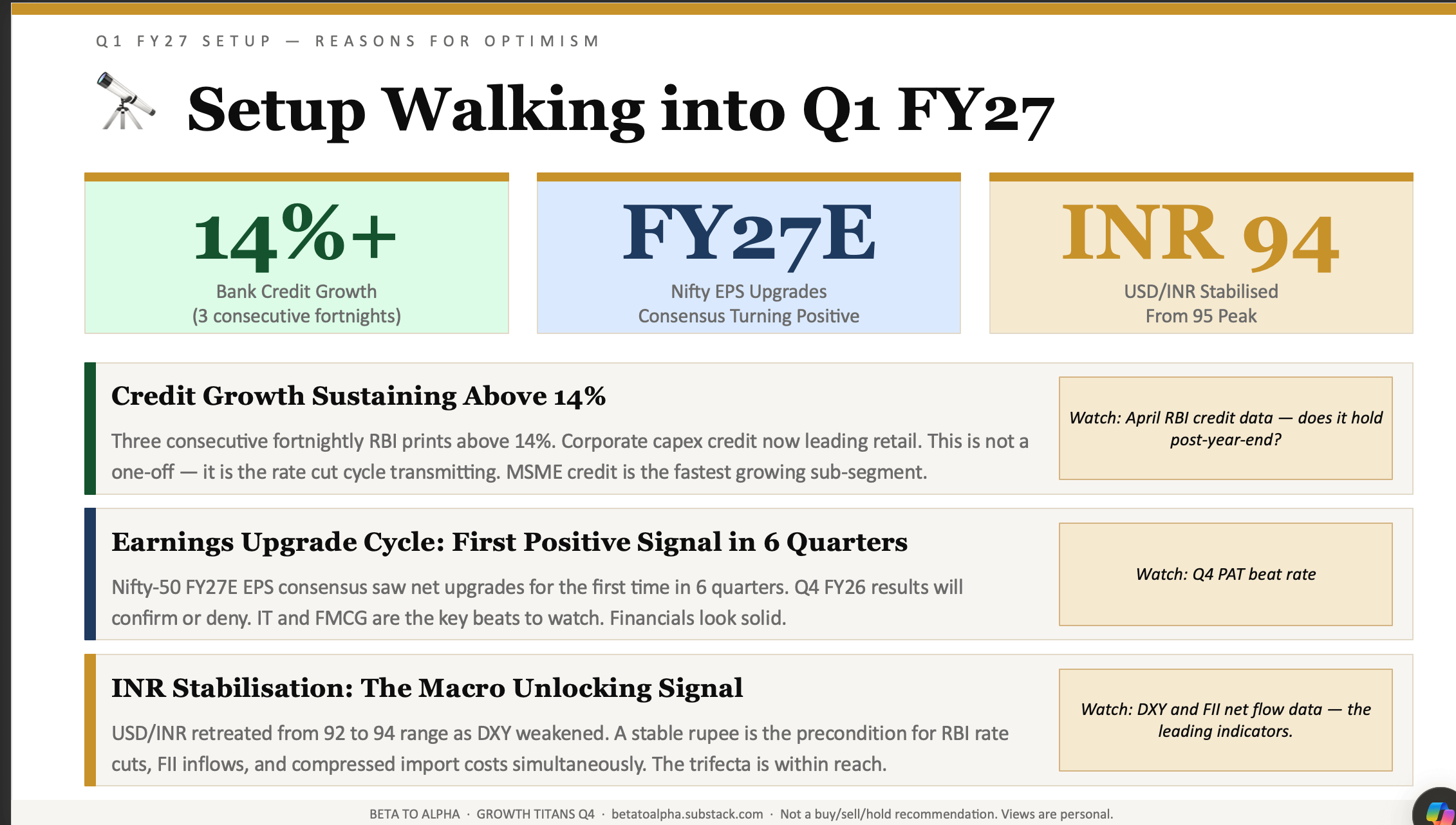
This is a slide we presented in the last Growth Titans, walking into this one - we see a lot of the silver lining emerge in a lot of names. Hence the setup is perfect.
In fact, we are also opening up access to all Growth Titans sessions conducted till date at a special price.
Accountability Check
After scanning 150+ companies we also need to make sure whether the growth in earnings is sustained with time, hence before the webinar commences we go deep into seeing where the accountability lies.
Have companies slowed down on growth?
Have companies continued inflecting on growth?
What is the future trajectory looking like?
Who are the new companies that have come into the Growth framework?
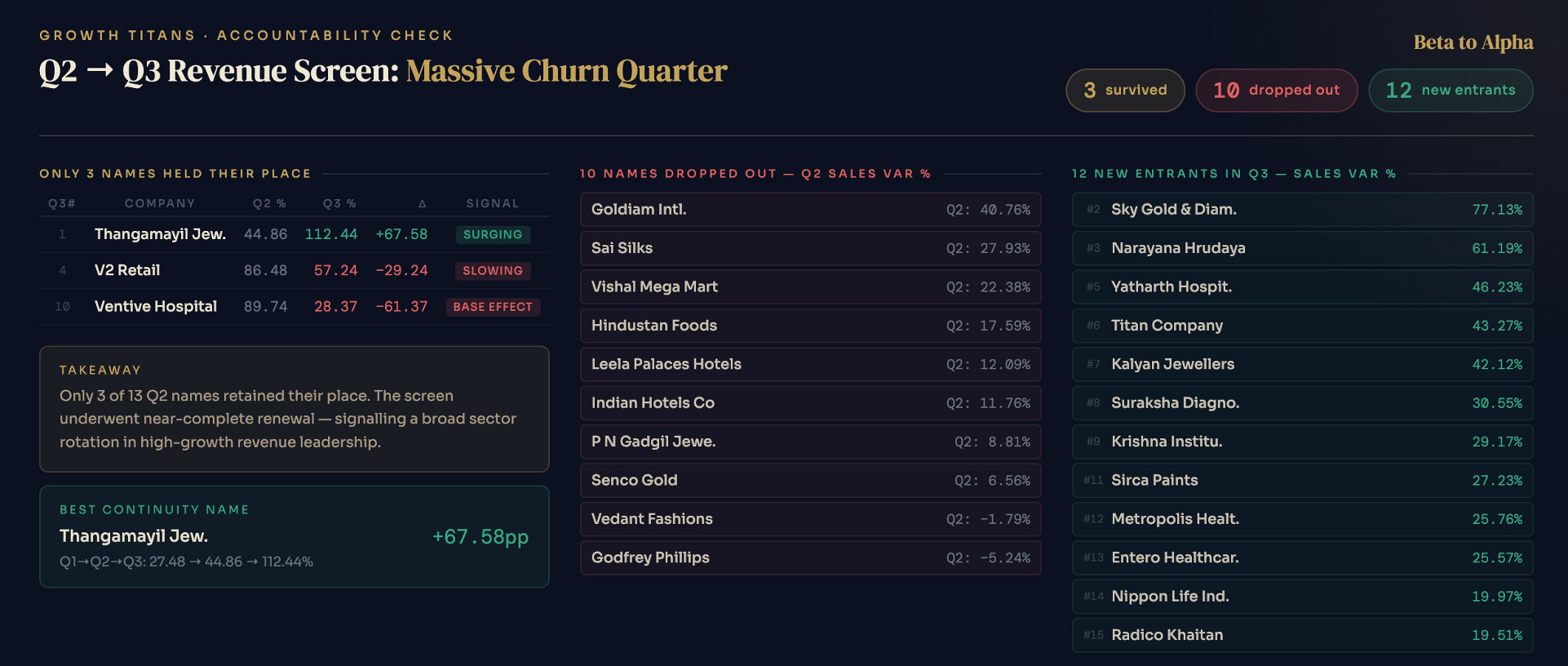
This is the accountability check from Growth Titans of Q3.
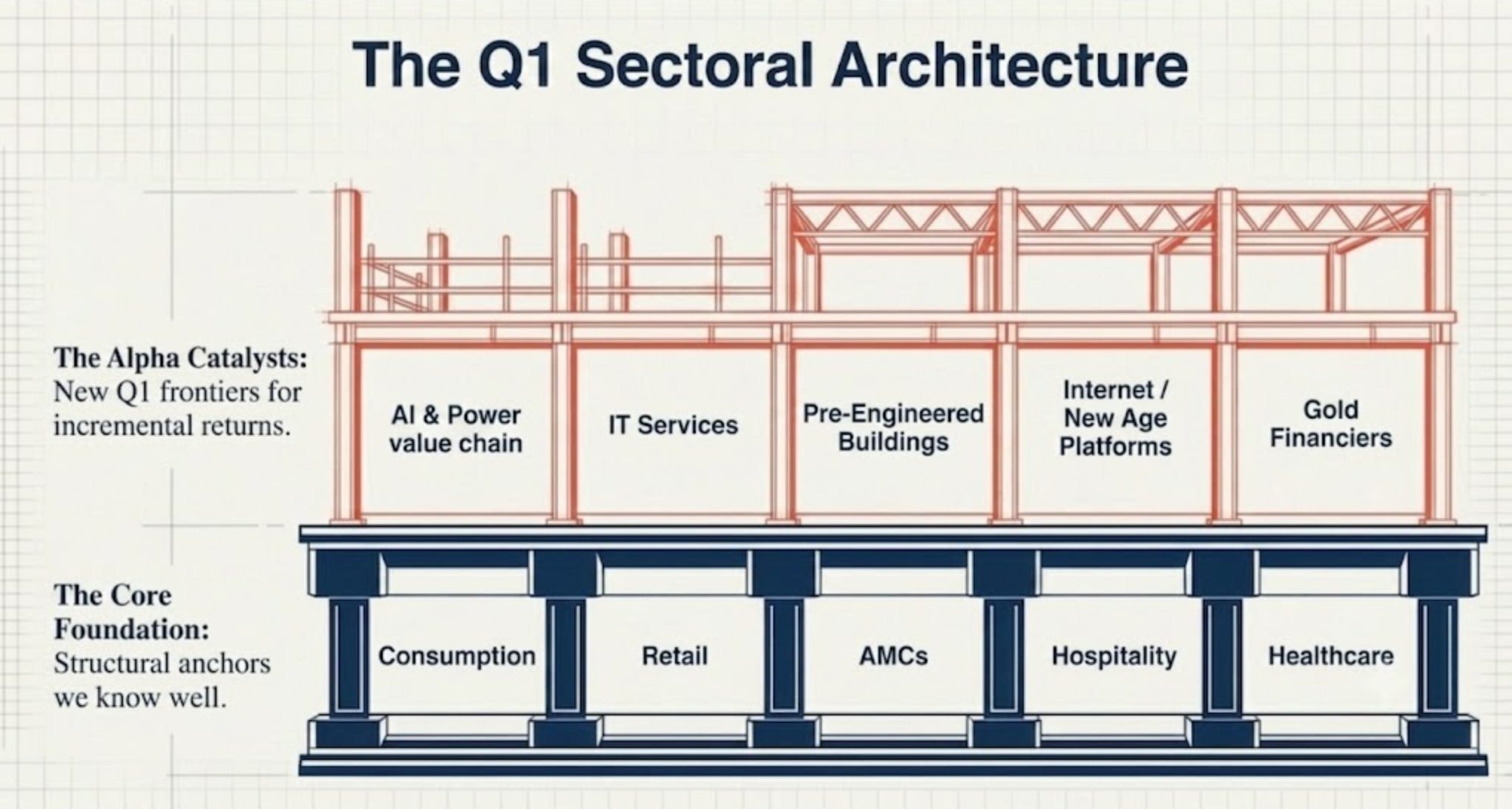
So what sectors are we covering?
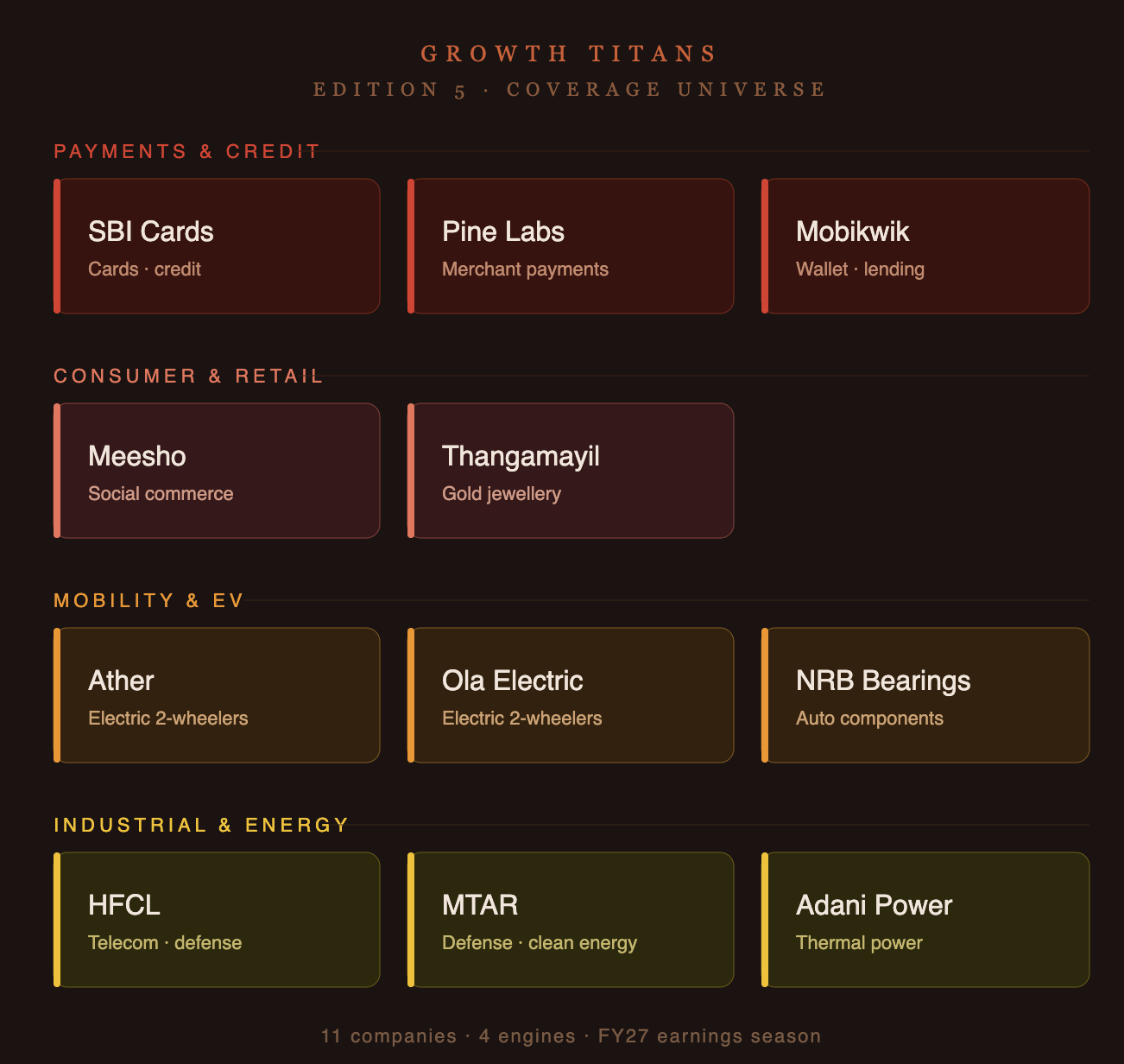
What Companies form a part of the deep dive section?
Register Now
You can register for both the sessions at a special bundled price or individually register for individual sessions.
Growth Titans will be held over two sessions this time -
Session 1 → 16th August 2026, Sunday, 11 AM IST
Session 2 → 13th September 2026, Sunday, 11 AM IST
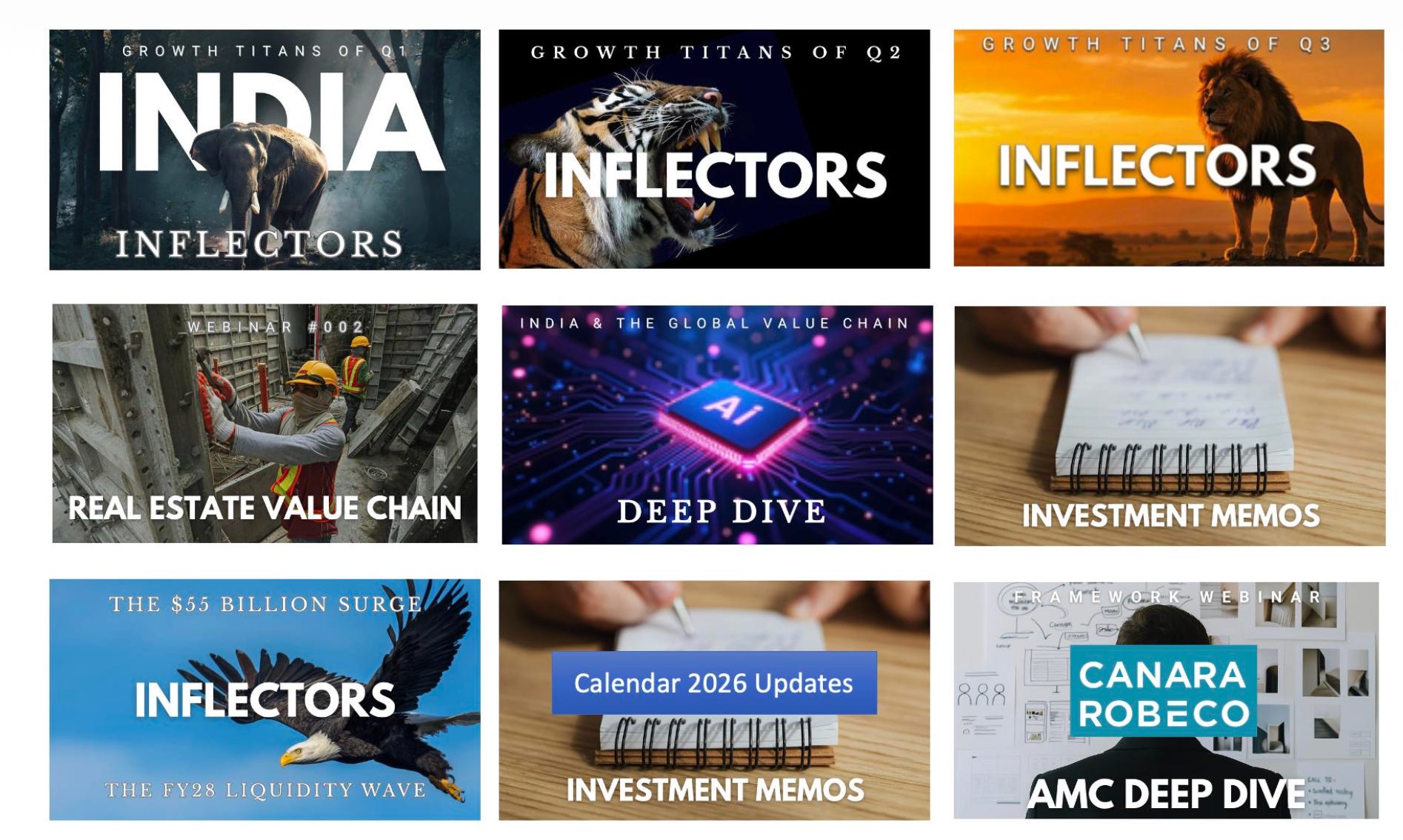
Our Archive
Get instant access to all Growth Titans session.
Comments
Nothing yet. Say the first thing.
Sign in to join the conversation.