
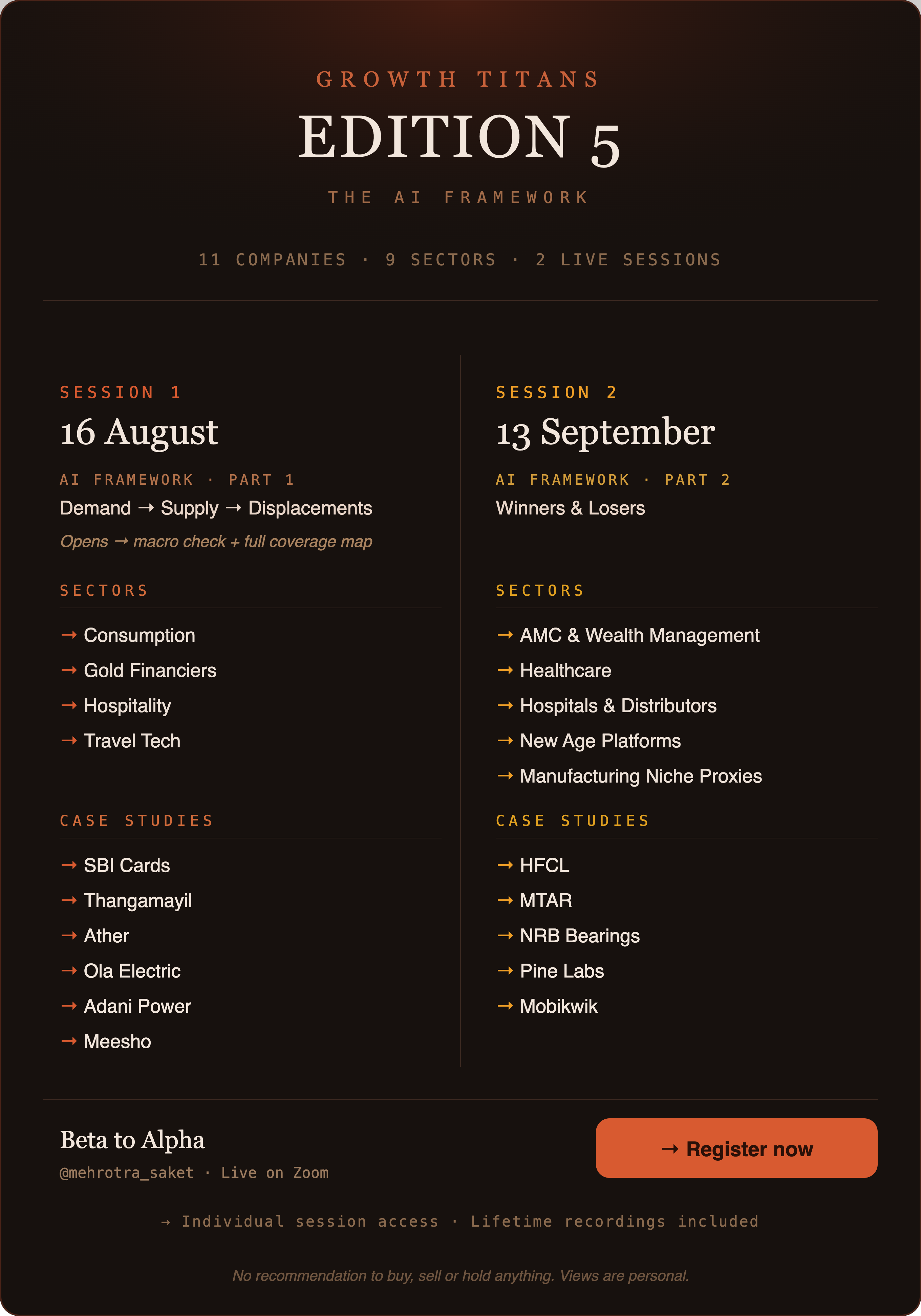
Growth Titans of Q1 starts in 24 hours. Are you in?
Everyone agrees IT services is “displaced” by AI. That agreement is the mistake, and the mistake is where the money is.
Here is the category error. Consensus reads exposure to AI as displacement by AI. Those are not the same thing. Every listed IT name in India has high AI exposure. Exposure only tells you the weather is coming. What decides demand versus displaced is not how close a company sits to AI. It is what the company actually sells.
Sell hours on a pyramid, and AI is deflation.
Sell the enablement layer, and AI is your best customer.
Sell a product or a pipe, and AI is a feature or a tailwind, and the entire services debate does not apply to you.

So you cannot value all of this with one lens. Tomorrow we break the sector into eight sub-groups. Sort those eight by what they sell rather than how AI-adjacent they look, and the single word “displaced” collapses into three completely different economies. Two of the eight shouldn’t even be in the IT conversation.
ER&D is the cleanest name in the entire sector, and it is barely an AI story. KPIT, Tata Elxsi, Tata Technologies, Sasken. What they sell is the physical world getting more software inside it: software-defined vehicles, ADAS, chip design, EV platforms, aero. You cannot LLM your way through safety-critical validation or automotive and aerospace certification. AI here is a productivity kicker layered on top of structural outsourced-R&D demand. The thing that moves this bucket is the auto and aero capex cycle, not a copilot.
The Microsoft and ERP ecosystem rides the same demand logic. Sonata, All E Tech. Copilot adoption and Dynamics implementation are a tailwind, not a threat. The catch is the moat: platform-partner reselling economics are thin, and the open question is whether the partner keeps the margin or the platform owner compresses it over time.
Mid-cap digital is where I push back on the easy read. Persistent, Coforge, Happiest Minds get filed under “safe digital.” True, they are the data, cloud and platform plumbing, and nothing runs without the plumbing. But a real slice of “digital transformation” billing is exactly the work copilots compress. This is the most crowded, most richly priced corner of the sector. So you have a demand story carrying a displacement undertow, trading like pure demand. That is not the safe trade. That may be the pain trade.
BFSI product IP is three software companies wearing an IT-services jersey. Intellect Design, Nucleus Software, Virtual Galaxy. Licence and SaaS economics. Sticky, regulated, incumbent. For these names AI is a feature-and-moat question, not a headcount question. Applying pyramid-deflation logic to a product company is simply the wrong model. If the market prices them like bodyshops because they file under “IT,” that gap is not a risk. It is a misclassification.
Tata Communications is not IT services either. It is the literal pipe. An arms dealer to the data-centre and connectivity buildout that AI demand is driving. Value it as infrastructure, because that is what it is. Judging it on a services framework tells you nothing.
Diversified BPM is the closest thing here to textbook displaced. Firstsource. Labour arbitrage on voice and back-office process, and automation eats exactly that. The only thing that offsets it is how fast the mix shifts to higher, harder-to-automate work.
Healthcare BPM is the sharpest two-sided bet in the whole set. Inventurus (IKS), Sagility. Revenue cycle management is textbook automatable, so the entire thesis reduces to one checkable variable. Are the contracts priced per full-time-employee, or per outcome? FTE-priced means the client captures the automation savings, and the vendor is displaced. Outcome or platform-priced means the vendor keeps the surplus AI creates, and the vendor has demand. Same technology, opposite outcome, decided by a line in the contract. Regulation is the moat that lets the good version hold its pricing.
And tier-1, the bucket everyone reflexively buries. TCS, Infosys, HCL Tech, Wipro, Tech Mahindra. Yes, the pyramid deflates. But these are also the firms enterprises trust to deploy AI at scale and carry the liability when it breaks. They are deflation drag and demand aggregator at the same time. The net of those two forces is the actual debate. “Dead” is not the debate.
Line the eight up and the point becomes obvious. “Displaced” was never one thing. It was three economies hiding under one lazy word: enablers where AI is the customer, product and infra names that are not services at all, and a deflation zone where the outcome turns on contract structure and mix.
The market has priced the whole sector off the word. That is the opportunity. When a product company is valued like a bodyshop, or a fibre network is valued like a staffing firm, the error is not in the business. It is in the label. And a wrong label is a wrong price.
Every one of the eight has a single tripwire that flips it from demand to displaced. For tier-1, it is whether revenue per head falls faster than volume rises. For healthcare BPM, it is FTE versus outcome pricing. For mid-cap digital, it is how much of the book is the exact work a copilot replaces. Find the one variable per bucket, and you stop trading a sector on a vibe.
The whole sector got one word. It needed eight.
P.S. We are going bucket by bucket through all eight of these tomorrow in Growth Titans: the one variable that flips each one, and where the label and the price have come apart. Details in the usual place if you want to sit in.
Disclaimer: Neither Saket Mehrotra nor Beta to Alpha is a SEBI registered investment advisor. Views are my own and do not represent my previous or current employer. Any mention of stocks and securities is not a recommendation to buy / sell. The author may hold positions in the stocks mentioned and sell it without prior notice. Please do your own due diligence before investing. The purpose of this newsletter is for educational purposes only.
No posts
Comments
Nothing yet. Say the first thing.
Sign in to join the conversation.