
Our biggest flagship quarterly webinar is happening in 13 days from now. Are you in?
Ask most people to name Indian fintech and you get Paytm. Push them and you get Bajaj Finance, which is a lending NBFC that happens to have an app. That was a fair map in 2023. It is now wrong.
In the last eighteen months the private fintech universe has cracked open onto the public market, and it has not listed as one thing. It has listed as layers. Payments, merchant commerce, broking, insurance, and the plumbing underneath all of them are now separate tickers with separate economics. If you still price the theme as “Paytm plus an NBFC”, you are mispricing where the money actually collects.
Here is the stack, top to bottom, with the numbers that matter.
Consumer payments: enormous volume, punishing economics.
PhonePe filed its updated IPO papers on 21 January 2026. The structure tells you everything. It is a 100% offer for sale of roughly 50.66 million shares, targeting about ₹12,000 crore. The company raises nothing. Every rupee goes to Walmart, Microsoft and Tiger Global on their way out. FY25 revenue was ₹7,115 crore, up 40%, and it finally turned free cash flow positive with ₹1,202 crore of operating cash. Then it paused the listing in March 2026. This is the layer everyone can name and the layer that has taken the longest to make money. Paytm sits here too. Massive reach, thin take, years spent proving the unit economics.
Merchant commerce: listed below its own private mark, and the market still bid it up.
Pine Labs listed on 14 November 2025 at ₹221. It opened at ₹242 and ran to ₹284 intraday, a 29% pop, closing the day worth around ₹32,000 crore. Read the valuation, not the pop. That ₹221 issue valued Pine Labs at about $2.9 billion. Its last private round in 2022 valued it at $5 billion. It came public at a down-round to its own venture backers, and public investors still rewarded it. That is the most important signal in this entire cohort: the private marks were the fiction, and the public market is repricing the whole class.
B2B payments: the same down-round story, one layer over.
Razorpay filed confidentially on 12 June 2026, targeting ₹5,000 to ₹6,000 crore at a $5 to $6 billion valuation. Its 2021 peak was $7.5 billion. FY25 revenue was ₹3,783 crore, up 65%, with the core payments business EBITDA positive. It reverse-flipped its domicile from the US back to India specifically to list here. Same pattern as Pine Labs: strong growth, real progress to profit, and a valuation haircut from the venture peak that the founders have accepted as the price of admission.
Broking and wealth: the one that actually makes money.
Groww listed in November 2025 under its parent, Billionbrains Garage Ventures. The book was subscribed 17.6 times. Look at why. Groww carries 37 million demat accounts and ₹2.6 lakh crore in AUM, and it reported ₹379 crore of net profit on ₹904 crore of income for just the six months to March 2025. Everything above this line in the stack is fighting to prove it can earn. This layer already earns. And Groww is not only a broker: it runs an AMC and an NBFC underneath the app, which means it is quietly building down the stack toward the rails.
Insurance: the turnaround nobody talks about.
PB Fintech, the Policybazaar parent, has been listed for a while and spent FY25 posting the kind of profit swing the others are still promising. It is the proof that a listed Indian fintech can cross into profit and hold it, rather than narrate its way there.
The rails: the toll booths under everything above.
BSE, CDSL, CAMS, KFin. Every trade Groww routes, every SIP the AMCs collect, every demat account any of these apps opens touches this layer. The apps at the top fight for the user and spend to acquire them. The rails at the bottom simply tax the outcome, whoever wins. This is the oldest idea in the book, and it is hiding in plain sight inside a theme everyone thinks is about apps.
Now the reframe.
Line the layers up and a pattern falls out. The closer a business sits to the consumer, the more it spends to win them and the thinner it earns. The further down toward the rails, the fatter and more durable the margin, because the rails do not care which app wins the customer. They get paid either way.
That is the whole thesis. Indian fintech did not grow into a bigger version of Paytm. It unbundled into a stack, and the take-rate improves as you descend it. The apps compete for attention. The rails collect a tax on the entire system.
Which is why the most interesting name in the cohort is Groww, precisely because it refuses to stay in its layer. Broker on top, AMC and NBFC beneath, climbing down toward the toll booth. That direction of travel, from the layer that spends to the layer that collects, is the move worth watching in every one of these businesses.
Fintech in India stopped being a sector. It became a stack. Price it one layer at a time.
Until now we have revealed 5 companies that we are covering in this edition of Growth Titans. Today we are adding 2 more names to that list - Mobikwik and NRB Bearings.
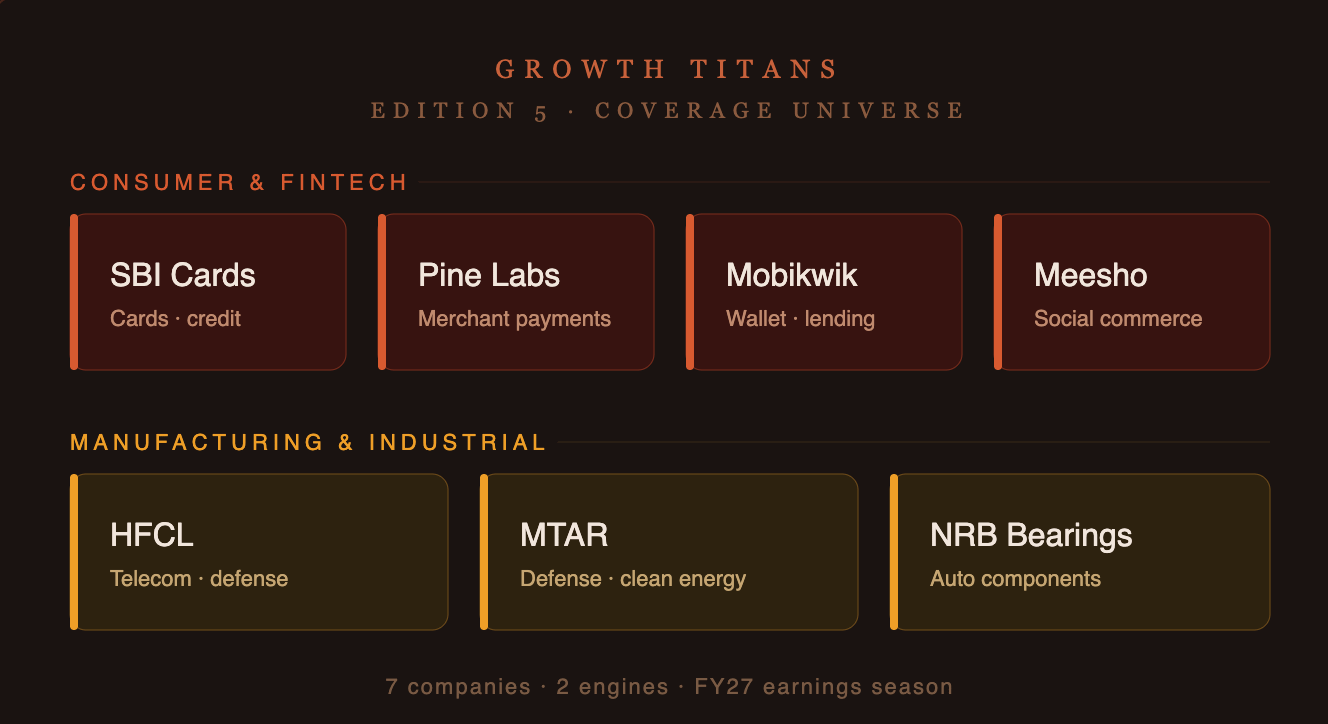

Growth Titans is back for its 5th edition.
Every earnings season poses the same scheduling problem.
→ Do it early and you miss the season
→ Do it midway and you miss the long tail
→ Do it at the end and it becomes a rear view mirror exercise
So this time we are not choosing. We are doing two.
Session 1 → 16th August 2026, Sunday, 11 AM IST
Session 2 → 13th September 2026, Sunday, 11 AM IST
Session 1 covers the early prints and sets up the thesis. Session 2 catches the long tail, marks the thesis to market, and adds what the first four weeks of results revealed.
Both sessions are bundled under one plan. One payment, both seats.
What is different this edition
→ Lifetime access to recordings
→ Full deck after each session
→ A simple framework to screen inflectors, taught rather than described
What stays the same
→ Global macro setup, then sectors, then names
→ 8 to 10 companies per session, picked on business model or competitive positioning, not on price action
→ An accountability review of what we called last time and what it did
FY28 is shaping up to be a breakout year for a large set of Indian companies. Most of them will not look obvious in the Q1 print. That is the entire point of the exercise.
Disclaimer: Neither Saket Mehrotra nor Beta to Alpha is a SEBI registered investment advisor. Views are my own and do not represent my previous or current employer. Any mention of stocks and securities is not a recommendation to buy/sell. The author may hold positions in the stocks mentioned and sell without prior notice. Please do your own due diligence before investing. The purpose of this newsletter is for educational purposes only.
No posts
Comments
Nothing yet. Say the first thing.
Sign in to join the conversation.