
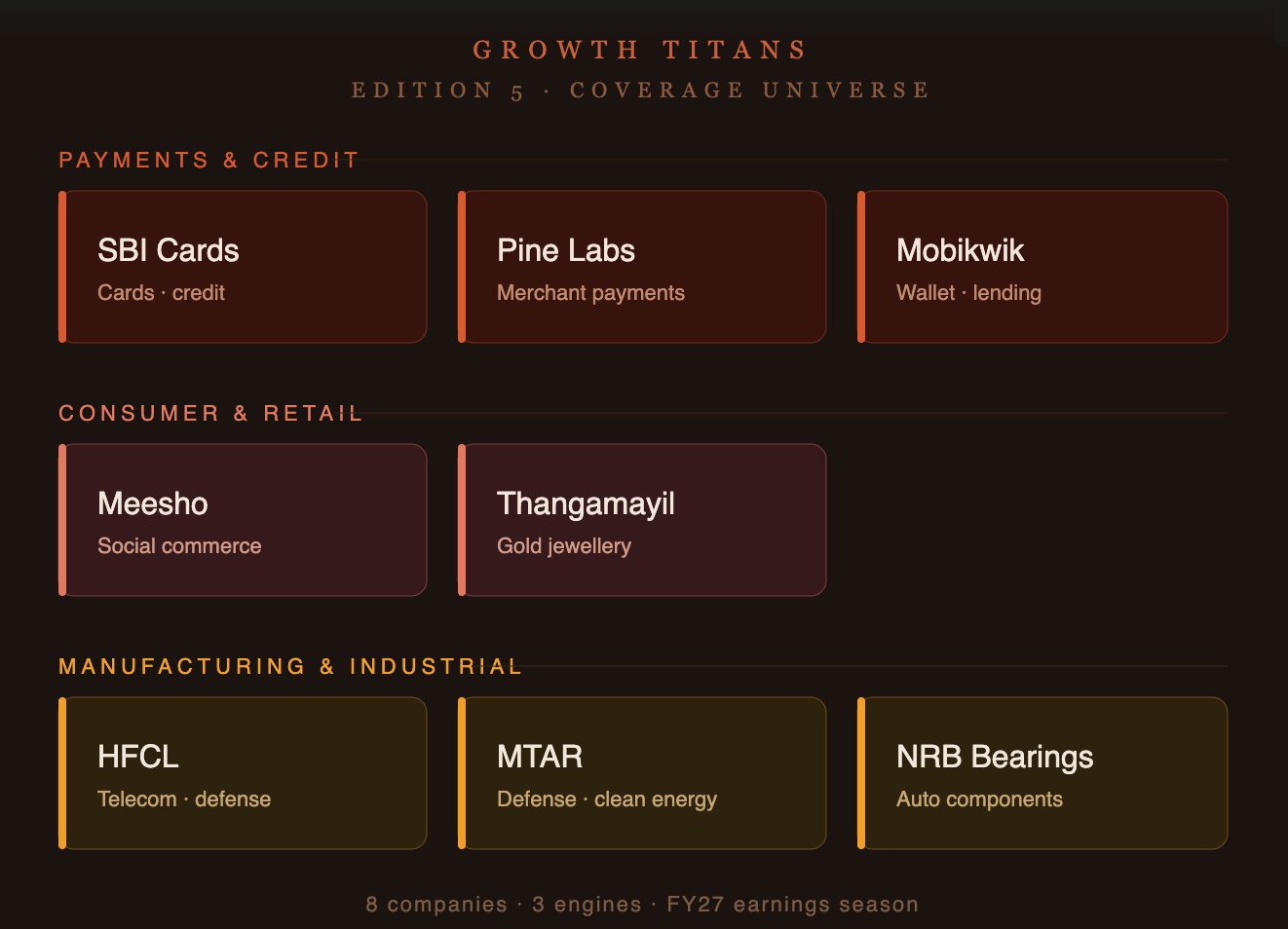
Before we dive into today’s post, Growth Titans will cover 10 companies in detail this time across 2 sessions. We have already revealed 8 names that will be covered. You will soon find out the other two names:
On to today’s post:
Burger King India grew same-store sales 12.6% last quarter. It still lost money.
That is the fastest same-store sales growth Restaurant Brands Asia has posted in fifteen quarters. The company that posted it is still in the red. Hold that thought, because it is the whole story of Indian QSR right now.
For two years, the quick-service restaurant sector was a place growth went to die. Same-store sales were flat to negative. Consensus stopped caring. Coverage went quiet.
The June quarter broke the streak. Every listed operator posted positive same-store sales and double-digit revenue growth in the same quarter, for the first time since FY23. Domino’s, McDonald’s, KFC, Burger King, all green. The sector is about to get re-rated on three words: growth is back.
Growth is back. That is true. It is also the wrong thing to celebrate.
Same-store sales growth is the number every headline will lead with, and the number that tells you the least about who actually made money this quarter. Two things decide that: whether throughput crossed the operating-leverage line, and who owns the customer. On the first, the operators are diverging hard. On the second, the brands are quietly losing ground. Neither shows up in the SSSG print.
Start with the scorecard.
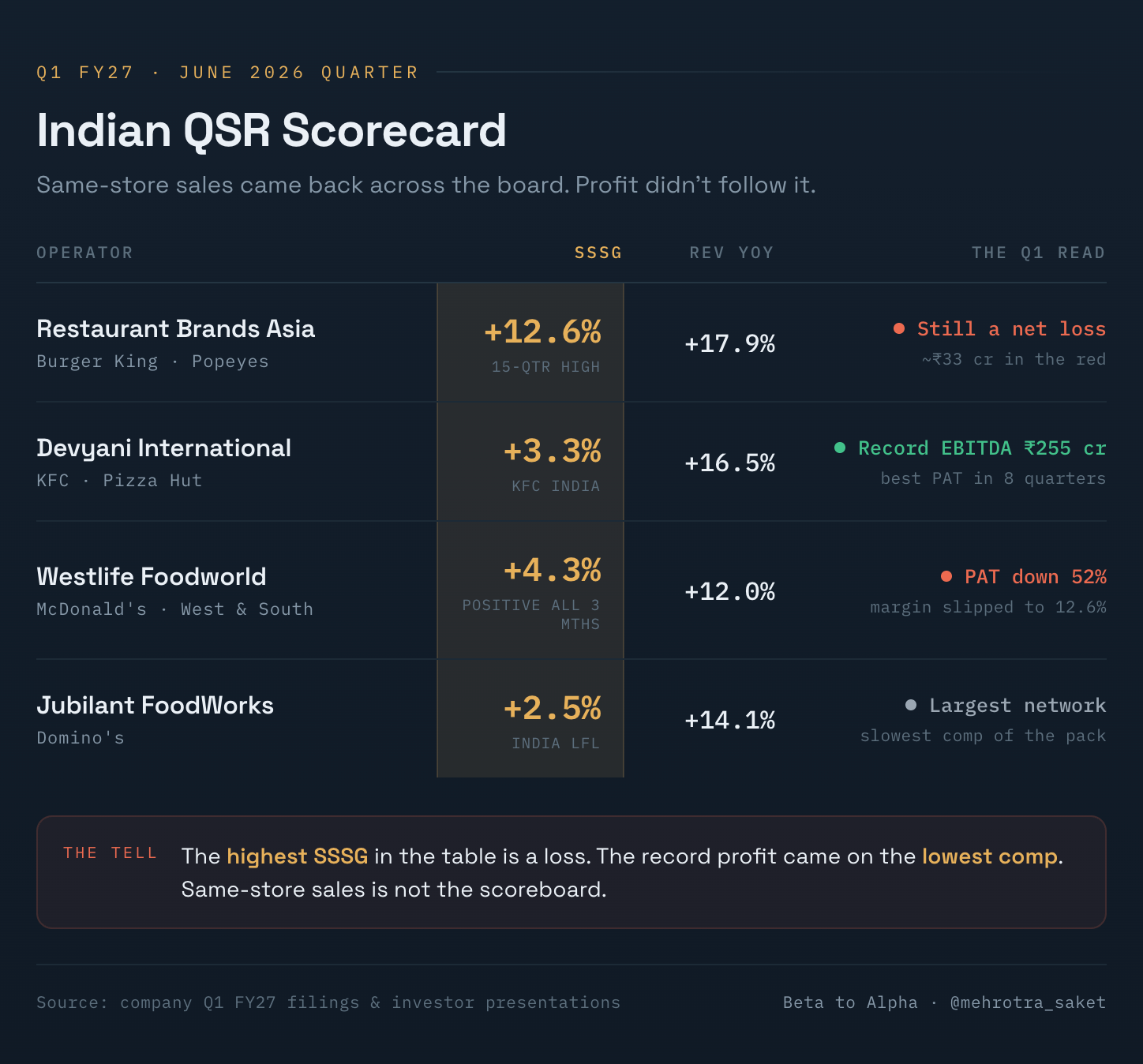
Read that table twice. The operator with the highest same-store sales in the sector is losing money. The operator with record profit posted the lowest comp of the branded majors. If SSSG drove the P&L, that table would be impossible.
It isn’t SSSG. It’s throughput and cost.
Devyani printed its best profit in eight quarters on a 3.3% KFC comp because volume finally pushed enough covers through a fixed store base to trip operating leverage. That is the entire QSR model in one line: these are high-fixed-cost boxes, and profit is nonlinear once footfall clears the threshold. Devyani cleared it. Restaurant Brands is still climbing toward it, which is why 12.6% growth still ends in a loss.
Now read Westlife, because it runs the experiment in reverse. McDonald’s West and South grew same-store sales 4.3%, positive in all three months, guest counts up. Textbook. And profit after tax fell 52%, with margin slipping to 12.6%. Positive comp, collapsing earnings. Input inflation, dairy and the rest, ate the leverage before it reached the bottom line.
So the same quarter contains both stories. Comp up, profit up at Devyani. Comp up, profit down at Westlife. The differentiator is not demand. It is the gap between throughput and the cost curve, and that gap is company-specific. A sector-level “QSR is back” call papers over exactly the thing that decides the winners.
There is a second reason to hold the champagne. Part of this comp is not demand. It is tax. GST 2.0 cut the rate on restaurant spend, and operators passed some of it through as lower menu prices. Lower prices lift volume, and lifted volume shows up as same-store sales growth. That is a one-time step-up in the base, not a structural reacceleration. Until someone decomposes these comps into volume versus price and mix, you cannot tell how much of the turn is real appetite and how much is a tax cut wearing a growth costume. Most of the sell-side notes will not do that work. It is the first thing worth doing.
Now the part that outlasts the quarter.
Every one of these operators told you the same thing about where growth is coming from: delivery. McDelivery is Westlife’s growth engine. Digital is 74% of its sales. The story is identical across the pack. And that is the problem hiding inside the good news.
Delivery increasingly does not run through the brand. It runs through the aggregator. Swiggy and Zomato own the app, the search, the customer data, and quick commerce is now pulling food ordering onto a still larger surface. When discovery, the customer relationship, and the data all sit upstream with the platform, the branded operator is left with the one thing it cannot outsource: the kitchen.
A QSR brand’s moat was supposed to be three things: the brand, store density, and the supply chain. In a delivery-led world, two of those three sit below the aggregator in the stack. The customer opens Swiggy, not the McDonald’s app. The aggregator sets the discovery and takes the rake. The brand becomes the manufacturing layer for someone else’s demand.
That is the variable that decides whether this turn is a trade or a franchise. If the operators own their demand, the operating-leverage math compounds and this is the start of a multi-year re-rating. If the aggregator owns the demand, the brands grow into thinner economics and hand the incremental margin upstream. Same-store sales cannot tell you which world you are in. It looks identical in both.
Same-store sales tells you the quarter turned. It does not tell you who keeps the money. In Indian QSR right now, those are two different questions, and the second one is being answered upstream of the brand.
Growth Titans is back for its 5th edition.
Every earnings season poses the same scheduling problem.
→ Do it early and you miss the season
→ Do it midway and you miss the long tail
→ Do it at the end and it becomes a rear view mirror exercise
So this time we are not choosing. We are doing two.
Session 1 → 16th August 2026, Sunday, 11 AM IST
Session 2 → 13th September 2026, Sunday, 11 AM IST
Session 1 covers the early prints and sets up the thesis. Session 2 catches the long tail, marks the thesis to market, and adds what the first four weeks of results revealed.
Both sessions are bundled under one plan. One payment, both seats.
What is different this edition
→ Lifetime access to recordings
→ Full deck after each session
→ A simple framework to screen inflectors, taught rather than described
What stays the same
→ Global macro setup, then sectors, then names
→ 8 to 10 companies per session, picked on business model or competitive positioning, not on price action
→ An accountability review of what we called last time and what it did
FY28 is shaping up to be a breakout year for a large set of Indian companies. Most of them will not look obvious in the Q1 print. That is the entire point of the exercise.
Disclaimer: Neither Saket Mehrotra nor Beta to Alpha is a SEBI registered investment advisor. Views are my own and do not represent my previous or current employer. Any mention of stocks and securities is not a recommendation to buy/sell. The author may hold positions in the stocks mentioned and sell without prior notice. Please do your own due diligence before investing. The purpose of this newsletter is for educational purposes only.
No posts
Comments
Nothing yet. Say the first thing.
Sign in to join the conversation.