
Though always cutting edge and intellectually challenging, Gertrude Stein’s work is still read today (and is still challenging!), and many of her books remain in print. Anyone interested in the endless possibilities of prose and how essays can embody a truly creative aesthetic, should read her and do so widely, in an immersive fashion without worrying about precise comprehension.
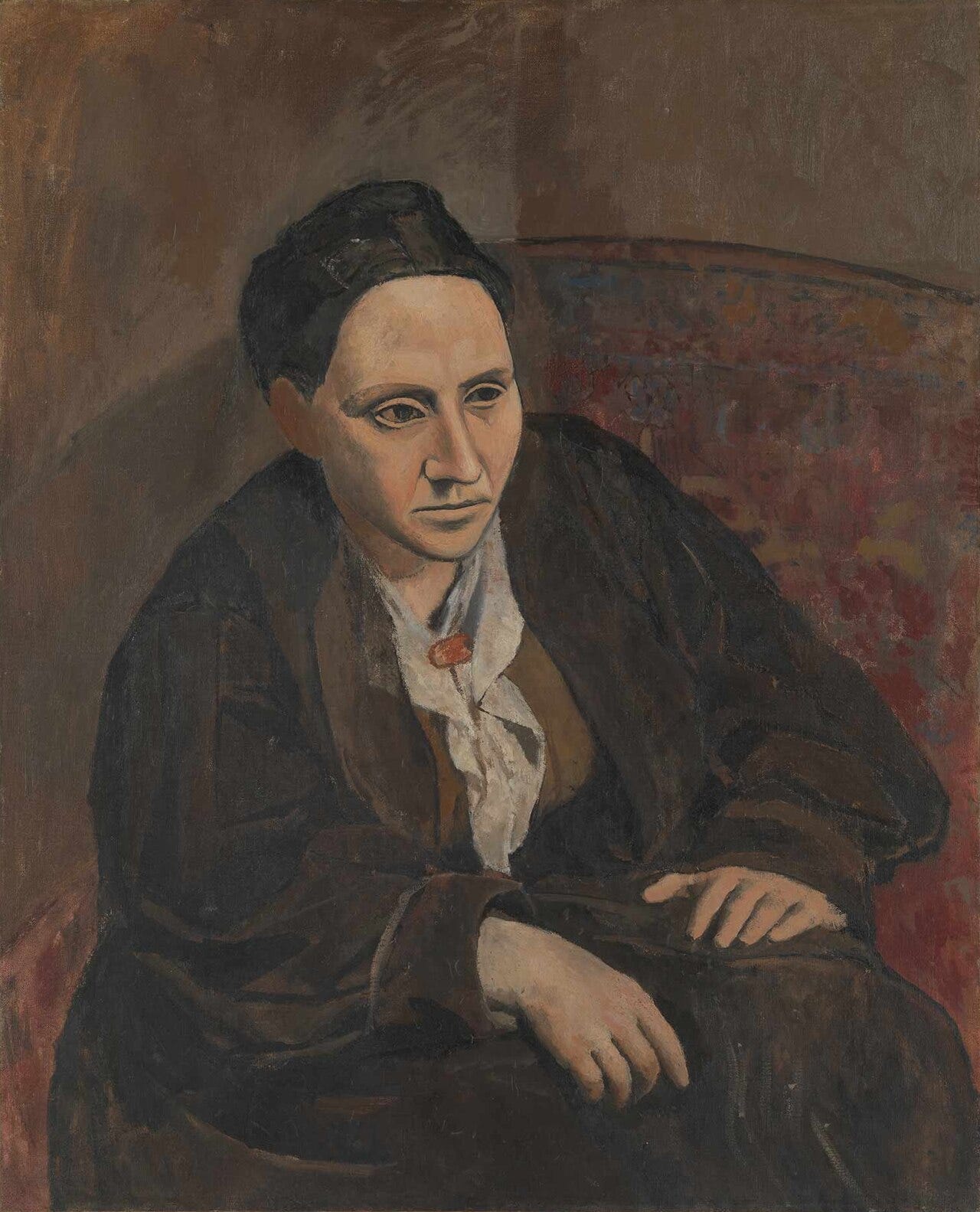
I wrote about Stein and one of her best-known works, Tender Buttons, in my foreword to The Best American Essays, 2020. Here are some of my comments on that landmark book:
Although she had already been writing rather unconventional fiction (Three Lives; The Making of Americans) and nonfiction (portraits of “Matisse” and “Picasso”), it wasn’t until 1914 and the publication of Tender Buttons—just weeks before the outbreak of World War I—that she achieved a certain fame. I say “certain” because it was as much fame as it was notoriety. Many critics found the work baffling and unintelligible at best; a few extolled its originality; others ridiculed it and its author as deranged. In a piece for Vanity Fair in 1923 and later in other essays, Edmund Wilson considered Tender Buttons “incomprehensible” although he would not dismiss it with “raucous guffaws” as others had. Based on her earlier work, especially Three Lives and the “Portraits,” he considered Stein a serious artist and one of the country’s truly important writers. He would continue to praise her work, and especially, a decade later, her first best-selling book, The Autobiography of Alice B. Toklas.
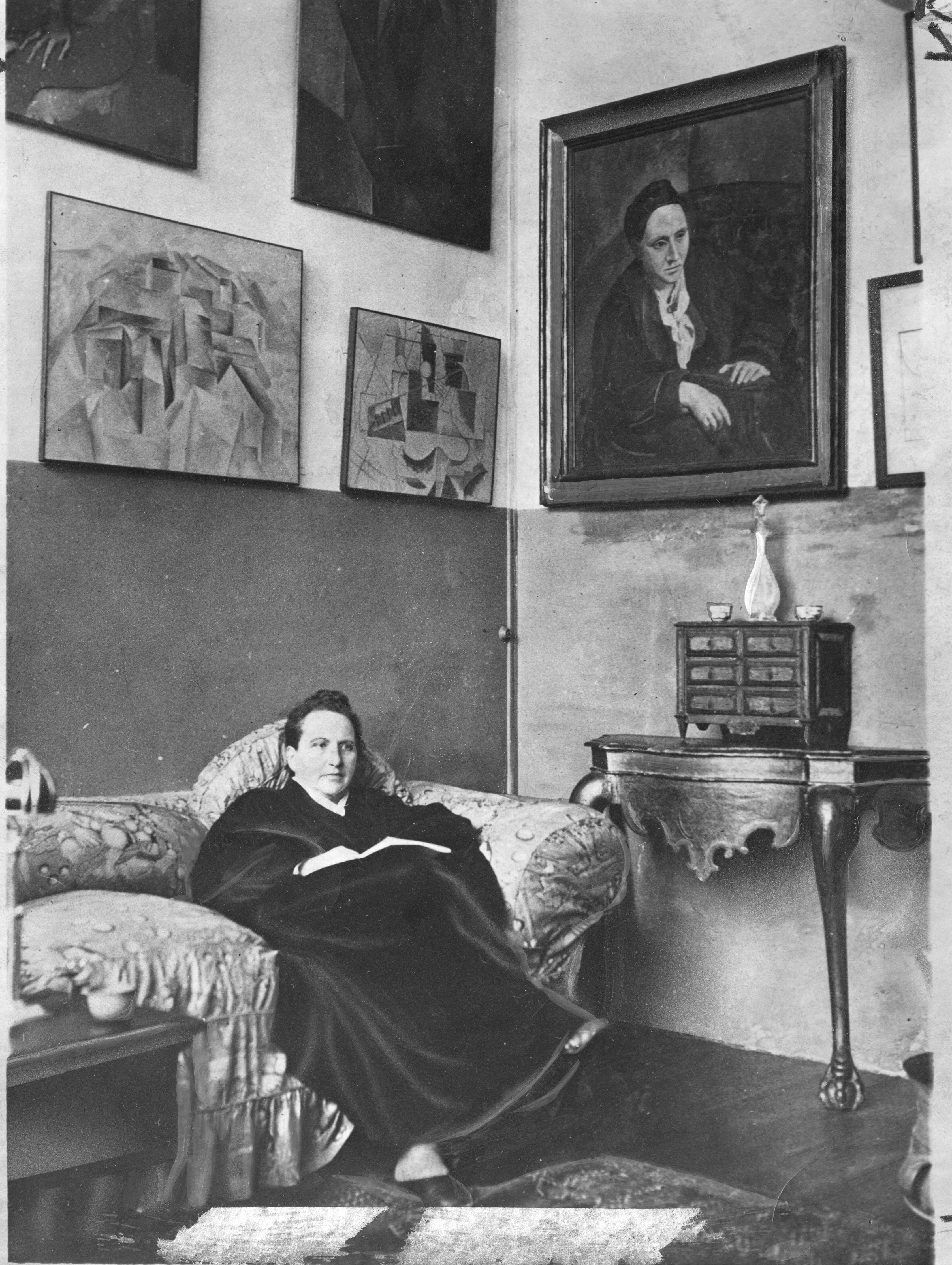
For all his interest in Stein, Wilson never attempted to interpret or explicate Tender Buttons. He concluded, not totally incorrectly, that the work was inspired by her fascination with Cubist painting and was an attempt to apply the visual techniques of Cubism to literature—“prose still-lifes to correspond to those of such painters as Picasso and Braque.” He thought the effort was aesthetically impossible, a dead end, the visual and the verbal arts being so unalike in their methods and media. Yet it was, of course, only the aesthetically impossible that had begun to motivate Stein.
For anyone unfamiliar with the book or who hasn’t recently encountered it, Tender Buttons is roughly 15,000 words long—my edition runs some sixty-five pages—and is divided into three parts, “Objects,” “Food,” and “Rooms.” It opens:
A CARAFE, THAT IS A BLIND GLASS
A kind in glass and a cousin, a spectacle and nothing strange a single hurt color and an arrangement in a system to pointing. All this and not ordinary, not unordered in not resembling. The difference is spreading.
“Objects” and “Food” consist of similar enigmatic prose “vignettes.” Some are a few pages long, others a few words, and all of them, like Montaigne’s digressive essays, bear only an oblique relation to their titles. The book’s final section, the more essay-like “Rooms,” opens:
Act so that there is no use in a center. A wide action is not a width. A preparation is given to the ones preparing. They do not eat who mention silver and sweet. There was an occupation.
And it concludes:
The care with which the rain is wrong and the green is wrong and the white is wrong, the care with which there is a chair and plenty of breathing. The care with which there is incredible justice and likeness, all this makes a magnificent asparagus, and also a fountain.
Wilson’s reluctance to translate the “unintelligible” into the “intelligible” would not discourage generations of critics and scholars from making the attempt. Is the work, with its abundance of erotic puns and imagery, a celebration of Stein’s newly found sexual relationship with Alice, the “tender buttons” being nipples--or could it be “tend her buttons”? Is it instead a tribute to a newly discovered, blossoming creativity, the boutons de fleurs of inspiration? Or are the tender buttons words themselves, here fastening and unfastening the underlying structure of composition and revealing the work to be sheer fabrication? Over the years, I have read numerous articles on Tender Buttons and have not found a single one fully satisfactory, that is, in terms of an overall exegesis. Though many offer piecemeal insights and some, like William Gass’s “Gertrude Stein and the Geography of the Sentence” (1973), may be critical masterpieces in themselves, I have never come away from any essay on the work—no matter what the approach—with the feeling of “Ah, now I get what’s going on here.” Still, Tender Buttons endures and quite a few editions remain in print. A newly corrected version appeared in 2014 as a centennial edition promoting “one of the most important and challenging texts of literary modernism.” Perhaps it gives credibility to Theodor Adorno’s comment about art works in general: “the more they are understood, the less they are enjoyed.” Tender Buttons endures not despite its incomprehensibility but because of it.
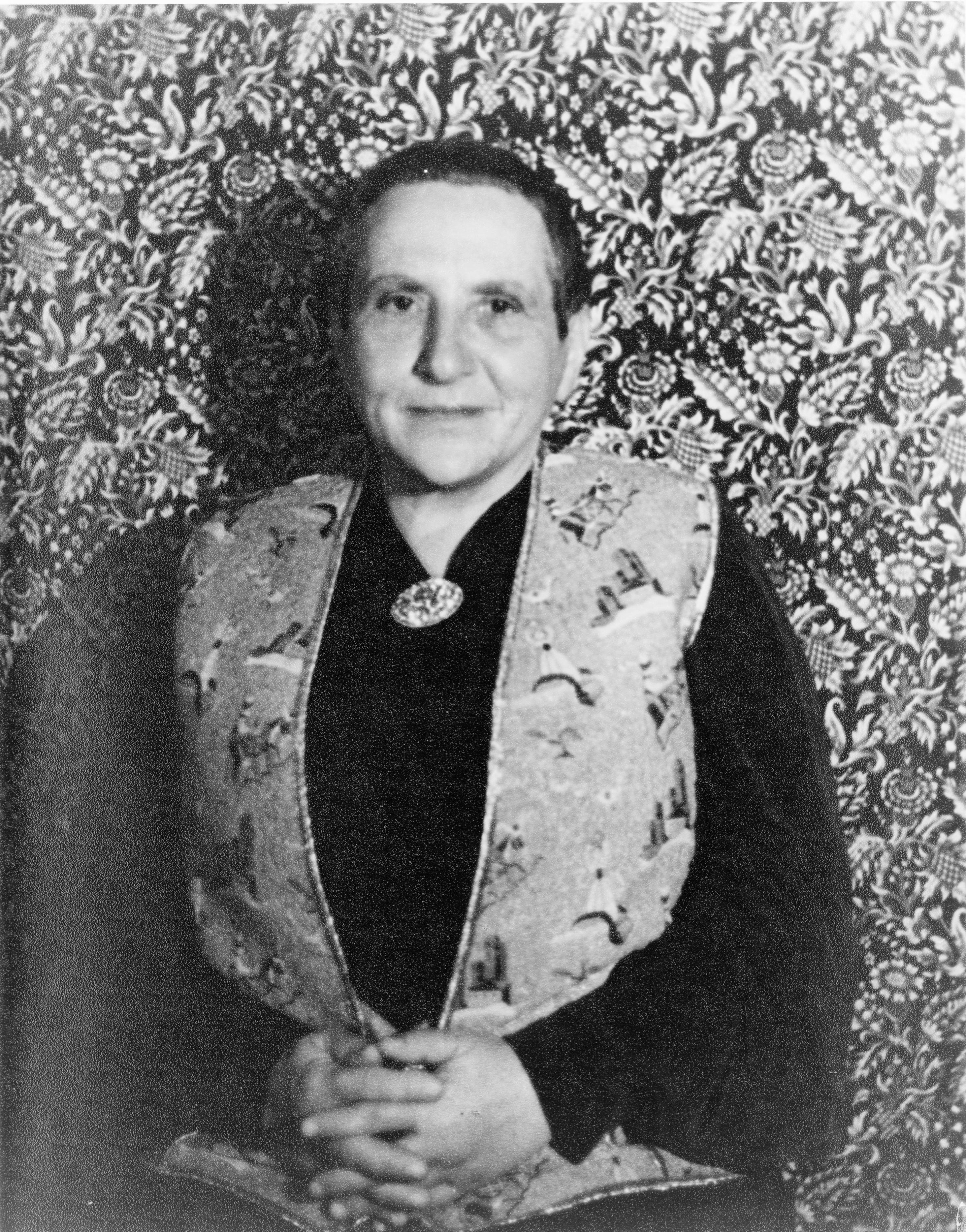
Full of puns, repetitions, and internal rhymes, a feast of plurisignification, showing a continuous delight in homonyms (tender/tender), heterographs (read/reed), and heteronyms (use/use), at times sounding exhortative, at times philosophical and ruminative, with little that can be identified as a personal voice, with phrases that start out as aphorisms and then collapse into absurdity, with words unanchored to syntax or context, with no conventional punctuation, no characters, storyline, or narrative direction, Tender Buttons—which Stein began writing in 1912—forcefully and yet playfully resists interpretation. Perhaps the clearest part of the work is its subtitle, “Objects, Food, Rooms,” which at least establishes an interior world of domesticity. I agree with the critic Lucy Daniel that Tender Buttons “is designed not to be ‘understood’ in the traditional sense.” In fact, as Katherine Anne Porter pointed out in an unfriendly 1947 essay, the relentlessly self-promoting Stein probably knew what she was up to: “she remarked once to her publisher that she was famous in America not for her work that people understood but for that which they did not understand.” As Stein, echoing Adorno, told a radio interviewer: “if you enjoy it you understand it.”
________________
For those unfamiliar with Stein and her work, I recommend as an introduction Lucy Daniel’s Gertrude Stein (2009), a compact and captivating critical biography published as part of Reaktion Books’s Critical Lives series.
Two other recent biographies:
Roy Morris, Jr’s Gertrude Stein Has Arrived: The Homecoming of a Literary Legend (2019), a well-documented and entertaining account of her 1934-1935 American lecture tour. An even more recent, and fuller, biography is Francesca Wade’s, Gertrude Stein: An Afterlife (2025).
The best and most thorough collection of her major work remains The Library of America’s two-volume Gertrude Stein: Writings 1903-1932; and Gertrude Stein: Writings 1932-1946.
Best American Essays Newsletter is a reader-supported publication. To receive new posts and support our work, consider becoming a free or paid subscriber.
Comments
Nothing yet. Say the first thing.
Sign in to join the conversation.