
Eleven years after the summer I spent being sexually harassed at and then sacked from my job as a bartender in a London pub, I was married and about to start teaching at a small liberal arts college in New England.
Early on during those eleven years, I finished college, got into an abusive relationship, started a graduate program in environmental ethics, dropped out, moved around some, finally got away from the abuser by moving back to Massachusetts and into my grandparents’ house, renting it from them so they could pay their fees at their retirement home near my parents, in Fargo, North Dakota.
She didn’t leave right away, the person whose brief presence in my life gave me nightmares for more than a decade, but the fact that we were living in a house that belonged to my family weakened her grip. She finally got bored with me and moved on to other energy sources.
I babysat, worked as a barista, rolled burritos, and somehow got into an MFA program for fiction even though I didn’t write fiction. I didn’t get funding my first year though, so I kept babysitting and rolling burritos until I did (I quit the barista job in dramatic fashion before I started graduate school, throwing the owner’s key at him when he raised his voice at me. I slowly removed it from my chain as he stood there yelling at me and aimed it at his knees as I turned and walked out the door. He was a dick).
There were other things, including an overnight stay in a respite program. I wrote a Modern Love essay about a guy I met at the coffee place and (sort of) the guy I married after that guy, but to me, that Modern Love piece is really about Post-Traumatic Stress Disorder, which I struggled with for decades before finally getting a diagnosis. I just thought I was messy, crazy, too much, etc., all the things many people seemed to think I was.
To be fair, I’m sure I wasn’t easy. No one likes to be around someone who definitely does not have her shit together.
My family seemed to breathe a sigh of relief when I met and married my first husband. We moved to Maine for his job as a collegiate rowing coach. I started teaching at the same college a year later, after picking up some classes at a local community technical school for about the cost of the gas to get me to and from that campus and a cup of coffee on the way.
I’d learned how to teach writing in graduate school and loved it. Nerves the first time walking in to my classroom, but after that, I looked forward to it every day, just being with my students and helping them understand how capable they were. I loved to get them hyped up and arguing about something and then surprising them that it was time to go. I loved to see the frustration and the breakthroughs, their realization that I read every word they wrote, that I was listening to what they were trying to say, their gradual understanding that I was there not to pull it out of them but to help them pull it out of themselves.
September, 2001, in an English Department in a small, private liberal arts college in Central Maine: I’m given an office without windows, but there is a high glass partition into the office next door, which does have a window. Other people share this space, but no one has anything personal on any of the desks. It’s also the supply room, so one wall has shelves full of pens, pencils, department stationery, printer paper, ancient staplers, staple removers, binders, binder clips, and so on. The department secretary, Judy, hands me some grammar sheets that other professors apparently use in their first-year writing classes, by way of “this is how people teach writing here.”
I am a “Category IV” professor, which means I am hired on an ad-hoc basis, semester by semester, according to the faculty handbook. According to the faculty handbook, this category is a short-term remedy for gaps in the curriculum, meant to cover sabbaticals, leaves, “rare” over-enrollments. It’s specifically not a long-term employment designation. (I will be a Category IV, a “Visiting Assistant Professor,” for nearly twenty years, until this way of distinguishing status within the professoriate disappears from the handbook. After that, I am a “Distinguished Senior Lecturer”).
My office mates are other supposedly short-term fill-ins like me, some of them kind of famous, sort of, important-seeming writers. The other faculty call our office “the bullpen.” This doesn’t appear to be a compliment.
The day I show up to teach in jeans, Judy slaps her hands on her desk and says “I never thought I’d see the day, but here we are: a woman professor teaching in jeans.”
Do I even need to say that the “men professors” taught in jeans all the time?
That was twenty-five years ago this September, which is when I’ll be returning to that same campus to resume that same job, teaching five sections of the first-year writing that I love. In jeans, or whatever the hell I feel like wearing on the day.
Remember how, in A Wrinkle in Time, when Charles Wallace and Mrs. Whatsit and Mrs. Who explain tessering to Meg, illustrating it with a fold on Mrs. Who’s skirt? I wish I could fold time and put my arms around the nineteen-year-old girl behind the bar in the Rose and Crown, or shake my head in disbelief with the thirty-year-old woman who was handed grammar sheets and shown to her desk in a storage closet at a prestigious private college.
But most of all, I would reach out and lift the chin of the college senior and tell her that she has beautiful eyes.
The woman who hit me didn’t start out hitting me, of course. Abusers start in more subtle ways: early on, she commented, randomly, on the shape of my eyes, that they are asymmetrical. She said she’d thought that I’d “been in an accident or something.”
I have my grandfather’s big Irish eyes. They are not symmetrical; on one of them, the lid comes down farther along the inside corner. I had never noticed (like many rape survivors, I am not fond of mirrors or pictures of myself).
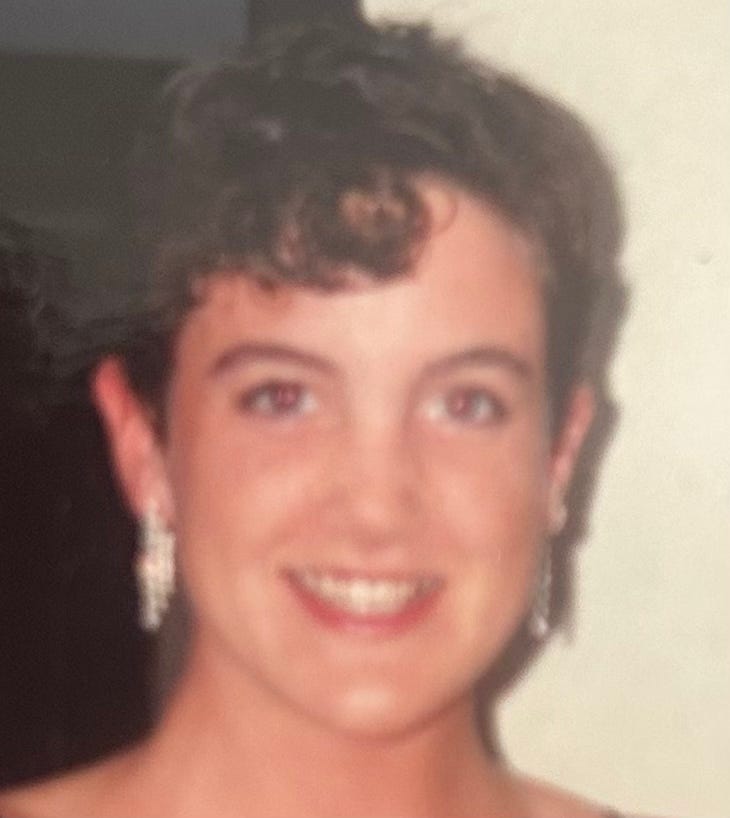
It’s a narcissist’s first move, I know now: destabilizing their target with a vague insult that has plausible deniability as such, with associated love-bombing. And it worked; I got sucked in for eighteen-months of pure hell.
The effects of violence and abuse can last years, and that’s why there is so much grief: you lose who you might have been if the bad things hadn’t been done to you, and you feel like you keep losing as time rushes on and you’re just trying to breathe and find your way back to something familiar as you’re pushed farther and farther off the path you might have been on otherwise.
It’s why I stayed in my first marriage far longer than I should have, and why I tolerated precarious, unjust work conditions for years and years (and years). But when I finally broke through, I knew I was free and that I would stay that way: intense waves of relief wash over me at unpredictable times, and I expect they always will. Here in Gabon, I look hungrily out the windows each morning at the plants, the flowers, the trees, the sky. I don’t wait for the shower to warm up but gasp when the icy water hits me and then grin and even laugh sometimes at how alive my body feels in the moments in between, as the water warms and my breathing slows again.
You remember to remember, when you’ve been through some shit.
But I can’t fold space and time and tell her that she’s going to be okay, that it will be worse than she can possibly imagine, but that she’s going to be okay. I can, however, imagine a future now that when it gets hard again, she survives because she has survived. She can know that she will always be okay, now. I can fold time that way, fold it forward.
And I am okay right now, with a full and broken heart. Because that’s what life will give you, if you let it.
I’m packing my things, imagining yet another new office, my ninth at the college, not a closet. A few favorite mugs for tea, pictures of my girls, the eagle poem my dad wrote in 1994. I will be present there, fully present, but I belong to the world now, too, to the whole world, not just one small part of it. That’s what this time away has given me: an understanding of how what was feeds what is feeds what will be.
“Because you will suffer soon and die, your choices/are neither right nor wrong” and “What you bring is the same as what you leave behind” wrote Irish poet Michael Longley, in the poem “Belongings” (also published as “Ghetto”). I tore it out of a New Yorker years ago but lost the clipping, forgot the title and who wrote it, and searched for years for proof of the line that had stayed with me, the last one: “Your last belonging a list of your belongings.”
I haven’t thought of belongings as things though, but as feelings, and think I’ve been searching for a long time for somewhere I belong, with myself: home.
Going west on 94 by Absaraka
Bald eagle wheeling, circling in lifting air
South sun reflected on white tail at each circle
I on 94 rushing straight line A to B,
Encased in steel, insulated from wind.
Who is more alive to Spirit?
What can I learn from Eagle?
Turn, shine, turn.
Benedicte, omnis opera Domini
Andy Fairfield 12/13/94
No posts
Comments
Nothing yet. Say the first thing.
Sign in to join the conversation.