
Because I never want to fly to or from Central Africa directly to or from the U.S. ever again, we broke up the trip both ways, stopping in Paris on either side of the ten days we spent in Massachusetts and Maine. We do know exactly how lucky we are to be able to travel this way and I won’t lose sight of it, even though I gripe endlessly about Charles de Gaulle airport. I’m not alone in that: the internet is filled with reels mocking its seeming dedication to chaos and nonsense, the randomly-coded terminals, hidden signs, secret passageways, and dark, speakeasy atmosphere. Here’s Gangster Spock on CDG:
There should be a Stephen King series where travelers stranded at CDG experience untold horrors for days (airport sushi, sneering lounge attendants, groups of eleven people walking in a double nickel pattern across the narrow corridors as slow. as. possible., gate reassignments, inexplicable ticket cancellations and seat changes, and being tossed around wildly in those busses, those damn busses) until they completely lose their minds. The finale will be when the pigeons living in the terminal start chanting in ancient Gaelic to the economy class folks, staring them in the eyes in increased focus as the world around them gets soft and hazy, floating like champagne bubbles. The birds instruct the unkempt Zone 7 vagabonds to bum rush the Air France lounges that don’t accept Priority Pass, using broken duty free burgundy bottles and dried baguettes sharpened to a point, dipped in poisonously dank gorgonzola, to fight their way to the charcuterie and patisserie buffets and the espresso machine that makes long chocolate cappuccino with double shots and soy milk.
“We’re all premiere class down here, Charlie D…”
I hope we’re travelers now, not tourists, even though we still occasionally do touristy things. But we have no home anymore, no fixed point, an important distinction, according to Paul Bowles, author of The Sheltering Sky, between tourists and travelers. We have been and expect to be changed by the places we go, and that is, by necessity, uncomfortable.
It isn’t simply that the concept of “home” no longer exists for us as it once did; we could just shrug and wander, live in a perpetual state of motion, float. But I think we want our situation to help us understand what a home needs to be, for us. Recovering American chronicles Jennifer Lunden’s story about leaving the U.S. for France; she travelled around France before settling into a place that felt right to her, immersing herself as best she could in each community to gather the information she needed to make a decision. It hasn’t been easy; it wasn’t supposed to be.
So as we travel, we try to gather up feelings, feelings often inspired by art and architecture, gardens and streetscapes, countrysides, attitudes, weather. Where do we feel inspired and connected, where do we feel a sense of meaning, where do people seem to care about each other, where have humans built in step, or at least not in competition with, the natural world, and what does what they have built and maintained communicate about their values?
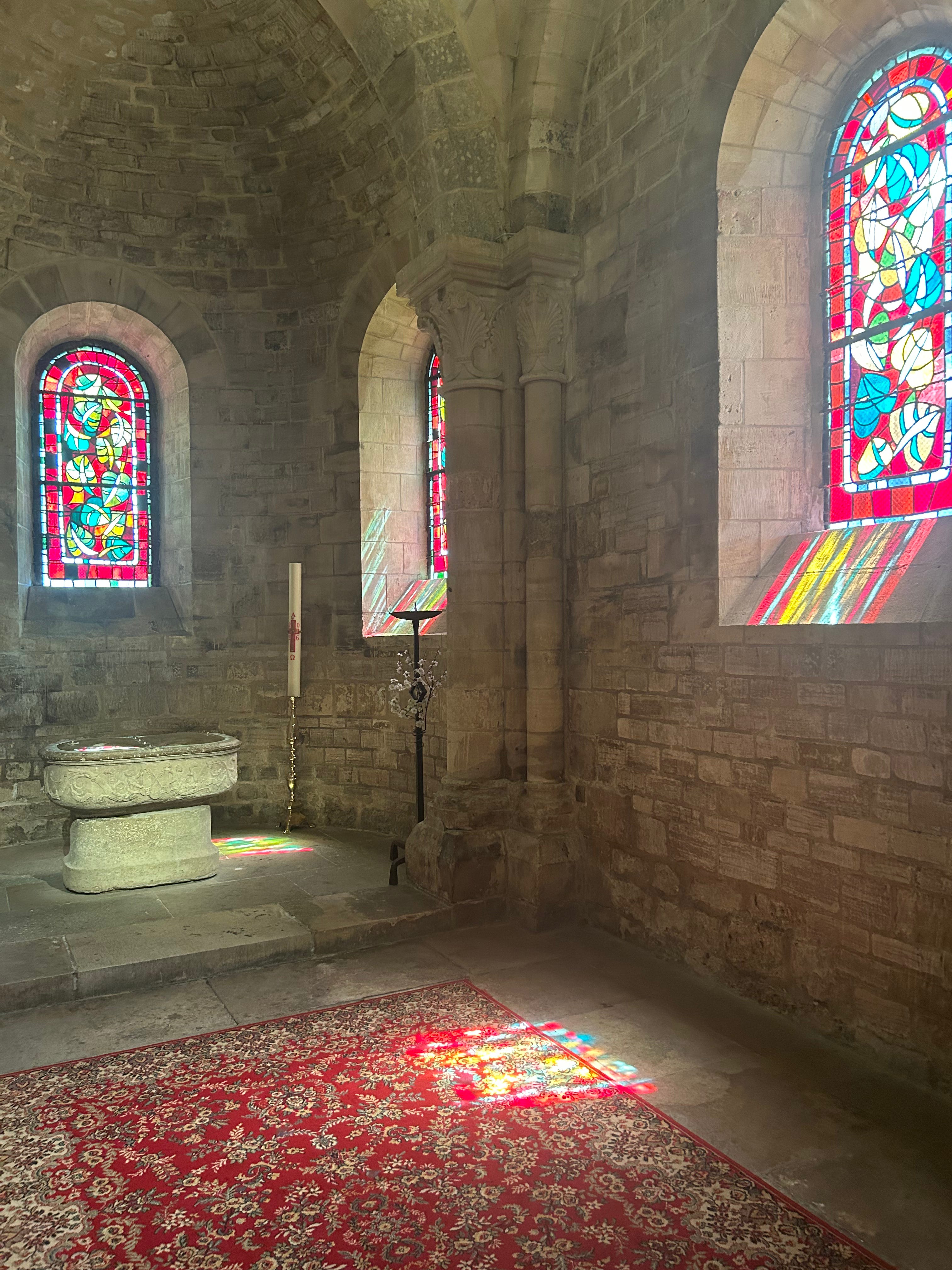
When I packed us out from Maine two years ago, I had to make hundreds of decisions about where our things were going to go: with us, to us as “Unaccompanied Air Baggage” (UAB), to us as Household Effects (HHE) by sea, or to storage, for probably the next seventeen years (we can call things out of storage, but I was overwhelmed and who knows how accurately boxes got labelled; I don’t have much confidence). Now, I’m going back to Maine, but will be living in a furnished home. Nate goes to language training near D.C. next winter and then to an unaccompanied post where he’ll most likely be living in cramped quarters for a year. We’ll both need to travel light, as in two suitcases and a carry-on at most, into 2029 at least.
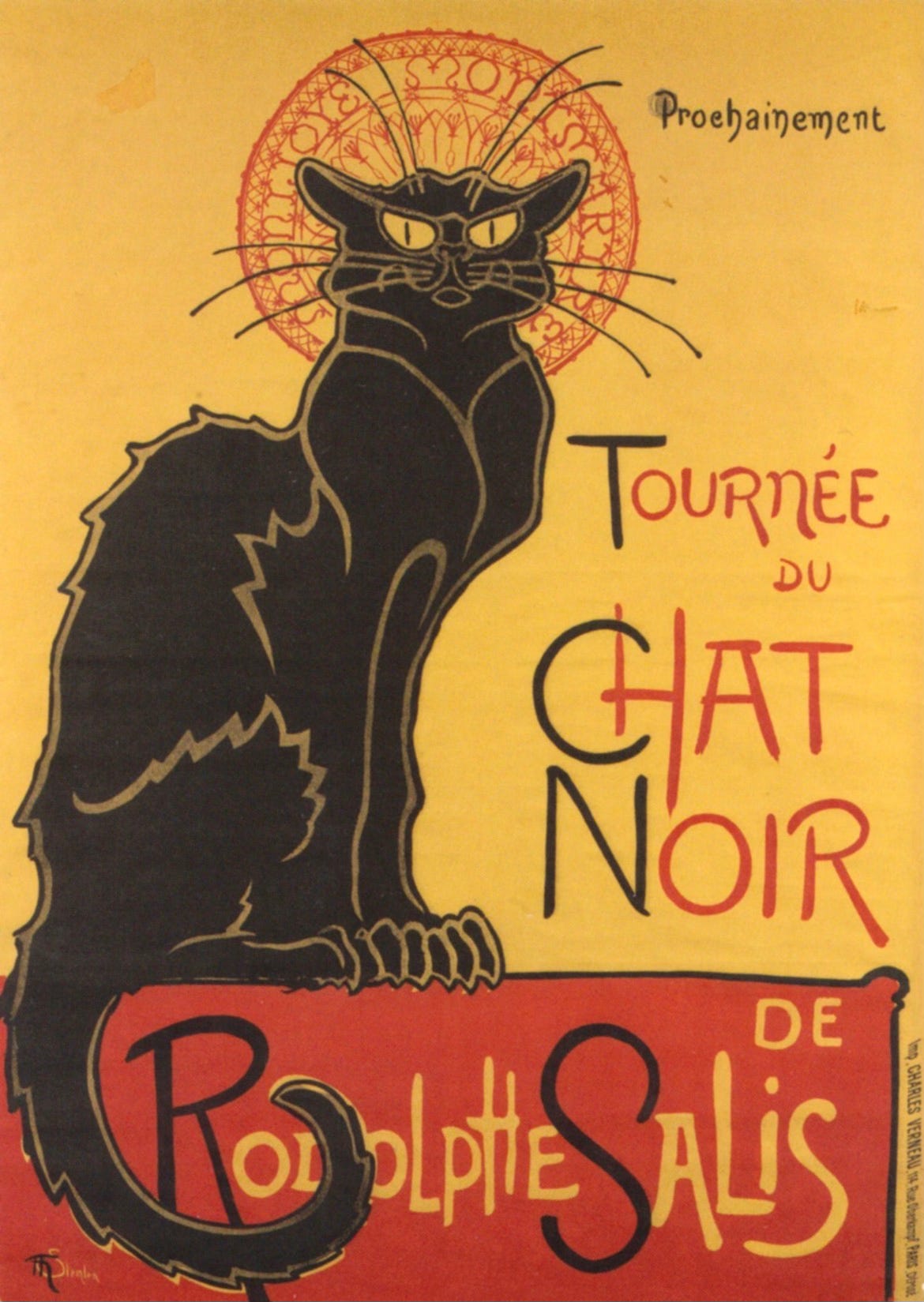
When we were up on Montmartre, we devised our favorite picnic again: a baguette with ham and gooey cheese, a bottle of champagne. We found another little park; there was a monument to Théophile Steinlein, the Swiss artist who did the poster art for the nightclub Le Chat Noir. You might recognize his work:
We had a soft cooler for the champagne and thought we were being careful but then Nate realized the bottle had tipped and more than half the champagne was in the bottom of the bag. No matter; he poured it out into our glasses and we toasted again: Paris, Steinlein, Rodin (we’d been to the Musée Rodin that morning), each other. It evoked for us the early, ominous, scene in A Tale of Two Cities when a cask of wine smashes on the cobblestones in Paris and people rush to drink it, scooping it out of muddy pools, even licking the stones themselves, and then walking away with hands and faces stained red as if with blood. The champagne was no worse for having been in the bag, and as far as we’re concerned, champagne from the bottom of a bag is better than no champagne at all.
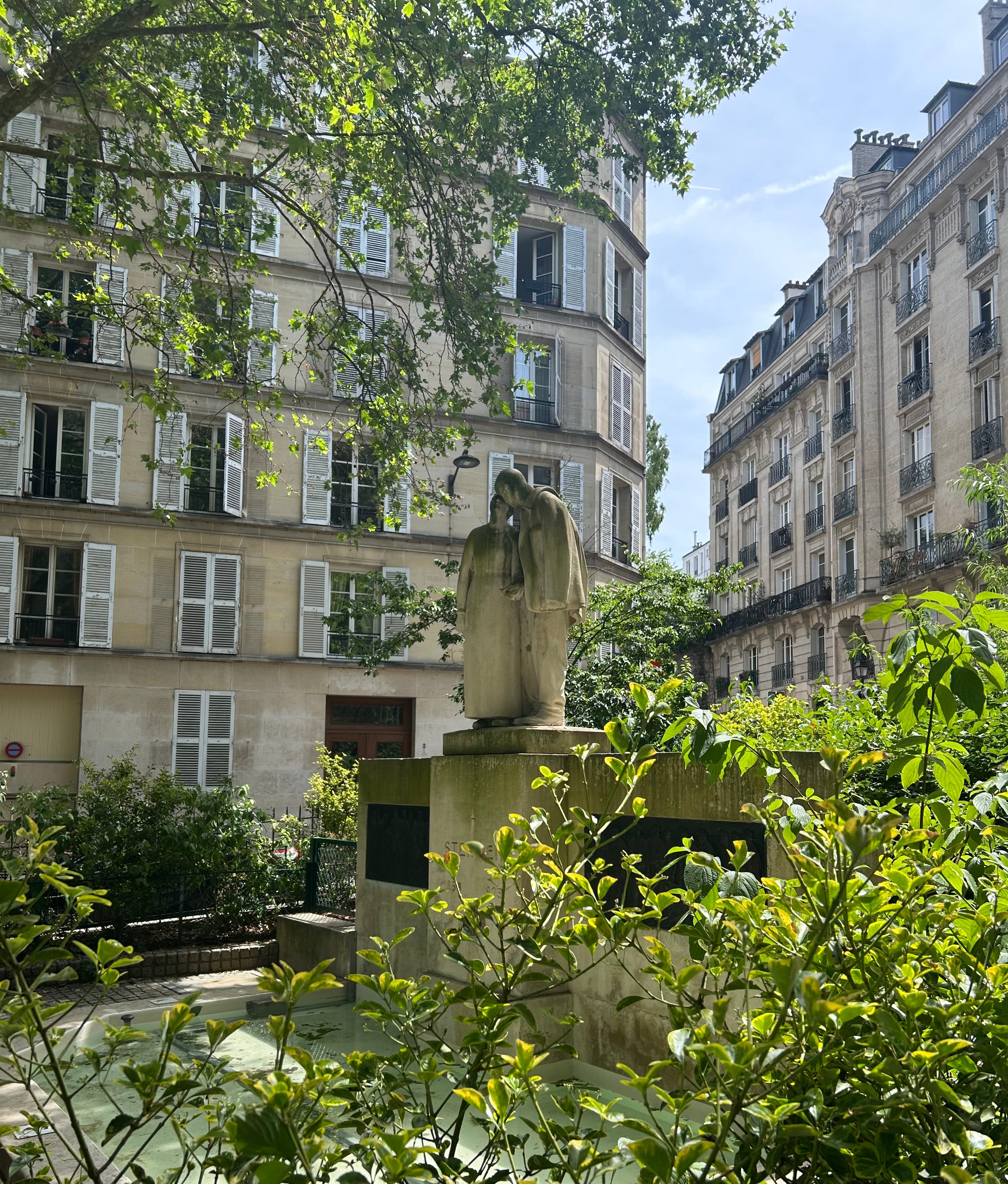
From the bench where we sat, the monument to Steinlein looked like a gentle homage to Rodin’s The Kiss: a man and a woman in a half-embrace, but more restrained, softer. When walked closer as we were leaving, we saw that the couple was not kissing at all, and it seemed all the more tender because of that. The woman’s face is lifted, but not to the man’s; their foreheads are touching, and it seems that he is comforting her while also suffering himself. His coat is draped loosely over his body, suggesting a wound or an infirmity of some kind. Her grief, though, feels untouchable.
We stayed in the 3rd arrondissement this time and while we didn’t love it as much as the 14th, it is still Paris and it has its charms, like the noodle shop at the end of our street and a wine bar where we discovered a blanc de noir champagne we’d never had, a Grand Cru from Ay, which means it’s entirely Pinot Noir, no Meunier, because Meunier is not, technically, a Grand Cru grape. We loved it so much we almost went to Ay on our last day in France to visit the maison, Champagne Dauby Mere et Fille; Nate reached out to them and they were willing to host us but not until late in the day, so we decided to leave it for next time.
After these visits, the one at Christmas, and just over a year ago, it feels like I’m finally learning Paris now, starting to understand it just a bit. My French, what little of it there is, relaxed somewhat, and people didn’t automatically start speaking English to me this time. (I freeze up in French classes themselves and get frustrated, but also, I’m amused at myself, the teacher struggling to be a student…).
Rather than visiting a hundred cities, I’d like to get to know a few very well; I don’t want a “country count” as much as I want to understand the places I get to go, so that maybe, just maybe, more than one will start to feel like home.
Thanks for reading No Half-Measures! This post is public so feel free to share it with anyone who enjoys travel writing, or art, or musings on the concept of home. “Likes” and comments are also great ways to let me know you stopped by. Thank you!
No posts
Comments
Nothing yet. Say the first thing.
Sign in to join the conversation.