
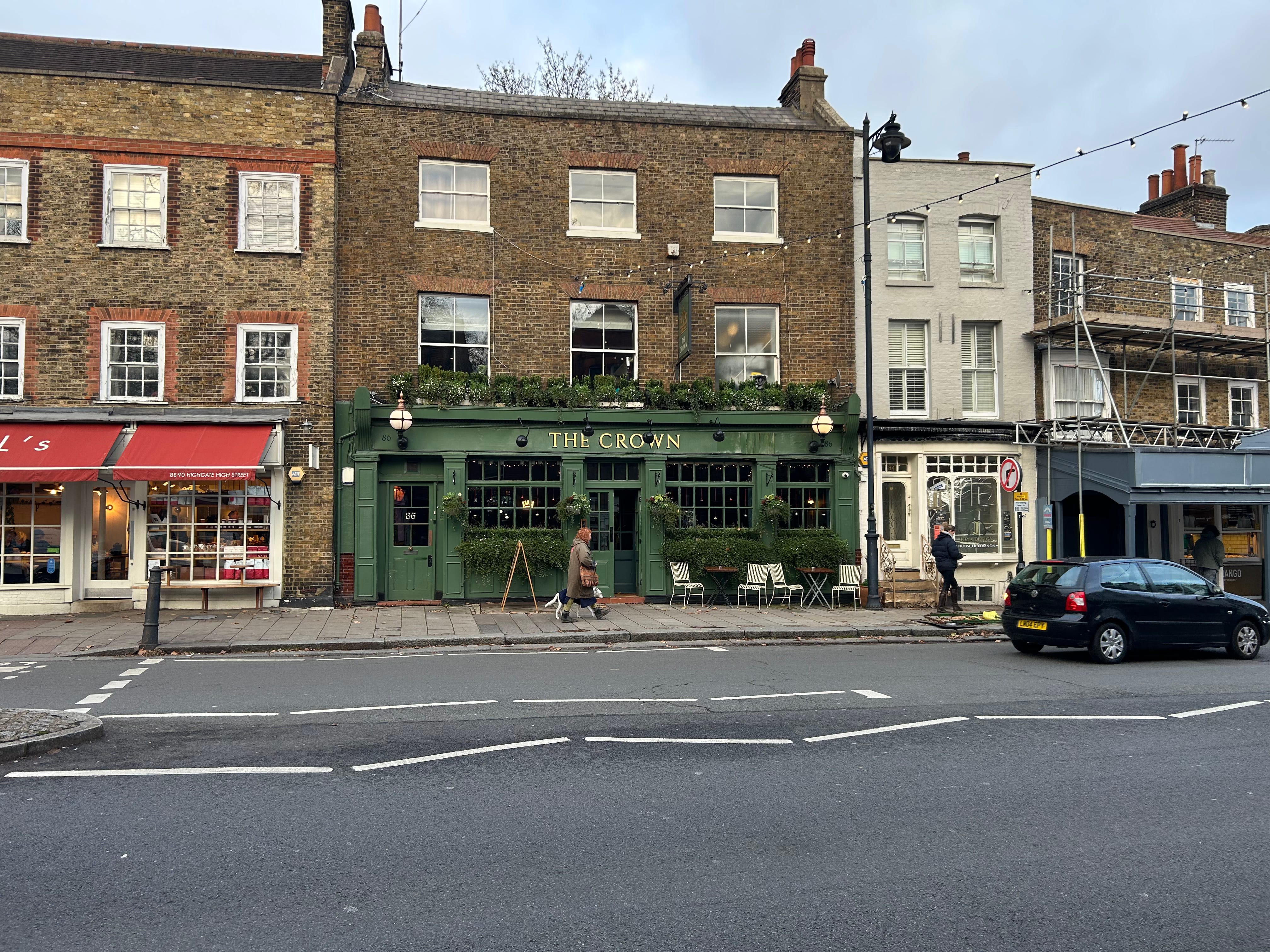
When the youngest child and I were in London last November, we had tea in a shop across the street from the pub I worked in the summer after my first year of college, in 1990. I’d eaten scones from this shop that summer, or whatever version of it existed back then; maybe it was more of a bakery.
Not much seemed familiar; the village was busier than I remembered. We stepped into the pub for a moment. It had been redesigned, the bar along the back wall now. The vibe was off, way off, so we didn’t stay.
I’d chosen London that summer because everyone else at Smith seemed to be doing superlative things with the break, the way everyone on that hyper-competitive campus seemed to be the best at everything they did, or tried to make it seem that way. My parents had moved from Alaska to Fargo, North Dakota, which I disdained then as flat and conservative and boring. And so much had happened that last year in Alaska that even though I was homesick, I wasn’t ready to go back.
I got a work visa through a program called British Universities North America Club (BUNAC). I wanted to disappear for a little while, and I liked the idea of being able to sit in a pub with a pint of beer and a book, something I couldn’t do in the U.S. (but found that so many pubs would only serve half pints at a time to women, because apparently drinking from a pint glass wasn’t “ladylike”).
I saved the money I earned from my work-study jobs, washing dishes and setting out breakfast cereals in the dining halls, and it was eventually enough for a plane ticket, Boston to London and back again.
I got a job in a pub in Highgate, in North London, The Rose and Crown, and soon, one of my customers, Kevin, a roofer who had become one of my regulars in just a couple weeks, was leaning over the bar and yelling at me: “Give me me money, you foocking whore!”
I ignored him, continuing to wipe down pint glasses, flicking my eyes around for Norman, a greying Lancashire man, the pub’s manager, who had pronounced me “clean and respectable looking” when I asked about the Barstaff Wanted sign, three days after I’d landed at Heathrow, less than a week after finals at Smith.
The morning I stepped into the Rose and Crown for the first time, Norman looked me over and nodded to his wife, Jean, who promptly took me behind the bar. She asked if I could make change, showed me the price list for drinks and where the dishwasher was, and then disappeared through a door which led, I was to learn, to the back stairs up to the kitchen, the bathrooms, and, on the third floor, where she and Norman lived, in the quarters provided by the company that owned the pub, leaving me completely on my own.
Kevin pounded his fist on the bar when I stepped away to take another customer’s order. One of his roofer friends put a hand on his arm but he flung it off and howled at me again. Finally, Norman came over and with a sharp lift of his head toward the door, told Kevin’s friends to get him out: “he keeps on he’ll be banned.”
Kevin was big but very drunk and it wasn’t hard for them to shepherd him along once they got him going. “Sorry luv,” they said to me over their shoulders as they all stumbled away. “See you tomorrow.”
I nodded, knowing I would see them tomorrow because I saw them every day. Every day, they came in when they were supposed to be working and I would line their pints of Guinness up along the bar. The Rose and Crown was an Irish pub (that year, when Ireland made the quarterfinals in the World Cup, their best showing ever, the place was a howling riot of green for days). The Guinness was so thick it took forever to settle, so as soon as I poured them one round, they wanted me to start pouring the next. They taught me how to pour a shamrock into the foam, telling me that if the shamrock was still there at the end of the pint, it was the sign of a good bartender.
Kevin’s pay envelope was down the back of my pants, scratching my skin and working its way into my underwear. After he was gone, I slipped it out and tucked it away in the little closet near the dishwasher, hiding it in a box of bar towels, one of the many places I used to safeguard my customers’ money. They trusted me with the cash they got paid in each Friday, maybe because I was young, or American; I don’t know.
I didn’t think it was strange, the first time one of them asked. It was my second day at the Rose and Crown, a Friday; I was still learning where everything was, still trying to decipher the different accents (my first customer asked for a “poyna soyda” and had to repeat it three times as he got increasingly annoyed before Norman leaned over and said “he wants a PINT of CIDER luv” imitating my accent and pronouncing all the consonants).
A older man in dirty, paint-splattered work clothes had beckoned to me and whispered across the bar, “willya keep me pay for me tonight? I’ll take out ten quid but don’t let me have more?” I nodded and knew what to do: I counted it out in front of him, wrote the amount on the envelope, then put it in my pocket.
I knew what to do because I’d grown up seeing people who knew they were going to get drunk safeguard their money this way with my dad, either so they didn’t spend it or so it didn’t get stolen off them when they were passed out. I also knew that generally, drunks were not dangerous, except when they were, and when they were, they were usually very dangerous.
In our village one night in the middle of winter, a man had stood outside the mission house door yelling that he was going to shoot himself if my father didn’t let him in. I was upstairs with my mom and sister.
Dad told him to walk around and put the gun in the window where he could see it and if he did, then he would let him in. He did, and my dad let him in.
He was hungry, and cold. He sat at the kitchen table spreading margarine on the moose meat and bread Dad gave him. I crept downstairs and sat on my dad’s lap in my nightgown.
The man said, “Need fat, Giinkhii“ (“preacher” in Gwichin, the Native language where we lived). I was “giinkhii vichi”: Preacher’s daughter.
That first time I held a customer’s money, he finished up his ten quid, about five pints back then, and said he was fine and could he have his envelope back. I said no.
He paused and looked at me. I waited, my eyebrows raised. Then he nodded and left.
The next morning, as I was setting out bar towels and ash trays, he came in and stood at the end of the bar, not taking a stool. I had already retrieved his pay from where I had stashed it the night before, knowing somehow that I needed to keep my hiding place a secret. I handed it to him without a word. “Good girl,” he said. Not “thank you” or even “ta.”
I had passed his test, and word got out.
When Kevin’s friends all came back into the pub for their usual pints, Kevin did not. The guy he usually sat next to told me that Kevin wanted me to give him his pay. I said no.
“Tell him I said he has to come get it himself. And he has to apologize.”
The friend said, “oof lass, he’s embarrassed.”
“Good,” I snorted, and they all laughed.
“Brassy American chick, this one!” They all raised their glasses to me. I just rolled my eyes and shook my head.
When people asked where I was from, I said “America, just America,” because I couldn’t talk about Alaska anymore. People at Smith, people in the Lower ’48 in general, found it fascinating, but I had started to just go blank in the face of their enthusiasm, their stupid questions about igloos and the price of milk.
A crowd of younger guys, not the roofers, would drink bottles of Budweiser, despite the extensive offering of British and Irish bitter, ale, and stout we had on tap, sing along to “Born in the U.S.A.” at the top of their lungs, and make endless fun of my accent (“knahhck it ahhhf!” they’d echo, when I objected to them speculating if I was a virgin or not, or if I could give good head.
They couldn’t seem to decide if my being American was a good thing or bad thing, kind of like how they would say Americans are fat and stupid and loud but they loved the music and movies and couldn’t wait to go someday.
I was a fascination, apparently. I didn’t mind, as long as no one looked too closely.
Kevin came in a few days later with a heart-shaped box of heart-shaped chocolates.
They had white and milk chocolate outer shells and they were pretty, with scrollwork on them, leaves and flowers. He pushed them across the bar at me and gave me a half-smile, not quite meeting my eyes. I didn’t know where to look, either. I took his pay envelope out from between the two pint glasses where I’d been tucking it every day, waiting for him, not wanting anyone to know about the closet, and put it next to the chocolates.
I wondered how he’d paid for them.
“Ta,” he said, softly.
“Thank you for the chocolates,” I said. “It’s my birthday.”
It was. It was June 12th. I was nineteen. I was already so tired, and it would be a long time, many, many years, before I found rest.
For Part Two of this story, click here .
Thanks for reading No Half-Measures! This post is public so feel free to share it.
You can listen to me read this post here:
0:00
-8:28
No posts
Comments
Nothing yet. Say the first thing.
Sign in to join the conversation.