
The imperialists seek a “dramatic change in the global order in terms of trade”. No shit.
There are two components. First, explicit recognition of Trump’s singular authority as god-emperor of a worldwide tributary system (“Have you said ‘thank you’?”). Second, explicit payment through that tributary system, via direct investment into favored sectors/firms in the US economy (which provide kickbacks to the Trump family).
Since the status quo ante global economy is not a tributary system it needs to be reconfigured into one. By force:
"Their economies are not crashing. Their markets are reacting to a dramatic change in the global order in terms of trade," [Rubio] said at a press conference in Brussels. "The markets will adjust."
When you’re a star they let you do it.
Or do they? It is true, the markets will adjust. But who is adjusting, to what are they adjusting, and why will this adjustment culminate in the end of American hegemony?
To answer we first must translate our Little Secretary into someone intelligible. Here is a straightforward way:
In the face of balance of payments deficits, governments could choose to adjust internally by reducing prices or demand, or adjust externally with “beggar-thy-neighbor” policies that pushed the problem of adjustment onto a country’s trade partners. Is there a political explanation of the choice of adjustment strategy?
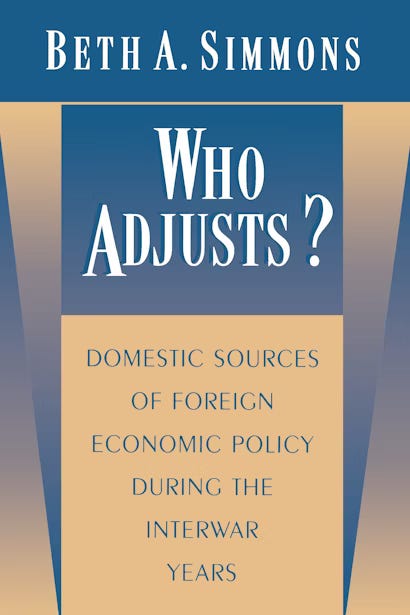
Those are some of the first words in Beth Simmons’ 1994 book Who Adjusts? Domestic Sources of Foreign Economic Policy in the Interwar Years. Therein is a simple theory to analyze the core economies’ foreign policies that produced the Great Depression and World War II:
Countries that were most likely to choose a cooperative policy mix were small, and had highly trade dependent economies. They were led by stable governments and were characterized by a quiescent labor force. … Large traders took advantage of their size to implement more restrictive trade policies. Countries that had the luxury of being insulated from the rest of the global economic system were the worse offenders: even in the absence of severe balance of payments problems, they tended to protect and devalue, forcing the smaller and more trade dependent countries to adjust to these hostile moves.
Does this model have application today? In Simmons’ sample Belgium was small and highly trade dependent; today Belgium hosts the capital of the European Union and thus contributes to one of the largest gross domestic products in the world economy. But we might think of countries like Switzerland (small, stable, quiescent labor force), which seeks cooperation through international institutions, while tragic Vietnam (small, highly trade dependent) is reportedly willing to do anything to have tariffs removed.
What about others? Simmons continues:
Unstable governments were also disruptive to international economic relations. By every criteria, they were unwilling — or unable — to cooperate. They tended to overconsume, ringing up larger and larger current account deficits. Political instability shook the confidence of capital, which fled in the face of political uncertainty. … governments with a brief life expectancy allowed their currencies to depreciate much more frequently [and were] associated with higher tariffs.
Hmm. Which country is characterized by political instability, overconsumption, large current account deficits, high tariffs, and a political effort to depreciate the currency that could generate capital flight? In the 1930s it was Great Britain, today it is the United States.
Markets will adjust. Good and hard, and permanently. People will continue to claim this is a policymaking blunder. It’s not a blunder, it’s a power play to conquer through division. 47’s regime is existential: if he ever loses power he and many in his circle will lose everything. They must either subjugate the globe to 47’s will via the worldwide abrogation of the rule of law, or face Elba; there is no stopping point between here and there.
The McKinleyian policies that produced world wars and great depressions were desperate attempts — generally by personalist regimes — to retain (or build) empires.
But fortunately there is at least one world leader who understands now what John Maynard Keynes knew then and what Beth Simmons reinforced at the end of history: the way to escape imperialist coercion is through cooperation. Come together, over Carney.
No posts
Comments
Nothing yet. Say the first thing.
Sign in to join the conversation.