
In my last post I mused (emph added):
Many people in national security express confidence in their ability to win the last war, but do they know how to win the next one? There’s a reason why China doesn’t want the US’s hardware, and it is because of software. (That is a two-way street.) …
Being the best at teabag stapling or tank construction in the 1990s does not save you from CNC-powered scale economies nor algorithmically-guided drones in the 2020s. Turns out the tanks are deathtraps in the 2020s, they just get in the way, all of that engineering was a bridge to nowhere: that tank got blown up by garage technology, technology that can be purchased at retail. What will be the death traps of the 2040s? Fighter jets? Submarines? Will it be desirable to possess nuclear stockpiles if algorithmic worms can melt them down on your own territory?
There are at least two potential disagreements with this. The first would question whether Russia is losing at all. To me they’ve already lost. The Red Army was supposed to be in Kyiv by the end of the first month at the latest, remember? Jeremy Shapiro understands the strategic terrain:
Both Russia’s defenders and its enemies suggest that a successful campaign in Ukraine will somehow produce a stronger, reinvigorated Russia capable of posing an immediate threat to Europe and beyond. But what exactly would Moscow have “won”? An angry, revanchist neighbor; a more unified, hostile Europe; a ruined economy; a gutted army; reduced international influence [ed.: esp in Middle East]; and a boss in Beijing. That is not victory but self-inflicted decline. …
In sacrificing its global influence for the chance to spend the past year pulverizing the previously unheard-of city of Pokrovsk in the Donbas, Russia has proved not its resilience but its near irrelevance. Russia has not rediscovered its imperial destiny. It has discovered only that it can still destroy—and that destruction is just about all that its foreign policy has to offer.
The same could’ve been written about Netanyahu: whatever impressive tactical victories he may have secured against Hamas has come at enormous long-run strategic cost.
This lesson generalizes: personalist nationalist leaders can centralize resources quickly and win some early blitzkrieg tactical battles on the “move fast / break stuff” principle, but in so doing they destroy their long-term power base and thus precipitate eventual defeat.
The second response is to question whether committing oneself to a heavy industrial base is investing into future death traps definitionally. Surely we need much more fixed capital investment?! Surely we need much more physical infrastructure! Everyone says so, all sides of the political “spectrum,” from the Green New Deal to Abundance to the crypto boys of the Casino Capitalism economy. Surely that is the basis of power in the 21st century?
Maybe! Or maybe that just creates more targets for swarms of bots to attack:
According to the research, the new ASW system could reduce a submarine’s chance of escape to just 5 per cent, meaning only one out of every 20 submarines would likely escape detection and attack.
As global powers intensify their race to put AI into military use, the study suggests the era of the “invisible” submarine – long a cornerstone of naval deterrence – may be coming to an end.
Instead of relying on old search patterns, the AI system acts like a smart commander in the ocean.
It uses data from sonar buoys dropped by helicopters, underwater sensors, radar and even ocean temperature and salt levels to build a live picture of what is happening under the sea.
Then, it quickly decides where to look, how to adjust its equipment and how to respond when a submarine tries to escape by zigzagging, going silent or releasing fake signals to throw off the hunters.
In computer simulations, this AI system was able to find and track enemy submarines about 95 per cent of the time, no matter how hard they tried to hide.
Even when submarines used hi-tech decoys or drones to distract the searchers, the AI kept up and stayed on their trail. …
But AI could make the strategy outdated.
Almost all political recommendations currently being made — deliverist or transformative, securitized or growth-oriented — are premised on the future being somewhat similar to the past.
That is very unlikely. If it is untrue then all current visions of industrial Abundance — tech-feudalist, market liberal, or socialist — are based on a false premise, just as 20th century land wars were based on a false premise.
The evidence that the capital-formation view is a false premise is everywhere. Traditional political parties are being hollowed out all over the world because traditional political coalitions organized around class intersts are no longer sustainable: the world is too wealthy, and the proletariat is no longer organizable via the shopfloor (because there is no shopfloor). It is why politicians are not being rewarded for redistributionary fiscal policies that would’ve been perceived as quite progressive even 10 years ago.
What is needed is not greater redistribution through the old channels; what is needed are new channels.
The long 20th century was about building up physical stocks of assets that are now depreciating rapidly as new technologies render previous investments obsolete. The job now is to manage flows. In Stocks World it is rational to build fortresses; in Flows World those become targets.
In the 20th century governments built organized blocs, arranged spheres, maintained buffers. That was occasionally successful because cross-border societal connectivity was low, so direct government negotiation was capable of ordering political economies to some extent. Now cross-border societal connectivity is high. Direct government negotiation is incapable of ordering to the same degree, governance is much more multi-faceted. This is why politicians rave then sputter. They promise to march but immediately trip and fall.
Power is diffusing. Spending $20bn on nuclear submarines that cannot prevent speedboat piracy is like spending 20 years building a wall that the blitzkrieg simply drove right past.
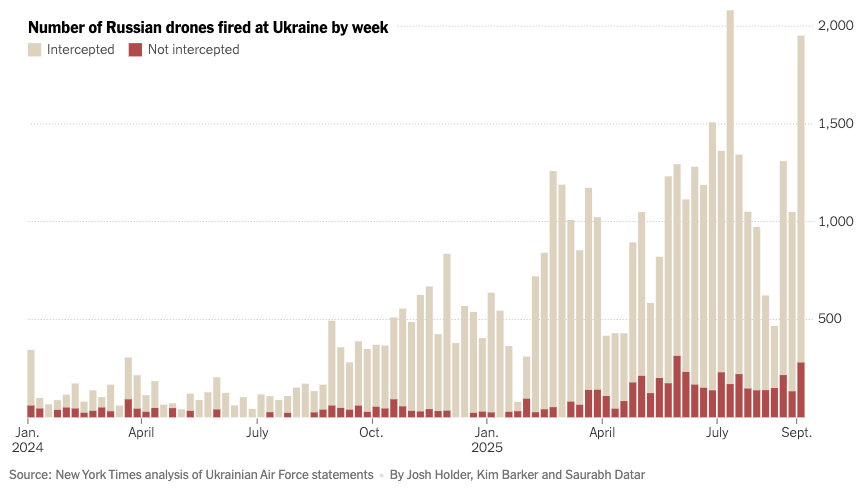
Which is why Russia now focuses its efforts not on building tanks, but swarms:
When Russia introduced self-destructing drones from Iran into its war against Ukraine three years ago, Moscow made headlines around the world by launching 43 of them into Ukraine in a single strike.
This month, in just one night, Russia sent more than 800 exploding drones and decoys swarming across the border. …
“So basically it’s about scale” … Russia is aiming to build an entire military branch called the Drone Forces.
Responding to these changes by building more targets seems like missing the point. The point is not to stop the flows. You cannot stop the flows, as 47 is learning in real time.
Power comes from directing the flows.
No posts
Comments
Nothing yet. Say the first thing.
Sign in to join the conversation.