
There are two general critiques of global capitalism and its relationship to a democratic state.
In the first, global capitalism erodes the state, minimizing its effectiveness and responsiveness to the polity, driving all of society into totalizing market logics that are disembedded from social institutions through dislocating competitive processes. The mechanism for this comes from finance: if governments do not conform to market logics then they will have higher financing costs, their firms will underperform, their citizens will have lower standards of living, which will make it more difficult for political incumbents to retain power.1 Let’s call this the “states vs markets” critique.
In the second, global capitalism coincides with the state in a mutually-reinforcing process that insulates both from the polity, via an oligarchic logic that perverts social institutions through doublethink/doublespeak. To prevent this requires some form of constitutionalism and/or democratization process, up to and including revolution. Let’s call this the “states and markets” critique.
Both outcomes are antithetical to pluralist republicanism. The first critique of global capitalism expects business to eventually capture the state, and it is a typical Marxian position. The second expects powerful states to fuse with business, in opposition to other states and corporations who oppose their interests. This was the position of Susan Strange, who noted that the “structural power” of leading states across four domains — security, production (and trade), investment, and knowledge (including “intellectual property”) — provides a foundation for market-leading businesses to transverse the globe in ways they otherwise could not.
Nvidia is the most powerful corporation in the world. Its products embody all four of these domains: they contain the most knowledge (“intellectual property”), they are the most valuable commodities in world trade, their investments move the global economy, and who has control of their products affects the security of every state, business, and person on earth.
Nvidia is the most valuable company in the world by market capitalization. It has a monopoly in the production of the most in-demand product in the world today, and can leverage its position as the critical node in global telecommunications, which is the industry that drives economic growth in leading economies (and has done so for over 30 years).
If any corporation in the world economy has meaningful structural power, it is Nvidia.
Yet Nvidia is currently being expropriated in an explicitly unconstitutional fashion by an enormously unpopular president who is supposed to be “business friendly”. So is AMD. So is Intel. So is US/Nippon Steel. So are the private law firms and universities. Next it will be Wall Street. The data-mining marketing companies — let’s stop calling them “tech” — sold out long ago, and pay their bribes via non-transparent crypto schemes.
Collectively, those firms represent Strange’s four domains: modern security provision is impossible without widespread data-mining infrastructure (also used for things like this), the production (“golden share”) and trade (“Liberation Day” but not really) systems are being nationalized by diktat, finance is coerced through the deregulation of crypto alternatives to Wall Street along with “debanking” legal threats, and the knowledge economy is being centralized through control of universities, leading tech companies, and the securitization of data operations.
So maybe this government is not friendly to business in the traditional sense that Republicans often are. After al, 47 is a “businessman”, if you call gangsterism a form of “business”, but has no prior experience in any of these industries or with any of these firms, and most of them did not support his political ambitions until very recently. He is not a Romney, nor a Ryan, nor a Bush, nor a Reagan, and he is not reliant on any specific part of the business community for support.
So this is not a Marxian takeover of a democratic polity by organized business interests. No, this is something other than that.
For a decade now a series of actors — Republican officials, religious leaders, business executives, financiers, foreign nationalists, “common ground” moderates sincerely interested in Infrastructure Week — have viewed Trump opportunistically, each claiming to be capable of taming him while using him for their individual purposes. Like this guy:
The Russian oligarchs thought they could control Putin, too. They couldn’t. He obliterated the legacy oligarchs from the Yeltsin, and replaced them with loyalists. Similarly, MAGA has destroyed the GOP, reversing its positions on most key questions and sublimating all previous power bases within the GOP under the rule of the Trump family.
Today we learn that 47 has created a loyalty metric and is using it to grade the loyalty of every notable business in America:
The West Wing has created a scorecard that rates 553 companies and trade associations on how hard they worked to support and promote President Trump's "One Big Beautiful Bill," a senior White House official tells Axios. …
Factors in the rating include social media posts, press releases, video testimonials, ads, attendance at White House events, and other engagement. …
The data, which is being circulated to White House senior staff, will be used as a reality check when someone from K Street calls and says, for instance, that they'd "love to catch up — was so great working with you to pass the big, beautiful bill." …
this is an evolving document, with the organizations' engagement on other presidential initiatives to be added.
“Social credit scores” will be next, in fact they’ve already been in private operation for over 5 years. This information will be merged with social media activity (probably including Substack activity) so as to be micro-examined by corporations including Palantir using processes at least as invasive as those created by DOGE; this is already being done to migrants and visitors, and there is zero reason to believe that there is any natural end point to this nor any check and balance against abuse of such a system.
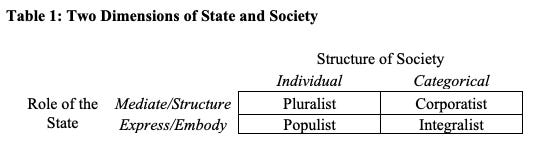
Tom Pepinsky has a very useful working paper for thinking through processes of democratic backsliding towards a post-liberal social order. In the paper he focuses on two dimensions which describe normative varieties of anti-liberalism: the ideal role of the state as either Mediating between private interests vs Expressing the public will, on one dimension, and the structure of society as consisting of either aggregations of individuals or of groups (classes, parties, categories) on the other dimension. Interacting those two dimensions gives us four ideal types:
And translating that framework to a context of democratic backsliding gives us four potential destinations:
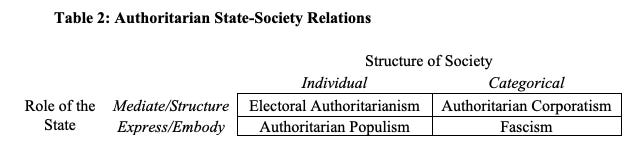
The question that emerges from this discussion is straightforward: which outcome are we headed toward?
The answer depends on your view of power. If power is instrumental, with states competing against markets in a process biased towards a totalizing logic of market supremacy, then powerful firms and actors should be able to see their individual interests take priority in opposition to the state; at the limit this would entail state capture by business. If power is structural, with states co-opting markets in a process oriented towards subsuming individual interests into categorical interests, then the bottom-right quadrant is the likely destination.
Yes, that one. Stop saying you’re sick of hearing about it. It’s not going away.
I’ll have more to say about Pepinsky’s framework in the future, and how it relates to the recent preoccupation with “weaponized interdependence”.
Thomas Friedman called it the “Golden Straitjacket” once upon a time.
No posts
Comments
Nothing yet. Say the first thing.
Sign in to join the conversation.