
Paul Musgrave has an excellent post on “consuming at the end of the American century” that I’m going to use as a jumping-off point.
When I was giving research talks1 I would present graphs showing China’s rise into global trade and investment networks and say “they are Japan + W. Germany in the 1970s, but more”. Most US-based commentators on the rise of China focus on the “more”, assuming that quantity is a quality of its own.
Thanks for reading Bespoke Human Content! Subscribe for free to receive new posts and support my work.
As Paul shows, that’s not wrong! China’s rise is the most important fact of the 21st century political economy (so far). At the same time, China’s rise had not displaced the US at the core of important global networks, just as the rise of previous industrializers did not. Paul’s examples reinforce that message and add some new flavors to it.
But as the conclusion of my research linked above argued, “China’s rise isn’t displacing the US” is not the end of the story: US hegemony is over. To understand why we can’t start at the end, we have to start at the beginning.
Paul rolls the tape at 1990. As Susan Strange noted in 1988, it is too analytically simplistic to add up shares of world trade or global production and then start ranking economies based on those shares. In a rejoinder to Milner and Snidal that foreshadowed the later “reductionist gamble” debates, Strange noted:
If structural power is the ability to determine who shall produce what, where, for what reward and by what means, the share of manufactured goods produced in the U.S. and the share of U.S. exports of manufactures is immaterial. The share of manufacturing and services, especially information-rich manufacturing and service, produced by enterprises headquartered in the United States and responsive to the government in Washington is relevant.
Reminder: this was 1988. This is before the end of history, before widespread capital account openness via the Washington consensus, before the WTO, before global value chains, before the “information economy” (much less “attention economy”), before Silicon Valley revealed just how important agglomeration effects truly are for the postmodern economy, and before the subprime crisis reminded of us the impossibility of avoiding complex interdependence via “decoupling”/”de-risking” (don’t hear so much about “de-risking” these days, do we??).
Back to China. Why did their rise not displace the US at the core of important global networks? Because their rise involved using US information — the term “human capital” was not often used in Strange’s day, although it has a longer history — to manufacture, using US information to market to US consumers, using US currency to settle transactions, and recycling their US $ profits into US financial markets (just like Japan and W. Germany did).
That’s the first-order effect: China developed by playing the US’s game in the US’s sandbox. China joined the US’s economy. You don’t weaken something by joining it, you strengthen it.
Wall Street reinvested China’s recycled $ profits into tech, which supported American profits — great for asset owners — and the military, so China’s rise helped reinforce American prominence structurally.
China’s rise in export markets came at the relative expense of Europe and Japan:
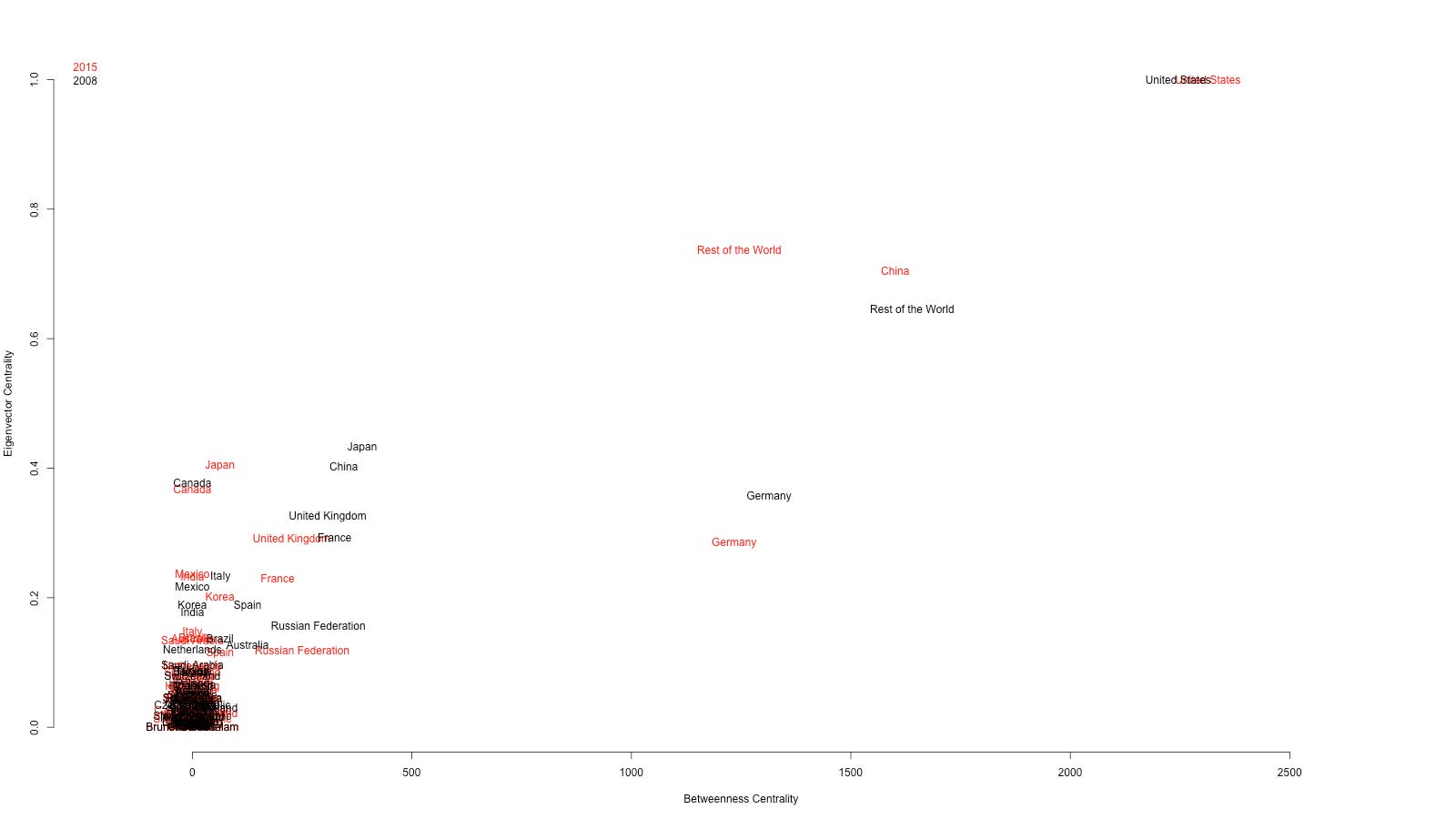
Country labels further top-right indicate greater prominence in the network of value-added international trade, operationalized using Betweenness (x-axis) and Eigenvector (y-axis) centrality measures common in the networks literature. In the post-subprime crisis period (2008-2015) China became much more prominent, displacing Japan, Germany, and other “Old Core” economies… but not the United States.
From this perspective, it’s not a problem for the US that China is making cheaper/better coffee than Tim Horton’s, one of the examples Paul uses. It’s a problem for Canada, maybe, but it’s a sign of the US’s structural power, per Strange, that US consumers have many ways to spend their dollars on things they want. It wouldn’t even matter if Cotti’s came for Starbucks, except for the shareholders of Starbucks (who largely have diversified portfolios). Similarly, it doesn’t matter to the US that people increasingly buy Anker electronics instead of Panasonic, to use another of Paul’s examples.
When I began claiming that China’s rise supported American structural prominence I was surprised that European audiences immediately understood this dynamic much better than American audiences. American social scientists are used to thinking in terms of the marginal effects of unit-level competition, rather than systemic effects of structural processes. That’s what the “reductionist gamble” debate was about. Perhaps the Europeans more directly observed their decline relative to the US and emerging Asia, especially following the subprime crisis (which became the eurozone crisis, viscerally illustrating complex interdependence).
But it reinforced my growing worry (over the years) that American policymakers — eager for a galvanizing mission such as they imagined existed during the Cold War — would misunderstand the nature of the structural transformation taking place, turn China in to a peer competitor unnecessarily, embrace coercive imperialism rather than strategic restraint, and destroy its own structural prominence as a consequence.
Which is why I really like Paul’s analogy…
Trump is the American Tokugawa and MAGA in foreign policy is trending toward becoming a neo-sakoku policy.
… with one important difference: the growing ubiquity of Chinese consumer products is not analogous to the spread of American ideas in the mid-20th century. Tetris didn’t win the Cold War for Russia, and Super Mario Brothers didn’t lead to Japanese hegemony in computing power either.
Nevertheless, I agree with Paul that the analogy is useful even though it is imperfect:
All told, these trends all point toward a world in five or ten years’ time that is much less structurally disposed to work in Americans’ favor, which sets up a possible self-reinforcing cycle in which the appeal of isolation relative to internationalism grows accordingly.
In fact, I concluded the research paper mentioned above with:
[power transition] could come from an intentional disruption of global networks by the core states, through malintent and/or short-sightedness. Those concerned about the long-run effect of the Trump presidency on the United States’ structural power thus have strong reason for concern.
But where I disagree with Paul — at least for now, we might need to dialogue about this at some point! — is in his conclusion:
China—despite not being a particularly extroverted power—will see its structural influence wax tremendously over that period. And structural changes work according to a Matthew effect in which growing connections have their own self-reinforcing properties: as you get more used to working with Chinese standards, Chinese firms, and Chinese tech, it gets easier to work with other Chinese institutions and ideas. … When and if the United States exits Trumpism, then, it will rejoin a world already in progress—a world that no longer orbits the United States, a world in which “American” is no longer the reference for all things (except measurement), a world that is actually internationalized as opposed to just Americanized. It will be a world that left America behind.
Whether China’s influence waxes or wanes is an open question. You don’t gain structural power by supplying the world with games and toys, nor with commodity-priced EVs, touchscreens, and solar panels. Panasonic doesn’t run the world. What increasing the supply of those products does is provide checks and balances, escape routes, provide mechanisms for evading power.
Remember: complex interdependence was originally thought of as existing on the opposite end of a spectrum from neorealism. Neorealism models views the world as a competition between independent states with unitary interests. But does that describe the phenomenon of an American academic choosing between a Canadian or Chinese coffee company while working in Qatar?
I don’t think that is what Waltz had in mind.
What we need is a more realistic model of power competition than polarity offers us. What we called “poles” during the Cold War were actually communities within a global network structure that competed for new links as the network grew. These communities were bridged by a non-aligned-but-connected mass in the “middle”. If we think about the world this way — via connectivity and communities — instead of arguing about how many poles there are at any given point in time, we can imagine pathways forward that are not “everyone dies” or “China’s boot on our throats”.
The US had a great opportunity to form proactive partnerships with China, which could’ve reinforced the network structure even as Europe and Japan face mounting demographic pressures. Instead, the US chose a status competition it cannot win.
But the ROW does not have to mimic the US, should not, and so far is not.
Like this one. Here’s the peer-reviewed version.
Comments
Nothing yet. Say the first thing.
Sign in to join the conversation.