
I am gratified by the current recognition of my Global Workspace Theory of conscious cognition, first published in 1983 and developed over several decades. My name, and GWT, have recently appeared in The Conversation, Startup Fortune, The Guardian, and other places in connection with artificial intelligence and the question of machine consciousness.
This is normal in science when insights that run against the dominant view of things begin to receive wider recognition. While I feel grateful for this attention, something is always lost in translation when a dense and sometimes complex idea is presented to the public.
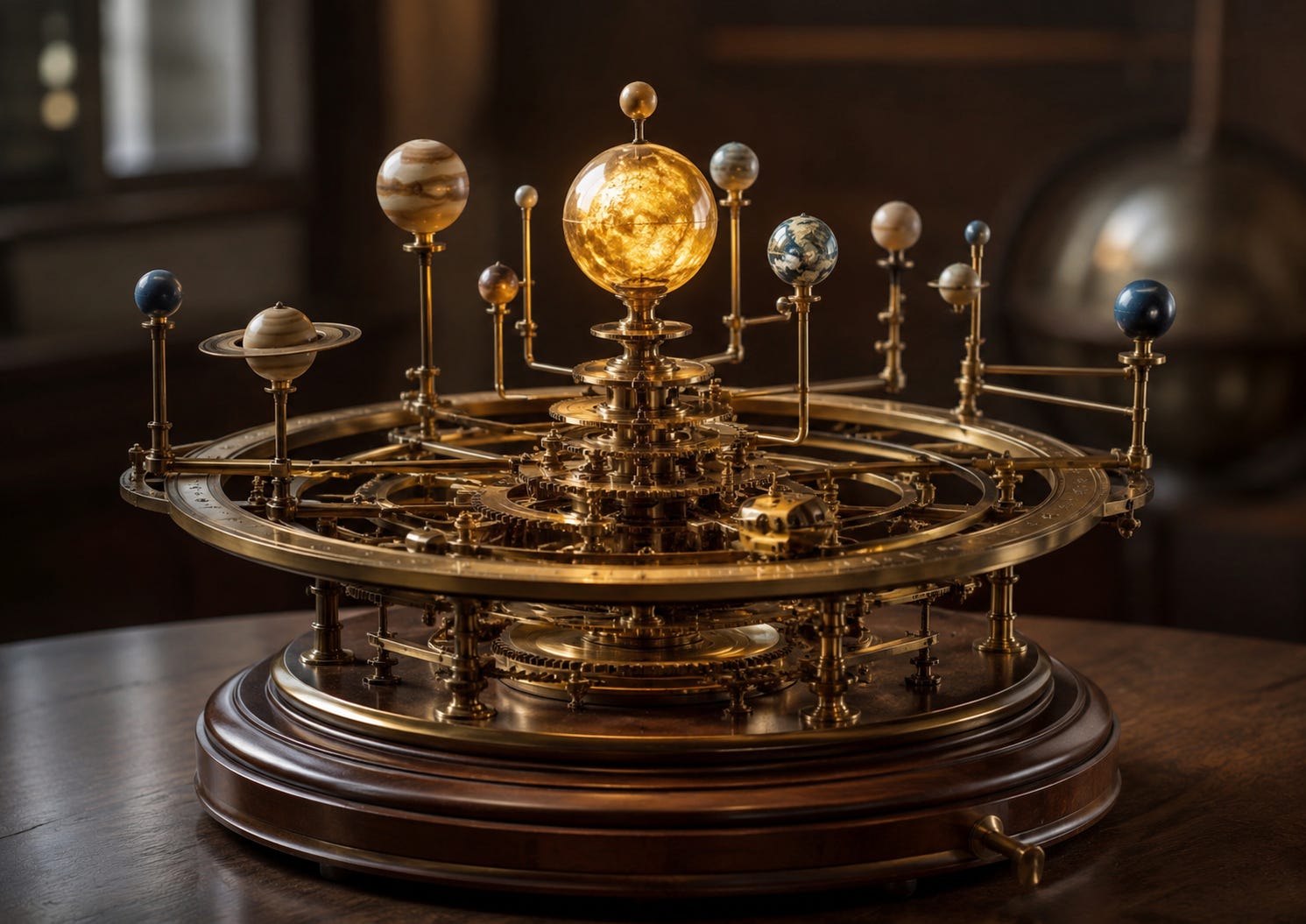
Newton crystallized our current view of the Earth and planets, but it took time for other natural philosophers to understand Newton’s mathematics and the revolutionary impact of the Copernican theory. To make it possible for new people to visualize the new and radically upsetting understanding of the Sun-centered system, some clever soul made a tabletop toy model of the Newtonian solar system, called an “orrery,” which you can still see in science museums and hobby shops.
The tabletop model consisted of a big ball representing the Sun and smaller balls for the planets, all connected cleverly by rods and gears to keep them in their proper places, rotating around the Sun. You can buy plastic orreries today, and they are a great way to learn about the real solar system.
But the obvious question remains: where are the little rods and gears that keep the REAL Sun and planets in their orbits? As far as astronomers could see, there were no physical connections between the real planets.
Comments
Nothing yet. Say the first thing.
Sign in to join the conversation.