
Dear all,
I spoke with the French newspaper Les Echos this week about the impact of the Alaska and Washington summits on prospects for peace in Ukraine. Here you can find the original article and here’s the full interview in translation:
Les Echos: What is your assessment of the recent summit in Alaska and Washington, or the prospects of one between Putin and Zelensky ?
Jessica Berlin: The Alaska and Washington meetings were a bizarre political theater that left Europe more or less where we started: with no concessions from Moscow and no clarity from Washington. Alaska was a historic political disgrace: President Trump rolled out the red carpet to a ruthless dictator and war criminal, greeting him with smiles and applause. Even good faith proponents of dialogue with Moscow can see such a welcome was shameful. Imagine FDR warmly welcoming Hitler to America in 1940 in the name of ‘dialogue’, while Paris was occupied and German bombs rained on London.
Beyond this symbolic shame for America, on a practical level Alaska achieved nothing for the US: Trump had threatened Russia with severe consequences if Putin didn’t agree to a ceasefire at their meeting. Putin refused, as expected, and Trump immediately backtracked. No word of consequences for Russia since. Shortly thereafter in Washington, Trump even asked European leaders to stop using the term ‘ceasefire’ to divert focus from his failure to secure one. The one concrete outcome from Alaska was a victory for Putin: his diplomatic isolation has been broken. After receiving a personal welcome from the American president, no other country needs to fear diplomatic backlash for receiving him. Trump’s red carpet opened the diplomatic door for Putin worldwide.
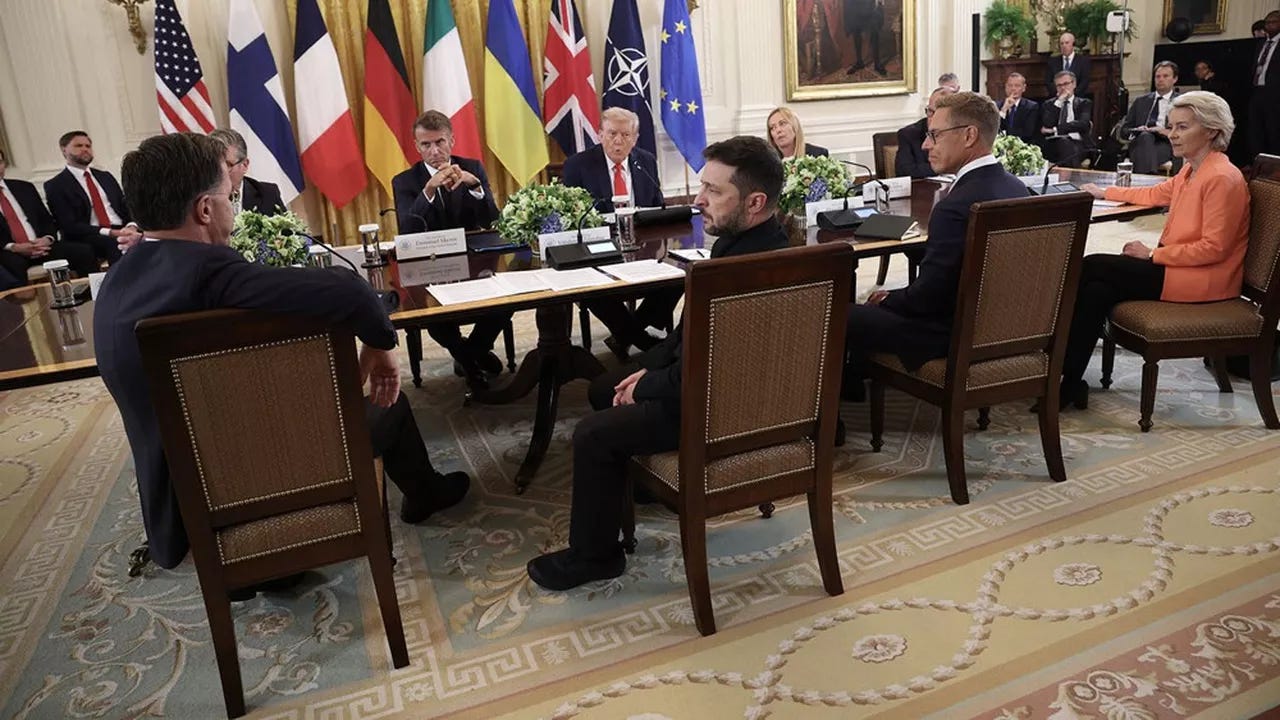
Many observers considered the Washington meeting a win simply on the basis that it did not descend into chaos or antagonism, like the White House ambush of President Zelenskyy in February. To consider the meeting a success just because it wasn’t a complete disaster distracts from the reality that little progress was made. Trump vaguely said America would be ‘involved’ in providing some sort of security assistance to Ukraine, but with no details of what that could look like beyond ruling out ground troops. He also declared he wanted to arrange a bilateral meeting between Zelenskyy and Putin, to which the Kremlin response was to insist that Moscow must be involved in any security guarantees for Ukraine – a ridiculous assertion.
After a week of intense diplomatic drama, Europe and the United States are ultimately nowhere nearer to having a cohesive strategy for how to bring Russia to the negotiating table and end this war than we were before.
LE: What do you understand about Trump's strategy: will he simply abandon Ukraine or, on the contrary, impose severe sanctions on Moscow?
JB: The most important thing to understand about Trump’s strategy is that he doesn’t have one. He came into office declaring he would end the war in ‘24 hours.’ That was seven months ago. He has no plan to end it now and lacks even a basic understanding of its causes, history, implications, and current state. He compounds his ignorance by surrounding himself with equally clueless advisors, rejecting the expertise and advice of Ukraine and Russia experts within the US government. The frequent mistakes and embarrassments of his Special Envoy Steve Witkoff, a billionaire real estate investor with zero relevant regional knowledge or diplomatic experience, are just one of many such examples.
The Kremlin knows Trump has no plan and that his threats are empty, and thus feels empowered to escalate their violence without consequence. In the past two months alone, Russia has increased their nightly missile and drone strikes by about 30%. Russia’s impression of American weakness was only reinforced by Trump’s backing down on his insistence that Putin agree to a ceasefire in Alaska. This was a classic example of the new acronym circulating in Washington, TACO: ‘Trump Always Chickens Out.’ His one consistent trait is inconsistency. For Europe to base its strategy on the US is like building a bridge on quicksand and then acting surprised when it sinks. We cannot rely upon this administration to defend transatlantic interests, democratic values, or even NATO members’ territorial integrity. Trump is on no one’s side but his own. The onus is therefore on us, in Europe, to increase the pressure on Moscow: through increased sanctions and strict enforcement of existing ones, increased military and financial aid to Ukraine, and seizure of Russian state assets and private Kremlin-linked assets in the EU.
LE: Don't the antagonisms between Moscow and Kiev, particularly regarding the fortified belt around Donetsk, destroy any hope of an agreement?
JB: There is currently no hope of a deal between Moscow and Kyiv, because the Russians show no willingness to step down from their demands of Ukrainian capitulation, and the Ukrainians remain determined to defend their country. Russia denies the legitimacy of Ukraine as a sovereign nation and of the Ukrainian people’s right to live free from Russian influence and control. This fundamental issue is the primary cause blocking any progress on a deal.
Regarding Kremlin demands for a so called ‘land swap’ in exchange for a ceasefire, there are numerous issues with this. Firstly, the term land swap of course implies that land would be swapped – but what Russian land is Russia offering to swap for Ukrainian land? None, of course. What they propose is not a swap, but Ukrainian capitulation. Ukraine, of course, cannot accept this.
Secondly, even if Ukraine would be willing to sacrifice sovereign territory in exchange for a temporary ceasefire, to withdraw from the fortress belt in Donetsk would be an open invitation for the Russians to simply attack Ukraine again, from an even stronger position. Ukraine has spent 11 years investing in the fortress belt and building it up as a bulwark against further Russian incursions. To abandon these fortifications to the Russians would be unthinkable from any military or political perspective.
Comments
Nothing yet. Say the first thing.
Sign in to join the conversation.