
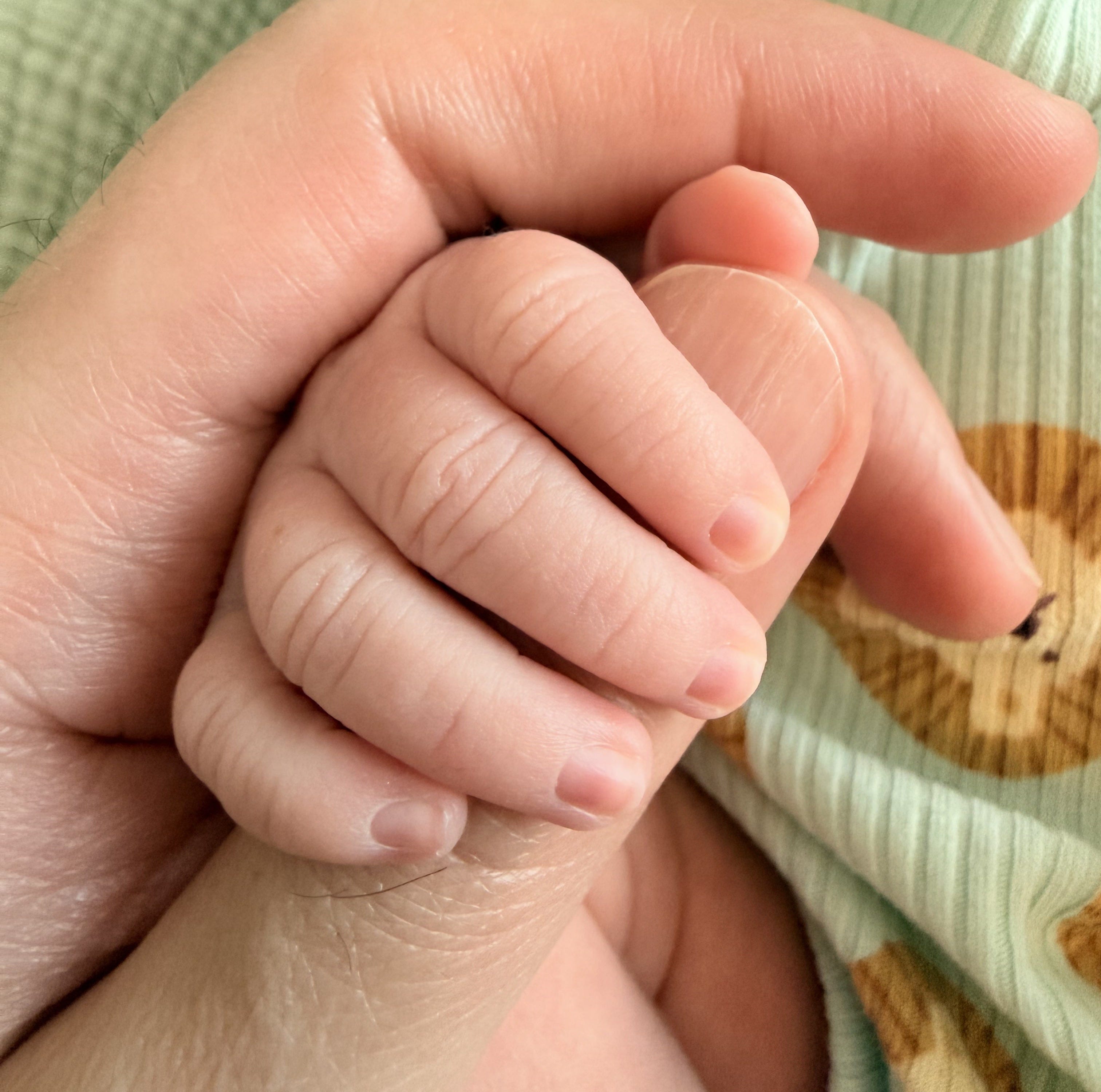
Beep...
A monitor sounded intermittently through the halls of the maternity ward at Northwest Washington Regional Hospital. The entire place felt sterile and yet emotionally charged. Three large screens displayed a grid of graphs arranged in neat rows. Each graph had a black background and three lines moving up and down: one white, one pink, one blue. In the center of the second screen was room 1312—the room where Marina had spent the night after officially beginning her induction protocol.
Beep—
The monitor sounded again, rhythmically. Beep, every three or four seconds. The graphs rose and fell, rose and fell. Jaime and I stared at them and studied the numbers, knowing full well we couldn’t make sense of any of it. Still, it was oddly soothing.
Beep—
We had checked Marina in at five p.m. the night before. She’d brought a few pillows and blankets from home.
“None of those plastic ones they give you at the hospital,” she’d said.
This wasn’t her first rodeo. She knew she’d need a few comforts from home to stay as comfortable as possible.
Beep—
For almost nine months, we had watched Marina navigate every appointment, protocol, and process with confidence—almost stoicism. Not this time. For the first time since we’d met her, her uneasiness was showing.
“I’ve never liked hospitals,” she said, as we entered her room for the first time. She had an overnight bag with clothes on one hand, her good pillow on the other.
And how could she not be nervous?
Marina had told us from the beginning: her first pregnancy had been easy as pie. Delivery, not so much. With her daughter, she’d endured almost eight hours of labor, and she dreaded having to do it all over again.
“Whatever happens, I want that epidural!” she’d said when we first met her.
We never hesitated to say yes.
When it came to our baby’s health, we’d take every precaution available. But her body was her choice and her choice alone.
Beep—
We gave her the biggest hug we could manage, and she squeezed us tightly, as if she could transfer her nerves to us.
At least she tried.
She stayed the night. We didn’t.
Dr. Dawson had told us there was no point. Even though they’d begin the first medications shortly after admission, the Pitocin wouldn’t be administered until four a.m., and only then would induction truly begin.
So we went back to the Airbnb and pretended to rest for a few hours.
Beep—
My phone alarm went off at three-thirty a.m. sharp on Monday morning, long before dawn. It was still dark outside, and I hadn’t slept much.
Neither had Jaime.
It didn’t take more than a single beep from the alarm to get us moving.
Beep—
It was June 1.
The beginning of Pride Month.
Beep—
There was a full moon. Hadn’t someone told us months earlier that more babies were born during a full moon?
“What if they don’t have a room for us?” I worried.
“We’ll be fine” Jaime said. I looked at him —I could tell. He too, was nervous.
Beep—
Jaime and I showered and got on our way.
We stopped at a McDonald’s drive-thru for a hot black coffee to go. It was the only place open at four in the morning.
But I didn’t need the caffeine to stay awake.
I needed the ritual.
The warmth of the cup in my hands. The smell of coffee filling the car. Something familiar in a world that was about to become completely unpredictable. Coffee wasn’t energizing. It was comforting.
Beep—
We took the elevator up to the L floor.
The same elevator that had carried us up five months earlier when Cathy had given us a tour of Labor and Delivery.
Crazy Cathy, as we jokingly called her.
Wherever she was that morning, she possessed far more sanity than we did.
Beep—
They checked us in.
“We have a room for you, right next to Marina’s,” the administrator told us.
“Phew,” I exhaled.
The full moon hadn’t gotten in the way after all.
Beep—
They buzzed open the secured doors. Doors designed to keep unwanted visitors out and prevent anyone from walking away with a baby.
Beep—
And we knew a thing or two about locked doors.
Over the previous four years, we’d spent our lives trying to open them.
I thought about all the doors we’d crossed through during this journey.
The first one had been in the middle of Times Square, when we rode the escalator up to our first surrogacy conference at the Westin. We knew nothing of egg cohorts, or PGT-testing, or surrogacy contracts.
We left that conference overwhelmed.
Sad.
Defeated.
Certain that parenthood might never happen for us.
“Surrogacy is not for everybody,” that one agent had told us after giving us the six-figure cost of the journey. He hadn’t blinked.
Beep—
We walked past the monitors and dropped our travel bag in our room.
The space was enormous by hospital standards. There was a large window, a sleeper sofa, and a hospital bed. Everything felt clean and new—very different from the hospitals we’d visited in New York, where rooms often held multiple patients separated only by thin curtains.
Here, Marina had her room.
And we had ours.
Beep—
It was now five-thirty a.m.
We walked next door to say hello.
Marina was wearing a hospital gown and connected to an IV. She never looked fragile —that’s not in her blood. But somehow, she looked more vulnerable than ever.
“Did you manage to sleep?” I asked.
“A little,” she said. “They kept coming in to check on me. They just started the Pitocin.”
Suddenly, it all felt real.
If all went well, we wouldn’t leave that hospital as a couple.
We would leave as parents.
The thought was so enormous that my brain immediately attached a condition to it.
“If all went well.”
That’s how my mind had operated for the previous four years.
Always hoping for the best while preparing for the worst.
Always asking: What could go wrong here?
And what if it does?
Looking back, though, things had gone remarkably well at almost every turn.
Perhaps the biggest lesson of the past four years was that hope was more powerful than fear.
Beep—
We gave Marina some space. The last thing she needed was the two of us staring at her for hours, waiting for something to happen.
So we returned to our room.
And we waited.
For four years, we had waited.
But this felt different.
There were no more checklists.
No more phone calls.
No more paperwork.
No more planning.
For the first time, there was nothing left to do. I closed my eyes, knowing very well I was not going to fall asleep.
Beep—
I thought about those early Saturday mornings back in 2023, when I’d wake up and spend hours researching surrogacy, trying to make sense of a world I knew nothing about.
I thought about the very first spreadsheet I built in the living room of our old apartment. How I tried to use cells and columns to make sense of an undecipherable world.
Agencies.
Clinics.
Costs.
Timelines.
There was even a savings tab with a formula that calculated how close we were to affording the journey.
At the time, it felt impossible.
Every year costs climbed higher.
Every year inflation seemed to outrun our savings.
Every year the finish line appeared to move farther away.
Beep—
Seven a.m.—I hear the knock and open my eyes. A nurse stopped by to check on us.
“Is there anything you need?” she asked.
“If you can tell us the exact time of birth so we know when he’ll arrive, that’d be grand,” I joked.
It wasn’t a particularly funny joke.
Still, she smiled.
“I wish I’d brought my crystal ball,” she said. “Be patient. He’ll come.”
Beep—
Be patient.
That, at least, we knew how to be.
Life had taught us that much.
Over the years, I’d learned that sometimes the best thing I could do was surrender to uncertainty. Trying to control the uncontrollable wasn’t just impossible—it was exhausting. No—it was draining.
And more often than not, the moment I stopped forcing things, life had a way of moving forward on its own.
Like that job offer in 2022.
The one that became our lifeline.
The one that came with fertility benefits.
The one that allowed us to take the first real step toward surrogacy.
Beep—
My parents texted.
It was close to nine a.m. now. Sunlight poured through the oversized windows, slowly pushing the hospital’s fluorescent lighting into the background.
“Any news?” my mom asked.
“Nothing yet,” I replied. “We’re still waiting.”
I took my phone by instinct—went to the chat we had used with Marina for thirty-something weeks. Where we had shared photos, and GIFs, and jokes, and sonograms.
“How are you feeling?” I texted, trying to walk that delicate line between being present and giving her space.
“I’m one centimeter dilated,” she replied. “The Pitocin is starting to work, but things are moving slowly.”
“Anything we can do?” Jaime asked. “Anything we can bring you?”
But Marina said no.
She wasn’t allowed to eat anymore—and even if she had been, she probably wouldn’t have wanted to.
“I want the biggest deli sandwich imaginable when I get out of here,” she wrote. “And a massive dose of caffeine.”
It made me smile.
For more than thirty weeks, she’d been unbelievably thoughtful.
She’d cut out cold cuts.
Anything raw.
She limited caffeine to the occasional half-caf, mostly for the placebo effect.
Not once had we needed to ask her to be more careful. Time and again, she would surprise us with how intentional she was being.
“I’ve been trying to eat eggs every day,” she’d say. “I heard they’re good for the baby.”
She’d done her research.
Just like we had.
Beep—
The monitor sounded again.
Even from down the hallway, I could hear it.
A steady reminder that things were moving forward, even when it felt like nothing was happening.
“I’ll go grab another coffee and a tea for you,” I told Jaime around ten a.m. “Call me if anything happens. I’ll come running.”
Truthfully, neither of us needed another hot beverage.
I just needed an excuse to move.
To walk.
To let my nerves loosen their grip for a few minutes.
So, I headed to the cafeteria on the second floor and bought two drinks I didn’t particularly need. I walked past the gift shop. They had blue and pink balloons for sale —I wouldn’t dare buy one.
Beep—
As I walked back to our room, I thought about those first agency interviews.
The endless search for the right fit.
The uncertainty.
The sales pitches.
The promises.
And then there was that one office near Bryant Park.
The one with the perpetually locked door.
The one where a woman tried to convince me to sign paperwork on the spot.
I remembered leaving that meeting wondering whether I’d just visited a surrogacy agency or accidentally stumbled into an underground human trafficking operation.
Even now, I felt uneasy about it.
Gosh, so much had happened.
And just as importantly, so much hadn’t.
Looking back, it felt as though we had spent years standing one bad decision away from disaster.
Beep—
I stopped on my way back toward our room. The monitors continued their steady chorus.
Somewhere in the distance, another alarm sounded.
Yet nurses moved through the halls completely unfazed.
Their calmness was strangely reassuring.
“Any news?” I asked as I stepped back inside.
“Still one centimeter,” Jaime said. “And you’ve been gone for less than fifteen minutes.”
Less than fifteen minutes.
It certainly hadn’t felt that way.
It felt like hours.
In that moment, time stretched and warped in ways I didn’t know were possible.
Our four-year journey suddenly felt brief compared to the waiting still ahead of us.
And yet we knew it would happen.
Soon.
Beep—
“Remember when we went to Connecticut for the fertility testing?” I asked Jaime, searching for ways to pass the time.
“You mean the most awkward day of our adult lives?” he said.
I laughed.
“That nurse asking whether your sample was in the same bag as your croissant?”
I laughed harder.
Some memories never lose their ability to embarrass you.
Beep—
I thought about Dr. Sam.
The dozens of calls.
The presentations.
The endless slide decks explaining the mysteries of in vitro fertilization.
One slide stood out in particular.
Back in 2023, he’d shown us a projected timeline.
If everything went well, we’d have a child roughly three years later.
At the time, three years had felt impossibly far away.
A lifetime.
And yet here we were.
Almost three years later.
Sitting in a hospital in the middle of a state we probably couldn’t have pointed to on a map back then.
Waiting for our son to be born.
Beep—
By eleven a.m., my parents had arrived.
“Nothing yet?” my dad asked.
“Nothing,” I said. “Marina’s doing well. We’re giving her some space. She’s two centimeters dilated.”
As we talked, I found myself thinking about something I’d gotten completely wrong.
For years, I’d assumed our strongest emotional connection would be with our egg donor.
After all, she was contributing half of our child’s DNA.
So we’d searched obsessively.
Dozens upon dozens of profiles.
Letters.
Videos.
Questionnaires.
Traits.
Interests.
Medical histories.
We analyzed everything.
Sometimes we’d narrow the list to a handful of candidates we weren’t particularly excited about and wonder if we should just choose one and move on.
We almost did.
“Can you imagine?” I asked Jaime. “If we’d picked someone else?”
He nodded absentmindedly.
“Our entire story would be different.”
Jaidan wouldn’t exist.
Oliver wouldn’t exist.
None of this would exist.
Jaime nodded again, though I could tell he wasn’t fully listening.
He was nervous.
I knew that look.
I’d known him for fourteen years.
He could hide anxiety behind a poker face better than almost anyone.
But I’d learned to read the signs.
The subtle ones.
And I knew his heart was beating faster than he wanted anyone to know.
Beep—
I thought about the day we found K, our egg donor.
How everything about her profile felt right.
How we joined the waitlist in fourth place, convinced we’d never reach the top.
And then, somehow, we did.
Little by little.
One spot at a time.
Until eventually, we were number one.
Beep—
I remembered meeting her over Zoom.
How natural the conversation felt.
How excited we were afterward.
How twenty-four frozen eggs eventually made their way to Connecticut.
And how, from that point on, everything became a numbers game.
A brutal one.
Each update cutting our hopes in half.
Again.
And again.
And again.
“Four embryos,” Dr. Sam told us at the end of the week. I remember doing the math.
Four chances.
That was it.
Four opportunities to build the family we’d spent years dreaming about.
Four chances before the road ended.
Beep—
A knock on the door. Jaime and I instinctively stood up.
It was now a bit past noon.
The nurse came in to give us an update. Marina was now three centimeters dilated. At four, she’d be considered in active labor.
“Contractions have started,” the nurse said. “We’ll try to get to six centimeters before the epidural.”
“She must hate us right now,” I said to Jaime. “I’m sure she wants us dead.”
I texted her again—knowing very well she might not answer.
But I wanted her to know we cared. I wanted her to know she wasn’t alone.
On the birth plan we had written months ago, we had agreed she’d labor on her own. No pressure, no hovering. We’d come in when it was time.
“What does this mean in terms of time?” Jaime asked. “Minutes, hours, days?”
“It’s hard to say,” the nurse said. “Once they reach five or six centimeters, things usually move faster. And at ten, things really accelerate.”
“So we should stay put?” I asked.
“You can go get something to eat,” she said. “It won’t happen in the next hour or two, I don’t think.”
That “I don’t think” lingered.
Because everything now lived inside that uncertainty.
So we split—Jaime went with my dad to get sandwiches. My mom stayed with me.
“Marina is such a strong woman,” she said quietly. “I can’t believe how well she’s doing this for you.”
We had been lucky. More than lucky.
I thought of the three profiles before her. Three possible lives that now felt like alternate universes. We wouldn’t be here in Fayetteville, Arkansas in this exact moment if we had chosen differently. We might not be anywhere near this moment at all.
I thought of her profile—those soft pink, yellow, and green highlights. “Arkansas” circled on my printout like a question I almost let turn into fear.
I was so close to saying no.
So grateful I didn’t.
So grateful Jaime steadied me when I panicked on a subway, trying to decide a future from a moving train.
Beep—
They came back with sandwiches no one really ate.
We waited again. Phones in hand. Words thinning out.
Just time stretching.
Beep— 2 p.m.
“Remember the transfer day?” I asked Jaime.
“How could I forget,” he said. “We almost missed the train stop.”
We laughed softly—like laughter had to pass through something heavy first.
I thought of Connecticut. Of Marina, Hayley, and us sitting at that Greek restaurant after the transfer. Of watching them drive away afterward, a stranger carrying our fragile embryo like something both invisible and enormous.
Beep—
Six centimeters. Four p.m.
“They’re going to give her the epidural now.”
And then they did.
Marina texted a few minutes later.
“I got my epidural—I was starting to curse you guys, not gonna lie.”
“That’s fair,” Jaime replied. “Curse away.”
Even here, even now, she made space for humor.
She always had.
Our embryo had been a cluster of cells. Then a blueberry. Then an olive. Then something we stopped being able to name properly because naming it made it real in a way we weren’t ready for.
Week after week, Marina had carried him with a steadiness that never asked for attention.
Beep—
At five, I couldn’t sit still anymore.
“Go walk,” my dad said, half suggestion, half an order.
So, we did.
We walked the halls in loops that never seemed to end.
Beep… beep… beep…
The monitors kept their rhythm. The world outside those walls disappeared.
Time didn’t pass so much as press against us.
Beep—
I pulled Jaime into a hug.
“I just want him to be healthy,” I said, barely recognizing my own voice. “He can take all the time he needs—just be healthy.”
Jaime held me tighter than words.
There was nothing else to say.
Just two people who had already been through too much to believe in certainty—but too far in to stop hoping.
Beep—
Seven centimeters. Then eight.
We kept walking.
6 p.m. My parents gave us space.
“We’ll be right outside,” they said.
As if distance still mattered.
Beep—
I thought of the anatomy scan in Arkansas. The sonogram printout we carried like proof. His tiny hand near his face like he was sucking on his thumb.
We had placed that strip of sonograms on the hotel bed and stared at it for hours, trying to understand how something so small could already feel so large.
Beep—
Nine centimeters.
Everything now felt like motion without direction.
Like the world had tilted forward and was waiting for permission to fall.
Beep— 6:30 p.m.
6:45.
The last months came all at once.
The apartment filled with boxes before the move. The search for daycare. The late-night reading of parental leave policies like they were written in another language. Our lives shrinking and expanding at the same time.
Beep—
Ten centimeters.
7 p.m.
“Any second now,” the nurse said. “Stay close.”
We didn’t move.
We couldn’t.
The hallway, the monitors, the lights—everything felt suspended, like the world was holding its breath with us.
7:25. Then the door opened.
A nurse stepped in.
She didn’t need to speak.
“We’re ready for you,” she said.
Beep—
We walked down the hall.
Beep—
Marina was there. Surrounded, supported, present. Strong in a way that didn’t need explanation.
They guided us to the warmer.
Beep—
“I can see a little head,” Dr. Dawson said.
“One more push,” she added gently. “Whenever you’re ready.”
Beep—
Everything narrowed.
To breaths. To Jaime’s hand. To the heat that invaded my eyes.
Beep—
I squeezed Jaime’s hand like it was the only fixed point left in the universe.
Beep—
“I just need him to be okay,” I thought.
Beep—
A final push.
A pause so complete it felt like the world had stopped becoming anything at all.
Then—
A cry.
“He’s here,” Dr. Dawson said.
I looked up. I wiped tears from my eyes.
And suddenly there he was.
Small. Wet. Breathing. Crying—not like the movies, not loud, just real.
Covered in vernix, fragile and alive and entirely present.
“He’s got a head full of hair,” Dr. Dawson said, beaming. “Look at him.”
“Dad, come here,” she said.
I couldn’t move at first.
My body didn’t understand.
“Dad,” she said again, softer now. “Come here.”
I stepped forward.
A pair of scissors. A line I crossed with trembling hands.
I cut.
Somewhere behind me, life kept happening.
The nurse carried him to the warmer, clearing his airways, grounding him in breath.
I turned.
Jaime had undone his shirt.
He was already ready —he was going to be a great dad.
“Here he is,” the nurse said.
And then he was in Jaime’s arms.
Skin to skin.
No distance. No noise. No past or future that mattered.
Just breath meeting breath.
A tiny body that had never known anything except our voices.
“Oliver,” I tried to say.
It broke before it arrived.
“Oliver,” I managed again, quieter.
Beep—
The monitor slowed.
Time slowed.
Life loosened its grip.
The room softened into something almost still.
I walked to Jaime. My newborn family.
“You’re here,” I thought.
Not as words meant to be spoken.
Just recognition.
In that moment—we weren’t two dads-to-be anymore.
Everything we had carried for four years fell away.
It became a beginning.
No posts
Comments
Nothing yet. Say the first thing.
Sign in to join the conversation.