
Editor’s Note: At the Prohuman Foundation, we recognize that lasting social harmony thrives on the joy of in-person connection. Here, Samual J. Abrams describes the importance of shared experiences in our search for meaning and community.
I first heard Daft Punk’s “One More Time” during my sophomore year of college. The song was everywhere; drifting down dorm hallways through bad speakers, spilling out of crowded rooms late at night when nobody was especially concerned about sleep or schedules, pizza boxes stacked along the walls and someone always insisting the night wasn’t over yet.
The familiar melody pulled people together. Doors stayed open. Someone wandered in. Conversations started.
What stands out now is not the song itself, but how the music worked as a kind of social gravity.
A few weeks ago, watching footage from a concert in London late at night after the house had gone quiet, I felt something similar again.
The crowd experienced something that has become less common in public life: joy without qualification. No ideological test. No signaling. Just participation.
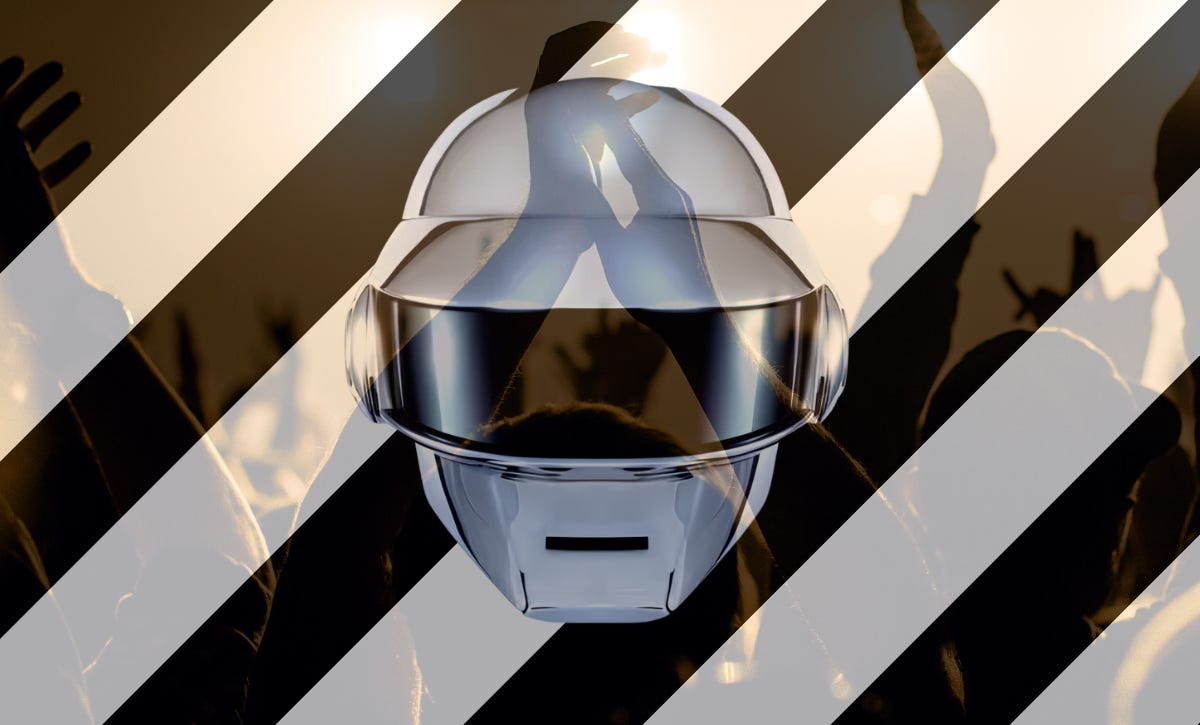
Producer Fred Again was finishing the final night of his residency at Alexandra Palace when Thomas Bangalter—one half of Daft Punk, absent from the stage for nearly two decades—appeared beside him for a two-hour back-to-back set leaning heavily on the Daft Punk catalog. The recognition moved through the crowd almost instantly. Thousands reacted at once: shouting, hugging strangers, raising phones that shook as people tried to record what they were seeing.
Even watching from across the Atlantic, through a screen, the reaction was striking.
Most cultural moments today arrive carefully managed and endlessly previewed. Experiences are individualized, streamed, consumed on demand. Few of them feel genuinely shared anymore.
This one did.
Daft Punk’s music has always belonged to collective spaces—dance floors, parties, crowded rooms—more than personalized feeds. Seeing Bangalter suddenly reappear alongside an artist whose work draws heavily on memory and emotional intimacy produced something unusual: a moment experienced simultaneously by thousands in the room and millions watching the full set.
What stood out to me was a sense of shared relief. That reaction was not confined to London. The relief traveled immediately—across American group chats, social feeds, and living rooms—because it touched a broader condition familiar on both sides of the Atlantic.
Americans today report high levels of loneliness despite constant technological connection. Participation in religious congregations, civic associations, and voluntary organizations has declined for decades. Many of the informal institutions that once structured social life have weakened, leaving fewer places where people regularly encounter one another outside work or family. Even entertainment increasingly happens alone, filtered through algorithms designed for individual preference rather than shared experience.
The underlying need for shared experiences has not disappeared. Societies that lose regular opportunities for them tend to find trust and civic confidence eroding alongside them. What we lose is a source of social cohesion.
Psychologist Clay Routledge recently wrote about collective effervescence: intense shared emotional activation and a sense of unison that emerges from coordinated behavior. He notes that research on collective effervescence suggests that it improves social cohesion.
People still want these moments when attention aligns, when strangers briefly share the same emotional experience without self-consciousness or performance. For much of modern history, religion, civic ceremony, and community gatherings supplied those moments. Today they appear wherever they can. Sometimes that means sports arenas. Sometimes spontaneous gatherings after tragedy or celebration. Increasingly, it happens at concerts, one of the few environments where large groups willingly surrender individual control in exchange for shared feeling.
Fred Again has built his following around precisely this impulse, turning fragments of ordinary life—voice notes, conversations, memories—into something communal. When Bangalter joined him, the crowd experienced something that has become less common in public life: joy without qualification. No ideological test. No signaling. Just participation.
Watching the crowd, I found myself thinking again about those dorm hallways: doors open, music echoing, people drifting toward one another. At the time, that kind of togetherness felt ordinary enough to go unnoticed. Now it feels rare.
Many Americans sense this change without quite articulating it: the closed apartment door, the individualized playlist, the evening spent scrolling rather than gathering. Shared experience has not disappeared, but it increasingly requires intention rather than happening on its own.
We communicate constantly, but share fewer experiences that unfold collectively in real time. Algorithms narrow attention rather than synchronize it. The result is not only political division, but a subtler form of social fragmentation: lives lived alongside one another rather than together.
Moments like the London concert briefly interrupt that pattern. They remind participants, and even distant observers, that shared feeling remains possible.
Samuel J. Abrams is a professor of politics at Sarah Lawrence College, a senior fellow at the American Enterprise Institute, and a scholar with the Sutherland Institute.
Opinions expressed by guest authors do not necessarily reflect those of the Prohuman Foundation. We value diverse perspectives and invite submissions from those who can enrich our understanding of topics close to our mission: to promote the foundational truth that we are all unique individuals, united by our shared humanity.
No posts
Comments
Nothing yet. Say the first thing.
Sign in to join the conversation.