

Editor’s Note: Today we continue a series of original essays by Prohuman Foundation advisor Dr. Michael Tobin. In this personal reflection about three remarkable encounters spanning 50 years, he reveals that by listening carefully to others, the particularities that set us apart can make our common humanity more fully visible.
As I approach my eightieth birthday, I find myself thinking more about the encounters that changed the course of my life.
The first took place in the winter of 1975. Snow clung to the bare branches outside the modest office assigned to psychology interns by the community mental health clinic in Springfield, Vermont. Inside, I waited for my next patient with the confidence only a twenty-eight-year-old can carry without embarrassment.
I had recently immersed myself in Gestalt therapy. Unlike traditional psychotherapy, which explored the past through conversation, Gestalt invited people to enact the past in the present. Empty chairs stood in for absent fathers. Conversations that had never been spoken were finally voiced aloud. The goal was not merely to remember an experience but to relive it until something shifted. To a young, eager, ambitious psychologist, more than a little intoxicated by the promise of transformation, it felt revolutionary.
She was sixteen. She entered wearing faded jeans and the hardened expression of someone who had learned far too early that adults rarely deserved her trust. Her life had been a catalog of violations and abandonments: abuse by her father, removal from her home, foster placements, residential treatment centers, one broken arrangement after another. I had read the chart. I knew the history, or thought I did, and besides, I had a method that promised to reach the wound without first knowing the person.
After listening for several minutes, I dragged a chair to the center of the room and asked her to imagine her father sitting there. She looked at the chair, then back at me. For a while, she played along. She cursed him. She told him how much she hated him. I watched, secretly pleased, feeling the familiar excitement of a young therapist who believes the machinery is working.
Then she stopped.
“You know something, man?” she said. “I’m crazy enough. I don’t need this shit.”
The room seemed to tilt. A moment earlier, I had known where the session was headed. I had entered that office believing I possessed a method to unlock another person’s suffering. Suddenly, the method looked theatrical, almost absurd, and I saw myself not as the healer I hoped to become but as a young man asking a shattered girl to perform her pain for me.
She looked at my shoulder-length hair and the small earring in my ear. “You’re a shrink, right?”
I nodded.
“Did they teach you how to read poetry?”
The question startled me. “Not really,” I said. “To be honest, the only poem I ever liked was The Love Song of J. Alfred Prufrock.”
For the first time since entering the room, she smiled. Then, without ceremony, she recited, “Let us go then, you and I, / When the evening is spread out against the sky / Like a patient etherized upon a table…”
I stared at her. A girl from rural Vermont, hardened by abuse and foster homes, was quoting Eliot to me in a mental health clinic as snow gathered outside the window.
“You know Eliot?”
She shrugged. “He knows me.”
I remember her hesitation before she read me her poems. I wish I remembered the words. Instead, I remember the astonishment of hearing beauty emerge from a life that had given her so little reason to expect it. She wrote about terror and loneliness, but also about Vermont’s Green Mountains, quiet lakes, grazing cows, and sunsets that somehow endured even the darkest days of her life. The chart had introduced me to an abused teenager who had drifted through foster homes and treatment centers. The poems introduced me to someone else entirely.
When I later described the session to my supervisor, Neil, I expected another technique, perhaps a better intervention, something that would restore my standing as a young wizard of psychotherapy. Instead, he offered a single word.
“Listen.”
Five years later, my wife Deborah and I were bicycling through Belgium on the first leg of what we hoped would become an around-the-world journey. After days of rain, we arrived, tired and hungry, at an empty campground nestled beneath a magnificent manor house surrounded by pine and oak trees, wildflowers, and the late-afternoon music of birds. The sun had finally broken through. We pitched our tent in a meadow and happily believed we had the entire place to ourselves.
Then he appeared.
He seemed to materialize from the hill itself, a tall man in bright orange overalls, a blue corduroy hat, a red bandana, a Fu Manchu mustache that didn’t quit, and a parrot perched on his shoulder. He stopped before us, bowed as though we were royalty arriving at court, and announced in a musical French accent, “I am Le Clown. Welcome to my campground.”
He studied me for a moment: the black beard, the earring, and the bandana around my head.
“You are a parrot,” he said. “Like Blackbeard.”
I pointed to the bird on his shoulder. “I think you mean to tell me, ‘You’re a pirate.’ The bird on your shoulder is a parrot.”
He threw back his head and laughed. “Ah, yes! Then you are a pirate, and I have the parrot. No, no, no. We are both pirates.” He turned toward Deborah, bowed again, and said, “And you, dear, are a pearl.”
Within minutes, we were laughing like old friends. It was impossible not to ask him the question his entire being demanded. Why Le Clown? Why speak of himself in the third person? Why the costume, the parrot, the theatrical bow, the air of someone who had stepped out of a folktale and expected the world to accept him on his own terms?
His smile changed as he answered.
During the war, he had lived under another name: Le Saboteur. He had blown up bridges, sabotaged German operations, and killed Nazis. He had been very good at it. Too good, perhaps.
“I learned,” he said quietly, “that even necessary killing exacts a price. Every life you take chips away at your soul.”
When the war ended, Le Saboteur could not simply return to ordinary life as if the world hadn’t burned around him and something inside him hadn’t burned with it. In the streets, he saw children without parents, children whose shoes were gone, whose clothes hung in rags, whose childhoods had been consumed by other men’s dreams of conquest. One day, he painted his face, dressed in bright colors, and walked toward an orphanage. The children began to follow him, first one, then another, then a ragged procession laughing and shouting, “Le Clown! Le Clown!”
He hadn’t escaped reality. He had answered it. Le Saboteur had been the man war required. Le Clown had become the man the ruins of war demanded. Standing in that meadow, listening to him, I understood something I couldn’t yet put into words. Identity wasn’t fixed. It could be summoned, imagined, chosen, demanded by history and answered by courage. The world had first asked him to destroy, then to heal. Somehow, impossibly, he had found a way to become both warrior and healer without lying about either.
Nearly forty-five years later, in 2024, my friend Seth and I completed a trek through Nepal’s Mustang region. Deborah and I had made the same trek once before with the same guide, Ayush.
The first time with Deborah, Ayush invited us to visit his mother in a small village high above Pokhara. She welcomed us with the warmth reserved for family. Though she and Deborah shared no common language, they found one another almost immediately. They embraced. Deborah cried. Ayush’s mother gently stroked Deborah’s cheeks before preparing dal bhat for us.
The second time with Seth, Ayush invited us again, but much had changed. Ayush’s younger brother had died in a motorcycle accident. I had known him as a porter and a sweet young man with intelligence, humor, and aspirations larger than the narrow mountain roads that took his life. His death devastated the family. Before we arrived at the house, Seth asked Ayush if he might speak with his mother. Seth knew about her loss. He carried one of his own.
After she graciously served us lunch, Ayush translated Seth’s request. She turned toward him with a warm smile, this tiny Hindu woman in her simple home, unaware that a Jewish father from Israel was about to place before her the one thing no parent should ever have to carry.
“You and I have something in common,” Seth said.
Ayush translated.
“I heard you lost your son.”
She nodded.
“I lost my son, too.”
Years earlier, Seth’s teenage son, Koby, had been murdered by terrorists in Israel.
Ayush translated again. His mother looked directly into Seth’s eyes. There was a silence before the tears came, the kind of silence in which language has already done all it can. She stepped toward him, and he toward her. A moment later, they were holding one another, both sobbing, both understanding, in that small kitchen above Pokhara while Ayush, a relative, and I stood nearby, wiping our eyes.
A Hindu mother from a mountain village in Nepal. A Jewish father from Israel. Different languages, histories, and faiths. Nothing about who they were disappeared. She didn’t become less Hindu. Seth didn’t become less Jewish. Their grief didn’t make them the same. It allowed them to recognize one another.
Only later, when I first encountered the phrase Unique Identity, Shared Humanity, did I understand why it struck me so forcefully. I had seen it before I had words for it. I had seen it in a sixteen-year-old girl who refused to be reduced to a diagnosis and instead offered me poems. I had seen it in a Belgian partisan who imagined himself into a clown because orphaned children needed laughter more than the world needed another broken soldier. I had seen it in Seth and Ayush’s mother, standing in a kitchen in Nepal, each carrying a sorrow the other didn’t need translated.
At this stage of my life, these stories no longer feel like possessions. They feel like gifts meant to be passed on. Not because they explain the world. They don’t. I pass them on because each reveals, in its own way, something I have come to believe: that beneath the accidents of birthplace, language, religion, history, and sorrow, one human being can still recognize another.
A girl opened a notebook. A clown bowed in a meadow. A mother and father held one another in grief. And somewhere beneath all of it, I still hear Neil’s single word, the one I first mistook for clinical advice and later came to understand as a way of meeting another human being.
Listen.
Dr. Michael Tobin has spent more than fifty years listening to people’s stories and just as long trying to understand his own. A clinical psychologist, award-winning author, and Prohuman Foundation advisor, he began writing at twelve with a three-act play about the Warsaw Ghetto—a child’s attempt to grasp courage and loss. His memoir, Riding the Edge, A Love Song to Deborah, won the Silver Prize in the Nonfiction Book Awards; his novel The Veil earned third place in the BookLife Prize; and his essays have received awards from The Free Press and Letter Review.
His latest novel, Resonance, co-authored with Daniel Chertoff, will be published in October 2026. He writes, he says, “to create characters who live at the edge of brokenness and beauty.”
To learn more about Dr. Michael Tobin and his writing, visit his website. For a deeper look at his forthcoming novel with co-author Daniel Chertoff, visit resonanceanovel.com.
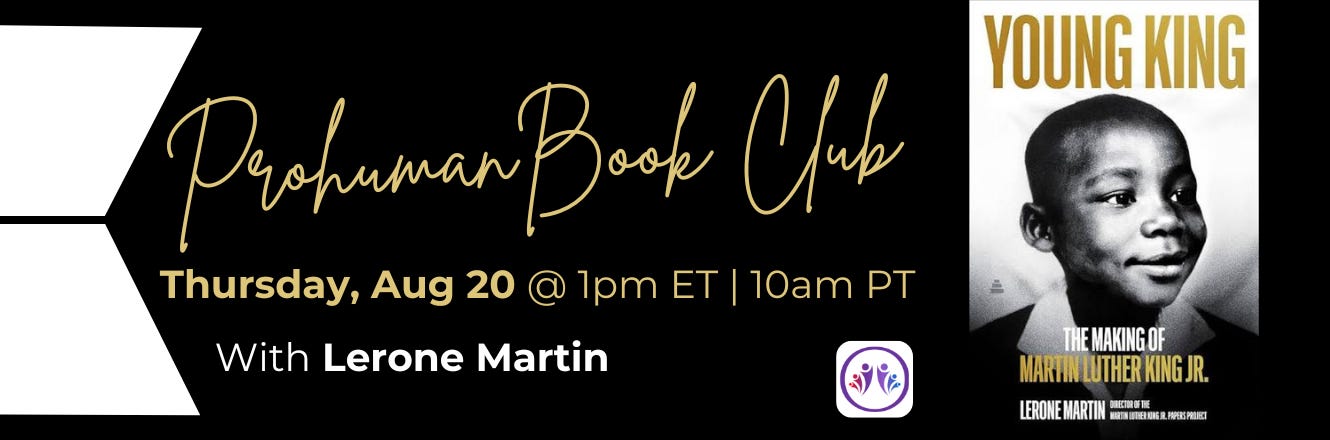
Join the Prohuman Book Club on August 20 for a conversation with Lerone Martin about his book, Young King: The Making of Martin Luther King Jr.
The book examines the formative experiences, faith, and principles that shaped Martin Luther King Jr.’s youth. We’ll explore how individual conscience and character develop, and the Prohuman Approach to cultivating shared humanity and the foundations of constructive civic leadership.

Join Us: Launch Event & Fundraiser
August 28, 2026, 6pm EDT
National Press Club, Washington, D.C.
You are invited to the National Press Club for cocktails, dinner, fundraising, and a performance by the legendary Daryl Davis in support of Renewing the Dream.
Learn more about our goal to restore the MLK marker and advance a culture of brotherhood over division:
Learn about Renewing the Dream
Opinions expressed by guest authors do not necessarily reflect those of the Prohuman Foundation. We value diverse perspectives and invite submissions from those who can enrich our understanding of topics close to our mission: to promote the foundational truth that we are all unique individuals, united by our shared humanity.
No posts
Comments
Nothing yet. Say the first thing.
Sign in to join the conversation.