
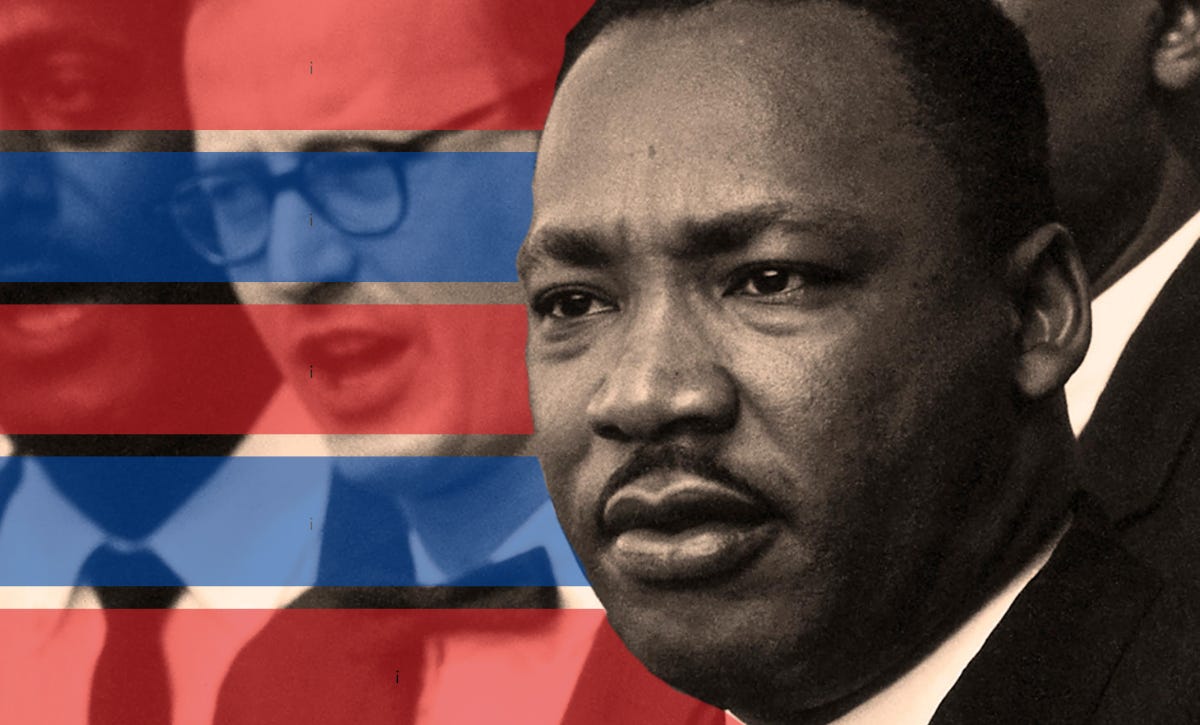
Editor’s Note: Tomorrow, Friday, August 28, the Prohuman Foundation gathers with esteemed guests, advisors, and supporters at the National Press Club in Washington, D.C. to launch Renewing the Dream: a campaign to revitalize MLK’s stone inscription at the Lincoln Memorial and to renew his dream of brotherhood. Reflecting on how Dr. King’s speech shaped his six-decade career in peacebuilding, Prohuman Foundation advisor Chip Hauss writes here about why Dr. King’s moral standard belongs to no single political party, and why honoring it today means refusing to write off our fellow citizens.
Join Us at the National Press Club
Phrases like “Dr. King’s legacy lives on” often have a hollow ring to them. Politicians and celebrities utter them but, in fact, don’t do much to give life to the values that changed American history in my youth, and could do so again—if and only if we stopped treating them mostly as platitudes.
I know that because Dr. King’s vision has been at the heart of everything I have done since I was in high school.
For me, Martin Luther King Jr.’s message was never an abstract political theory. In August 1963, I desperately wanted to go to the March on Washington, but my parents wouldn’t let me because they worried that it might be too dangerous. I ended up listening to the speech on a transistor radio while at tennis practice instead.
His words blew me away, especially the line about how a person’s character mattered more than the color of their skin.
That simple, profound idea became the foundation of my sixty-year career teaching and writing about peacebuilding and large-scale social change while also building movements that could turn King’s dream and related ideas into reality. What made King’s vision so revolutionary was its radical, universal humanism. Judging people by their character rather than their group identity demands that we treat every individual with intrinsic dignity. It asks us to look past our superficial differences to see the human being standing in front of us.
Yet somewhere along the way, our culture lost sight of how demanding that standard truly is. Today, public life is dominated by polarization and institutional distrust. We sort people into ideological camps before we ever bother to learn who they are. When we reduce human beings to their political labels or demographic categories, we abandon the very heart of King’s dream.
Honoring his legacy today requires more than celebrating past victories; it demands a fundamental shift in how we treat those with whom we disagree. True nonviolence is not passive agreement, nor is it a moral club to beat over the heads of our political opponents. It is a rigorous discipline of civic engagement. It requires us to stand firmly for fairness while simultaneously refusing to demonize those on the other side of an issue.
If we genuinely want to build a functional society, we cannot write off half our fellow citizens as irredeemable. Dr. King understood that a just nation must make room for everyone—including those who opposed him, vilified him, and ultimately took his life. He refused to let bitterness dictate his response, choosing instead the hard, uncomfortable work of persuasion and reconciliation.
That challenge is more urgent now than ever. As Archbishop Desmond Tutu famously observed, “If you want peace, you don’t talk to your friends. You talk to your enemies.” Real peacebuilding begins when we step outside our comfortable ideological bubbles and choose respectful engagement over self-righteous isolation.
King’s dream was never meant to be owned by one political party or movement. It is a shared moral standard. If we want his legacy to be more than a yearly ritual, we must choose character over color, empathy over contempt, and human connection over political warfare.
Charles “Chip” Hauss is a Senior Fellow for Innovation at the Alliance for Peacebuilding and an advisor to the Prohuman Foundation, dedicated to bridging political divides through nonviolent, cooperative change. The author of nineteen books on peacebuilding and politics, he focuses his work on intersectional social change and peacebuilding initiatives in the United States.
Opinions expressed by guest authors do not necessarily reflect those of the Prohuman Foundation. We value diverse perspectives and invite submissions from those who can enrich our understanding of topics close to our mission: to promote the foundational truth that we are all unique individuals, united by our shared humanity.

TOMORROW: Launch Event & Fundraiser
August 28, 2026, 6pm EDT
National Press Club, Washington, D.C.
You are invited to the National Press Club for cocktails, dinner, fundraising, and a performance by the legendary Daryl Davis in support of Renewing the Dream.
Learn more about our goal to restore the MLK marker and advance a culture of brotherhood over division:
No posts
Comments
Nothing yet. Say the first thing.
Sign in to join the conversation.