

Editor’s Note: This is the second in a series of original essays by Prohuman Foundation advisor Dr. Michael Tobin. Drawing on the collected wisdom of a lifetime and a moving story of loss, Dr. Tobin asks what remains after memories fade. It’s a timely reflection (June is Alzheimer’s and Brain Awareness Month) and a hopeful portrait of that which persists through presence and devotion.
A few days ago, a friend asked me whether I knew about a phenomenon called Terminal Lucidity. “Never heard of it,” I said.
“You’re not going to believe this. It’s like it’s straight out of that movie Awakenings.”
I had seen the film, so I knew what he meant. Long-term catatonic patients, silent for decades, were given L-DOPA and suddenly awakened—capable of movement, speech, emotional expression, and memory.
“It’s similar,” he said. “There are documented cases of Alzheimer’s patients regaining clarity shortly before death. They recognize loved ones and speak coherently, sometimes saying things that had gone unsaid for years.”
The idea unsettled me immediately. I read about it, dreamed about it, became obsessed with it, and discussed it endlessly with friends and family.
My wife, Deborah, diagnosed with Alzheimer’s in 2018, no longer speaks. There are occasional words, fragments that appear briefly and then vanish, but the multilayered conversations that once shaped our lives together are gone.
Alzheimer’s has taken away the wife I once knew.
Gone is the woman who moved effortlessly among five languages. Gone is the psychologist whose intuition often grasped the truth before my analytical mind did. Gone is the woman who could navigate a foreign city after seeing a map once. Gone is the meditator and yogi who approached every spiritual tradition with curiosity and seriousness.
But those are only accomplishments.
The Deborah I miss most revealed herself in small moments. There were so many Deborahs within her that I sometimes felt married to an entire cast of characters. One year, she would become absorbed in psychology; another, in spirituality; another, in architecture. One afternoon, she quietly set the renovation plans she had designed on our kitchen table.
“This is what our house will look like.”
A year later, the walls had shifted, rooms had appeared, and we were living inside a house she had imagined before the rest of us could see it.
She was also the woman who once caught me standing in front of a mirror, sucking in my stomach, and who said without hesitation:
“Who are you kidding? You’re fat.” That was Deborah.
She challenged me, argued with me, laughed with me, and often understood me better than I understood myself.
A few years ago, our son completed negotiations for a building project he had spent months pursuing. Contracts were signed. The deal was done. As he drove away, he pulled over and began to cry.
Later, he told me why.
“When everyone thought I was a terrible student and no one believed in me,” he said, “Mom did. She always told me, ‘Don’t worry. You’re going to do something important. Just remember I believe in you.’”
At that moment, decades later, he heard that voice.
That was Deborah. Not the degrees. Not the languages. Not the accomplishments.
The unwavering conviction that another person could become more than they believed themselves capable of being.
That woman no longer exists. And yet something remains.
Each morning before heading to her day program, she kisses and hugs me goodbye. When she returns home, she does the same. Before bed, another embrace, another kiss. Sometimes she sits beside me in silence as I hold her hand. Occasionally, we look into each other’s eyes for a long moment, and something passes between us that I cannot fully explain.
I don’t know what she experiences in those moments. I don’t know whether the depth I feel is truly mutual or merely my longing reflected back at me. Yet it feels real.
When I first heard about terminal lucidity, my mind immediately drifted to a fantasy I suspect many caregivers share: What would she say to me if, for one final moment, she returned completely? What would I say to her? Which version of Deborah would appear?
The questions came quickly.
Would we finally speak honestly about what we had avoided for years? Would we apologize for old wounds? Would we finally grant each other the understanding that somehow never arrived at the right time? Would there be closure?
But another possibility slowly entered my mind as well, one far less comforting. What if terminal lucidity is not the mutual reconciliation we imagine? What if it is only a brief monologue from the person who is disappearing? What if, for a few moments, the person returns fully to themselves, only to vanish again almost immediately afterward?
There is something both miraculous and cruel about that possibility. We are given a glimpse of what has been lost, and then the glimpse vanishes.
As these thoughts unfolded, I realized how much of my longing was tied not only to losing Deborah but also to losing the possibility of answers.
In long marriages, some things remain unfinished. Certain disappointments are softened but never fully explored. Certain needs go unnamed. Then illness arrives, and the possibility of revisiting those places begins to fade.
Psychologists call this ambiguous grief: the person is still physically present yet psychologically altered in ways that create an ongoing experience of loss without finality. The person you love is both here and not here at the same time.
Alongside grief, there can be emotions even harder to admit. If Deborah were to return fully, even for only a few moments, would I feel joy alone? Or would there also be rage? Would some part of me think: You came back only long enough to remind us what we lost? Even writing those words fills me with guilt.
But caregiving often involves emotions that resist simple categories. Love, exhaustion, tenderness, resentment, devotion, loneliness, gratitude, and grief can coexist in the same moment.
I ask myself whether my fascination with terminal lucidity is partly a refusal to accept the relationship that now exists between us. Perhaps I still long for words because they were once one of the primary ways we knew each other.
Language mattered deeply to us. It was my use of words that first drew Deborah to me. She loved my imagination, my intensity, and my ability to shape experience through language.
But Deborah moved through the world differently. She was less interested in speaking than in listening, less drawn to analysis than to stillness. She communicated through silence and a deep nonverbal presence.
I sometimes joked that I wasn’t afraid of losing her to another man. I was afraid of losing her to a cave in India, where she would drink tea, eat a little rice, meditate all day, and disappear into silence. Perhaps, in some strange way, we are now living inside a version of that silence together.
I keep thinking about something that happened recently.
One evening, I sat with Deborah and showed her photographs from the bicycle trip we took together decades earlier.
There we were in Brussels, sitting on a narrow hotel bed, studying a map she would memorize after a single glance. Her long black hair spilled across my shoulder as we argued cheerfully about where to go first.
In another photograph, we stood beside our bicycles in Provence, with a field of sunflowers stretching behind us and the French Alps faint in the distance. We were sunburned, exhausted, and impossibly happy.
In a third, we stood on the balcony of the Bedford Hotel in Beirut. We were about to meet her Lebanese family for the first time. We smiled for the camera, concealing our fear as distant gunfire and tracer rounds reminded us of the nearest shelter.
The photographs captured places. What they really captured were two people becoming themselves. Deborah looked at the photographs in silence. I searched her face for some sign of recognition—a smile, a flicker, a trace of memory—but found nothing I could confidently name.
That night, while asleep, she spoke.
“Picture.”
A pause.
“A couple.”
Three simple words. Not a conversation. Not a resurrection. Not a final revelation. Yet those words moved through me with extraordinary force.
They suggested that somewhere beneath the silence, beneath the disappearance of memory and narrative, something remained connected to us, to our shared life, and to the emotional reality of who we had been together.
I don’t know whether terminal lucidity will ever come to Deborah. I don’t know whether there will be a final conversation, a final reconciliation, or a final chance to ask the questions that remain unanswered.
Perhaps there will be. Perhaps there won’t.
What I do know is that every morning she kisses me goodbye. Every afternoon, she kisses me hello. Before bed, she still reaches for me. And when she looks into my eyes, I don’t feel emptiness. I feel presence. Not the presence I once knew. Not the Deborah who challenged me, debated me, and shared my life through words. But a quieter presence that keeps resisting disappearance.
Perhaps that is why terminal lucidity affects me so deeply. I long for proof that the person I love still exists beneath the silence.
But I am beginning to suspect that, in ways I do not fully understand, Deborah has been showing it all along.
Subscribe for free to receive new posts and support the Prohuman Foundation.
Dr. Michael Tobin has spent more than fifty years listening to people’s stories and just as long trying to understand his own. A clinical psychologist, award-winning author, and Prohuman Foundation advisor, he began writing at twelve with a three-act play about the Warsaw Ghetto—a child’s attempt to grasp courage and loss. His memoir, Riding the Edge, A Love Song to Deborah, won the Silver Prize in the Nonfiction Book Awards; his novel The Veil earned third place in the BookLife Prize; and his essays have received awards from The Free Press and Letter Review.
His latest novel, Resonance, co-authored with Daniel Chertoff, will be published in October 2026. He writes, he says, “to create characters who live at the edge of brokenness and beauty.”
To learn more about Dr. Michael Tobin and his writing, visit his website. For a deeper look at his forthcoming novel with co-author Daniel Chertoff, visit resonanceanovel.com.
Meet The Author
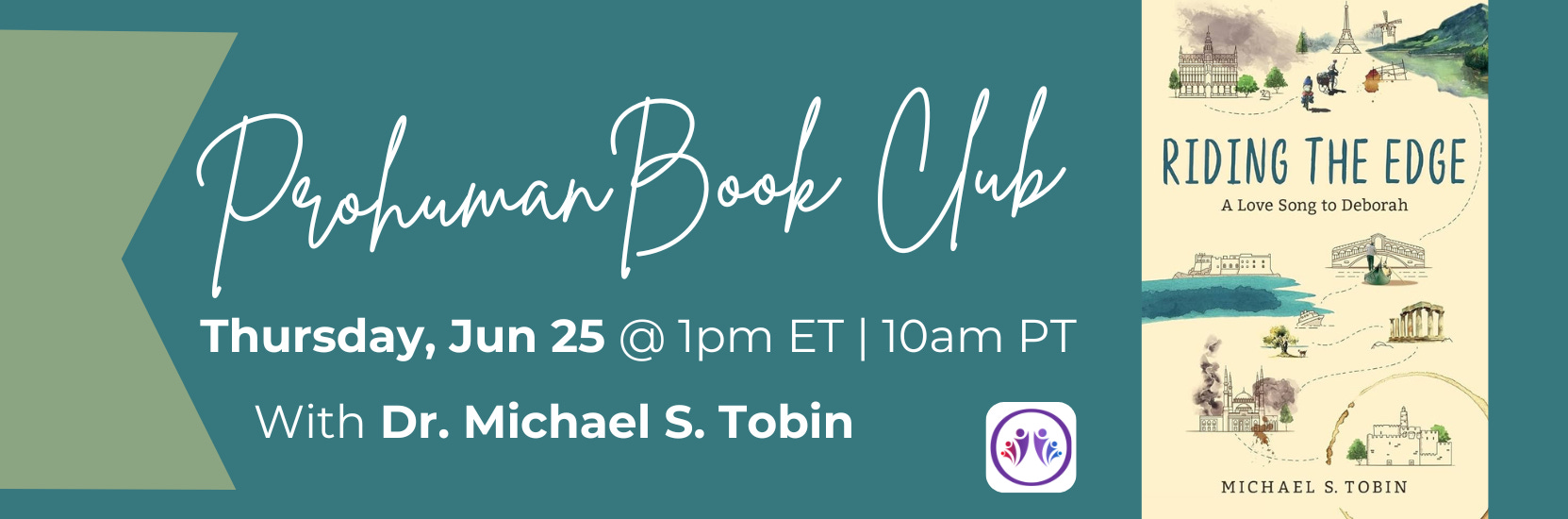
Dr. Tobin will join the Prohuman Book Club on Thursday, June 25 to discuss his book, Riding the Edge: A Love Song to Deborah. Join the club for more information and invitations to future events.
Opinions expressed by guest authors do not necessarily reflect those of the Prohuman Foundation. We value diverse perspectives and invite submissions from those who can enrich our understanding of topics close to our mission: to promote the foundational truth that we are all unique individuals, united by our shared humanity.
Comments
Nothing yet. Say the first thing.
Sign in to join the conversation.