
The case for animal universalism—that all sentient animals go to heaven—seems totally decisive.
Here is the basic argument for animal universalism: animal welfare is a good thing. It’s good for dogs and pigs to be happy. When a dog lies in the sun and feels happy, that is good. God is morally perfect (on the standard religious views which we’re considering). Thus, if God is choosing between capriciously snuffing out animals or giving them an eternity of bliss, he’d give them an eternity of bliss.
For a parallel case, imagine that a deer is dangling off a cliff. You can either:
Let it die.
Rescue it at no personal cost and take it to a farm where it will live forever in infinite sublime bliss.
Clearly the second option is better, and God saving animals is relevantly like it! God, in his infinite wisdom, can think of a better fate for animals than being wiped from existence. God, in his infinite goodness, would actualize this better state. Thus, all dogs, pigs, fish, and shrimp go to heaven. This is basically the argument that Dustin Crummett makes in his paper on the subject.
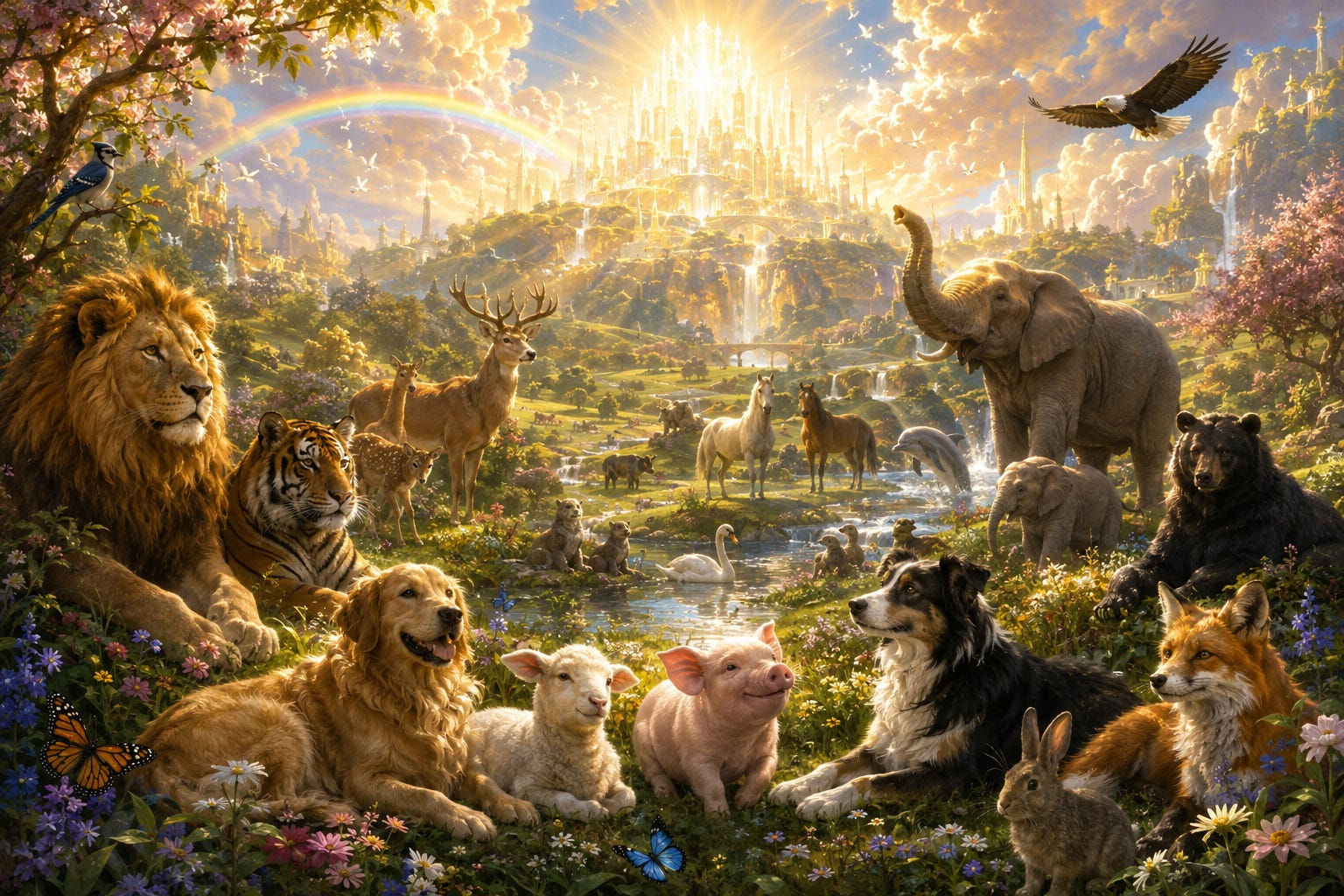
There are a few other arguments pointing in the same direction. For instance, if you think animals go to heaven, you have an easier time explaining why animals are permitted to suffer so much in this life. That is easier to explain if their pain and hardships are infinitely outweighed in the life to come. In addition, for those who take at least the Hebrew Bible seriously, there are passages like Isaiah 11:6 which are best explained by animal universalism:
The wolf will live with the lamb,
the leopard will lie down with the goat,
the calf and the lion and the yearling[a] together;
and a little child will lead them.
But the basic argument—it’s good for animals to be happy, so God would make them happy forever—strikes me as by far the most decisive. It’s enough to settle the debate. The standard arguments for humans going to hell don’t apply to animals. Pigs and sheep can’t understand right and wrong, and thus they cannot deserve to suffer. Nor can they repeatedly culpably sin or lock the gates of hell from the inside. I am thus a lot more confident that all dogs go to heaven than that all people do—and I’m pretty confident that all people do.
So what are the arguments against animal universalism, aside from prejudice against anything that sounds vaguely liberal?
I decided to watch Brian Besong’s opening statement in his debate with Alexander Pruss on the subject to hear his argument. I didn’t find any of his arguments at all convincing.
His first argument is that heaven consists of receiving the beatific vision—a direct encounter with God. But animals, lacking rationality, couldn’t receive the beatific vision. Thus, they can’t go to heaven.
Each step of this seems very dubious. Why think that rationality is required for the beatific vision? Why think that God couldn’t equip animals with whichever faculties are needed to allow them to receive the beatific vision? Humans are, in this life, wildly psychologically defective—if God can equip us to receive the beatific vision, why can’t he do that for animals? In addition, even if animals can’t receive the beatific vision, they can still receive eternal reward in the afterlife. Perhaps this wouldn’t technically count as heaven on the Catholic view, but it still means animals would have an eternal postmortem paradise.
Besong’s second argument is that one needs to cooperate with Christ to go to heaven. One can only go to heaven, on his view, if one merits entrance into heaven. We merit entrance into heaven by cooperating with Jesus. But animals can’t deserve anything, so they can’t get into heaven.
Again, it’s not clear why God can’t equip animals with whichever faculties are needed to make morally significant decisions in the next life. Presumably he could slowly increase the intellectual abilities of animals until they were capable of making consequential moral decisions. So why wouldn’t he?
In addition, the inference from “humans need to merit heaven,” to “animals need to merit heaven,” is very dubious. Humans are capable of deserving things. Animals are not. So while it makes sense that humans wouldn’t be able to go to heaven unless they deserve it, it makes a lot less sense for animals.
Lastly, even if animals don’t deserve the beatific vision, they still presumably either deserve other reward or don’t need to deserve reward for it to be good to bestow it on them. Nobody thinks it’s wrong to give dogs belly rubs on grounds that they’re undeserved. Why not an eternity of belly rubs?
Besong then argues against the idea that animals could have an eternity of happy life on grounds that animal happiness depends on bodily processes like eating. However, if they were eating, they’d be hungry, and if they were hungry, there would be variations in their blessedness. He then questions whether they would defecate and expresses incredulity that heaven would contain defecation.
This seems like a totally bizarre chain of inferences. First of all, animals could be happy without eating. God is infinitely powerful and smart. You think he can’t think of a way to make animals happy forever without needing them to eat food? God designed the psychophysical laws and all the physical facts about animals. Heck, I can think of a way to have animals be happy forever without eating (just make them naturally happy)—and God is infinity times smarter than me.
Second, to eat, they wouldn’t need to get hungry. They could just be motivated to act without feeling hunger pains. Third, even if there were variations in their blessedness, why in the world would that be so decisively bad as to make it not worth giving them eternal afterlives? Fourth, God in his omnipotence and infinite wisdom could dispose of waste without needing animals to poop (say, by spontaneously causing food to disappear once it enters their stomach). Fifth, even if they did have to poop, God could obviously clean up their poop by miracle.
These arguments outrageously underestimate God’s ability. Remember, we’re talking about the Lord of the universe here. He’s not going to be stymied by engineering challenges.
Besong then suggests, “it would be strange to think that in the heavenly landscape you’ve got dogs copulating off behind a tree.” The responses to the point about hunger apply here as well. God can make dogs happy without needing them to copulate. But in any case, is the fact that Brian Besong personally finds dogs copulating to be strange a good reason to think that God would capriciously snuff them out instead of allowing them to be happy forever? Maybe the copulating dogs could be off in their own separate area.
He also then worries that if dogs in heaven were copulating all the time, there would be “exponentially large” numbers of animals. Surely God can think of a way to prevent dog sex from leading to reproduction! In any case, if dogs being in heaven is good, why would the number increasing be bad?
Besong then argues that if dogs were made happy all the time, a bit like a drug overdose, that would be a “placation” of an animal’s nature, not a fulfillment of it. But surely it is possible for God to work out some pleasures that neither have whatever objectionable features are present in drug overdoses, nor required the various Fs: fighting, fleeing, feeding, and reproduction. Animals could enter states akin to those reached during deep meditation, appreciate the beauty of nature, feel deep joy and gratitude, or be given the ability to grasp deep intellectual truths. They could enjoy one another’s company.
Another argument that people sometimes give against animals going to heaven is that they have “animative souls.” These kinds of souls apparently can’t grasp universals or persist after the death of the body. Now, I am very dubious about this metaphysical view. It isn’t at all clear what the connection is supposed to be between the diminished rationality of animals’ nature and their inability to survive bodily death.
But even if there was such a connection, God could simply teleport animals away from harm whenever they were about to die. He could replace them with physical duplicates of their corpse and allow the animal to live forever in paradise. That seems better. Now, obviously this would be a bit weird, but if doing something weird is the only way God can prevent dogs, cows, and pigs from being wiped permanently from existence, then he would.
Up until now, almost every sentient being who has ever lived has died a horribly painful death after just a short period of time. If you think God wouldn’t rectify that situation, despite being able to do so, to an infinite degree, at no cost, I think you have badly underestimated either his ingenuity or his goodness.
No posts
Comments
Nothing yet. Say the first thing.
Sign in to join the conversation.