
Before I tell you about the gun, I need to tell you about the man.
By the time someone becomes “the one with the gun,” everyone has already stopped seeing everything that came before.
The missing sleep.
The quiet desperation.
The pieces of a life slowly coming apart.
That day taught me something I’ve never forgotten.
Every crisis starts as a person.
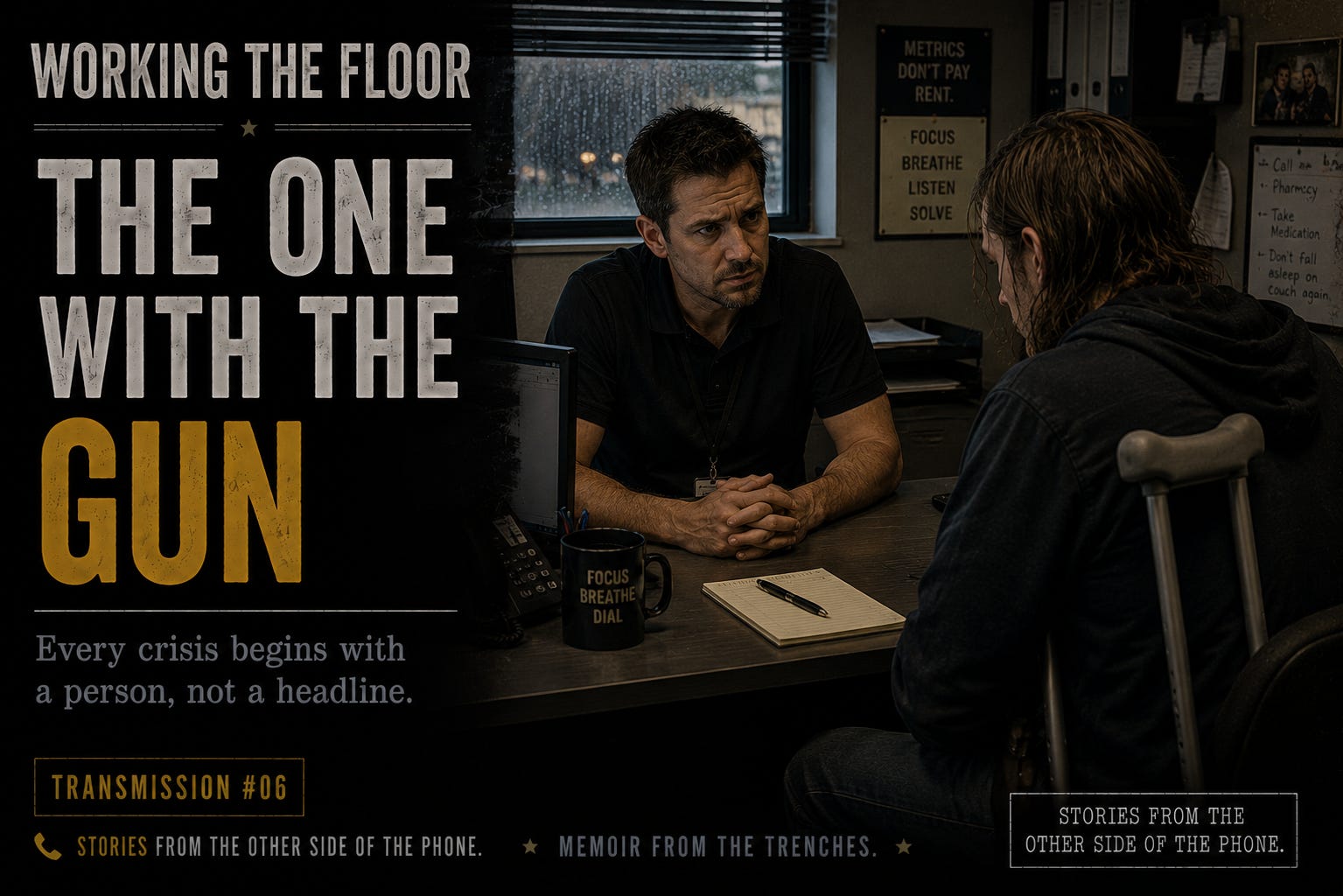
**Names, locations, institutions, and identifying details have been changed or fictionalized to protect privacy. Some characters may be composites. These pieces are creative nonfiction based on lived experience, memory, and reflection.**

The One With the Gun
I don’t remember his name.
White kid. Early twenties. Came in quiet. Stayed quiet. Said thank you when he logged off. You wouldn’t have thought much of him if you passed him in the hallway. Just another headset wearing down another neck.
He had a leg missing—wore his pant leg pinned up, prosthetic never quite right. I heard rumors he’d lost it in a train accident. Some said he passed out drunk on the tracks. Others said it was pills. Didn’t matter. Whatever happened, it stayed with him.
He was always just off. You could feel it if you paid attention.
One day, one of my collectors walks over to my desk—nervous, jittery.
“I think he’s got a gun in his desk,” she says.
I froze.
Now, let me be clear—I wasn’t trained for this shit. I wasn’t a cop. Wasn’t security. I’d done six months in the Marines decades ago, but what the hell was that gonna do for me now? I wasn’t built for crisis.
Except… I kinda was.
ADHD kicks in like a damn survival mechanism when the pressure spikes. I didn’t even think. I just moved.
I called him into my office.
Tried to keep it light. Casual. Talked to him like nothing was wrong. Meanwhile, I had one of my supervisors slip over to check his desk. A quiet sweep. They walked by and gave me a little shake of the head: nothing there.
I relaxed—barely.
Then I asked.
“You carrying anything?”
He didn’t flinch. Just nodded.
And then he did the thing I still see in my head—he reached down and patted his pinned-up pant leg.
That leg. The one with nothing inside it.
That’s where it was.
At that moment, I thought, Well shit, I’m about to get shot in a call center.
But I didn’t panic. I didn’t confront. I didn’t mention the gun again.
I looked at him—really looked. He was high. I mean high. That pale, sweaty look you only get when the opioids are slipping out of your bloodstream and your body is begging for more. He looked wrecked. Like he hadn’t slept in days. Like maybe the gun wasn’t for me.
So I said the only thing I could think of.
“You hurting?”
He nodded again.
“You’re not okay, man. You need to go home. Get some sleep. Clean up. Come back tomorrow.”
He didn’t push back. Just nodded one last time and walked out.
I told security to pull his badge. Said if he came back in that day, it was a hard no. And I sat back down in my chair, heart pounding, wondering what the hell just happened.
He never came back.
And I never saw his name again.
I don’t know where he ended up. Rehab. Street. Graveyard. Could’ve gone any direction.
I didn’t save him. But I didn’t provoke him either. I just gave him an off-ramp when he needed one.
And some days, that’s all you can do.
Sometimes the hardest thing to disarm isn’t the weapon.
It’s the hopelessness holding it.

Working in collections meant seeing people on some of the worst days of their lives.
Most stories ended with a payment.
Some ended with a lesson.
A few stayed with me because they reminded me that every headline begins with a human being whose story nobody bothered to ask about.
Working the Floor is an ongoing Bent But True memoir series about collections, survival, burnout, dark humor, and the unforgettable people who shared the floor.
Subscribe for future transmissions from the floor.
Comments
Nothing yet. Say the first thing.
Sign in to join the conversation.