
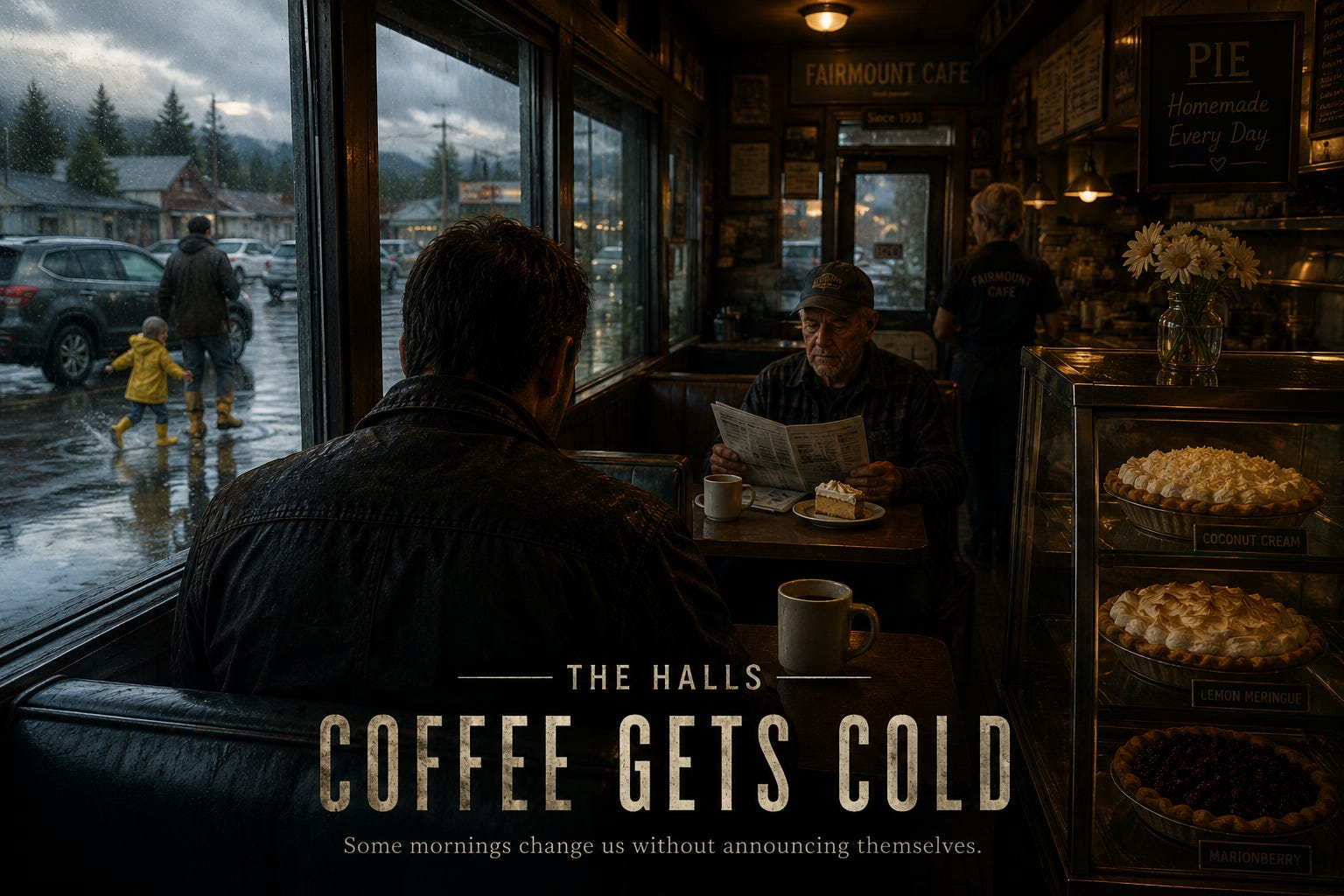
Some places stay with us long after we’ve forgotten what we ordered there.
Maybe it’s the way the light came through the windows. The sound of familiar voices drifting across the room. Or the comfort of knowing that, for a little while, the world expected nothing from us except to sit down and stay awhile.
Sometimes healing doesn’t happen in extraordinary places.
Sometimes it begins over a cup of coffee that’s allowed to grow cold.

Coffee Gets Cold
Daniel almost missed the Fairmount Café.
The sign stood only a few yards off Highway 101, its faded red lettering softened by decades of Peninsula rain until it looked less like a business trying to catch your eye and more like an old friend content to wave as you drove past. He caught it in his rearview mirror just as the entrance disappeared behind him.
For another hundred yards he kept driving.
There wasn’t any reason to stop. He wasn’t especially hungry. The coffee in the travel mug sitting beside him was still warm enough to drink, and home was less than twenty minutes away.
Then again, there wasn’t any reason not to stop.
He eased onto the shoulder, waited for a pickup pulling a fishing boat to rumble past, and circled back.
The parking lot was nearly full.
A white contractor’s truck leaned comfortably across two spaces as though everyone had quietly agreed years ago that was simply where it belonged. Beside it rested an aging Subaru carrying enough dried mud around the wheel wells to suggest pavement was merely something tolerated between forest roads. Beneath a broad cedar, a faded blue Ford pickup sat with yesterday’s newspaper folded neatly across the dashboard beside a cracked Mariners coffee mug.
The truck looked as though it had been there forever.
So did the café.
Places like this had become surprisingly rare.
Every town seemed determined to reinvent itself. Restaurants opened with reclaimed wood walls, clever names painted in perfect script, menus designed to photograph better than they tasted. They lasted a season or two before becoming something else.
The Fairmount had somehow escaped all of that.
It hadn’t tried to become memorable.
It had simply remained.
Daniel shut off the truck but left his hands resting on the steering wheel.
Rain had passed through before dawn. Water still slipped from the cedar branches one patient drop at a time, tapping softly against the hood. Somewhere beyond the parking lot a raven called into the gray morning, paused as though expecting an answer, then called again anyway.
He smiled.
Some things understood that silence wasn’t the same as being alone.
The cool air carried the smell of wet cedar until it gave way to something warmer drifting through the café’s front door.
Fresh coffee.
Butter melting on a hot grill.
Bacon.
Toast.
Underneath it all came the unmistakable scent of cinnamon rolls cooling somewhere beyond the kitchen.
The brass bell above the entrance greeted him with a quiet chime.
For the briefest moment, Daniel had the odd feeling he’d walked through that doorway before.
Not yesterday.
Not last week.
Just…
before.
The feeling disappeared as quickly as it arrived.
Inside, the Fairmount was comfortably awake.
The breakfast rush had already passed, leaving behind that easy stretch of morning when nobody seemed anxious for another table. Sunlight filtered through broad windows overlooking Highway 101, softened by low clouds until everything inside the diner glowed silver instead of bright. Ceiling fans turned lazily overhead. Somewhere behind the pass window a spatula scraped across the grill, followed by laughter that drifted into the dining room before dissolving among the clink of silverware and quiet conversation.
Near the register sat a glass pie case beneath a handwritten sign.
PIE
Nothing more.
Inside waited coconut cream, marionberry, apple, and lemon meringue. The whipped cream on the coconut leaned ever so slightly to one side, and one slice of apple had already disappeared.
Daniel hoped whoever baked them never learned to make them look perfect.
Perfect pies belonged in magazines.
These belonged here.
“Morning, honey.”
The waitress looked up from wiping syrup bottles.
Her gray hair was pulled back without much concern for appearances. Reading glasses hung from a beaded chain around her neck. She moved through the room with the confidence of someone who knew where every regular sat before they opened the door.
“Morning.”
“Sit wherever you’d like. Coffee’s fresh.”
Daniel thanked her but lingered a moment before choosing a booth.
Three roofers occupied a table near the windows, debating whether one man’s aching knee predicted rain better than the weather report. At the counter, a nurse in blue scrubs cradled a mug with both hands while staring absently toward the highway, her eggs growing steadily colder beside her. An older couple shared both a crossword puzzle and one pair of reading glasses, passing them back and forth with the quiet efficiency of people who had long ago stopped keeping score.
Nobody looked rushed.
Nobody seemed eager to leave.
It struck Daniel that people didn’t simply come here to eat.
They came here to continue their lives for a little while before returning to them.
He slid into a booth beside the window.
The vinyl sighed softly beneath his weight.
Outside, Highway 101 carried logging trucks, tourists, delivery vans, and commuters toward places that undoubtedly felt important this morning and ordinary by next week. Every few minutes someone slowed as though considering breakfast before continuing west.
The waitress returned carrying a heavy white mug and a laminated menu.
“I figured coffee was a safe place to start.”
“It usually is.”
She filled the mug nearly to the brim.
“You hungry?”
Daniel opened the menu.
He studied it for a moment, then found himself looking back toward the pie case.
“I was thinking pie.”
She smiled.
“That’s not breakfast.”
“It could be.”
“It usually is.”
He laughed.
“I’ll pretend to be responsible.”
“What’ll it be?”
“The two eggs, bacon, hash browns, wheat toast.”
She nodded, pencil already moving.
“And after that?”
He looked toward the pie again.
“Coconut.”
“I had a feeling.”
She tucked the pencil behind her ear.
“I’ll put your slice aside before somebody beats you to it.”
As she headed toward the kitchen she called over her shoulder.
“June! Two eggs over easy!”
A voice answered from somewhere behind the pass window.
“Already working on it!”
Daniel wrapped both hands around the mug.
The coffee was hot enough that he couldn’t drink it yet.
Across the room, an older man sat alone near the opposite window.
His newspaper lay folded beside his plate. A slice of coconut cream pie rested in front of him, looking as though he’d forgotten it existed. He reached for his coffee, lifted it halfway to his mouth, frowned almost imperceptibly, then set it back down again.
Only then did he notice Daniel watching.
He nodded toward the pie case.
“Coconut’s better.”
Daniel smiled.
“So I’ve been told.”
“Smart waitress.”
“I think she made the decision for me.”
“They usually know better than we do.”
The older man picked up his fork.
“Everybody comes in thinking they want the marionberry.”
Daniel glanced toward the display case.
“And they’re wrong?”
“They usually are.”
A logging truck rolled past outside, making the windows hum for just a second.
The crossword couple celebrated finally solving a clue.
One of the roofers insisted he’d been right all along.
Someone laughed in the kitchen.
The older man unfolded his newspaper again.
Daniel took his first sip of coffee.
It was exactly as good as it smelled.
Neither man seemed to feel any urgency to continue the conversation.
The morning was doing a perfectly good job of that on its own.
June appeared beside the booth with the coffee pot before either man noticed she’d crossed the room. She looked into the older man’s cup, shook her head with practiced disappointment, and poured fresh coffee over what remained of the old.
“You’ve done it again.”
He looked down as though the cup had surprised him.
“I guess I have.”
“You always do.” She smiled toward Daniel. “Twenty years I’ve been watching this. Every Thursday it’s the same. Orders coffee. Orders pie. Reads half the newspaper. Drinks about half the coffee.”
“I finish the pie.”
“Eventually.”
The room answered with quiet laughter. One of the roofers held up his mug before she even reached the table.
“You reading minds again, June?”
“Honey,” she said without breaking stride, “after thirty years in this place I don’t have to.”
Daniel watched her disappear into the kitchen just as another ticket appeared on the rail. Nobody seemed to wait to be noticed. Somehow they already had been.
The roofers finished breakfast a few minutes later. None of them asked for the check. Each left a few folded bills beneath the ketchup bottle, waved toward the kitchen, and wandered out the front door still arguing about salmon runs and weather reports. The crossword couple finally solved the last clue, folded the newspaper together, and left arm in arm. At the counter, the nurse looked at her watch, laughed to herself, shoveled two hurried bites of eggs into her mouth, and hurried out, still buttoning her jacket.
The room never became empty.
It simply made space for whoever came next.
The older man buttered another piece of toast before speaking again.
“You’re not from here.”
Daniel smiled. “I live here now.”
“That’s different.”
He spread the butter carefully, taking it all the way to the corners before setting the knife aside.
“I left when I was nineteen. Couldn’t wait to get away. Thought everything worth seeing was somewhere else.”
“What brought you back?”
“My wife.”
The answer carried the sort of smile that had been earned decades earlier.
“She wanted to see the Peninsula. I told her we’d spend a weekend.”
“And?”
“We forgot to leave.”
Daniel laughed.
“Happens to people around here.”
“So I’ve noticed.”
The older man looked toward the windows where a break in the clouds had begun pulling pale sunlight across the wet pavement.
“Funny thing is, I don’t think I fell in love with the mountains.”
“No?”
“I fell in love with having somewhere ordinary to belong.”
Daniel let that settle between them.
Outside, an older station wagon pulled into the parking lot. A woman climbed out carrying a bouquet of grocery-store daisies wrapped in brown paper. She walked inside, replaced the flowers already sitting in the little mason jar beside the register, hugged June without saying much of anything, accepted a cinnamon roll folded into wax paper, and disappeared back through the front door.
Daniel watched the whole exchange.
“Friend of hers?”
June overheard him while wiping the counter.
“Wednesday.”
“I’m sorry?”
“Every Wednesday for… I don’t know… fifteen years maybe.” She straightened the fresh flowers. “She brings these. I send her home with breakfast. Neither of us remembers exactly how it started.”
She shrugged as though some things didn’t need an origin story.
“They’d probably feel strange if they stopped.”
Daniel found himself smiling.
The older man followed his eyes toward the daisies.
“Places collect pieces of people.”
Daniel looked around the room.
The scratches in the tables.
The faded booths.
The pie case.
The flowers.
Even the old bell above the door had a different sound each time it rang.
“I think they do.”
“No.” The older man smiled gently. “I think people leave pieces of themselves behind. Places are just kind enough to hold onto them.”
Neither man spoke for a while.
The silence never felt awkward. It felt occupied.
Outside, a young father climbed out of an SUV parked beside the window. He walked around to the passenger side just as a little girl in bright yellow rain boots jumped down on her own. She landed squarely in a puddle left by the morning rain and laughed with her whole body.
Her father looked around with exaggerated disappointment, shook his head as though such behavior simply couldn’t be tolerated…
…then stepped into the puddle beside her.
The splash was bigger than hers.
She laughed even harder.
The older man’s smile arrived slowly.
“My boy would’ve loved that.”
He never looked away from the window.
“Every puddle was an invitation. His mother quit buying cheap shoes because she knew they’d be soaked before lunchtime.”
Daniel could picture it without trying.
“My daughter had a yellow raincoat.”
The words came so naturally he almost missed them himself.
The older man simply nodded.
For another minute neither of them spoke. June passed behind them carrying fresh coffee to another table. Someone in the kitchen dropped a spoon. A delivery driver stepped inside with two boxes of produce, set them beside the counter, accepted a slice of pie wrapped in foil, and headed back to his truck.
Life continued without asking either man if they were ready.
Daniel rested both hands around his mug.
“For a long time…” he said quietly, watching the steam rise between his fingers, “…every memory seemed to end in the same place.”
The older man didn’t interrupt.
“I remembered the hospital. The phone call. The funeral.” Daniel looked down into the coffee. “It got to where I couldn’t think about her without ending there.”
The older man rubbed a thumb across the handle of his mug.
“I know.”
His voice remained almost conversational.
“I was telling somebody a story about my son once. Nothing important. Just the time we spent an afternoon trying to hit squirrels with water balloons.”
A small laugh escaped him.
“The squirrels won.”
He looked out toward the parking lot again before finishing.
“I got halfway through the story and realized I couldn’t remember what his laugh sounded like.”
The sentence settled quietly into the room.
Nobody noticed except the two men sitting with cooling coffee between them.
Daniel closed his eyes for only a moment.
He wasn’t standing beside a hospital bed.
He wasn’t answering a telephone.
He wasn’t at a funeral.
He was sitting on the living room floor while his daughter laughed so hard she snorted, then buried her face in a pillow because she hated when she did that. He remembered teasing her until she laughed even harder.
When he opened his eyes, he found himself smiling into the coffee.
The older man noticed.
He smiled too.
Neither of them said anything.
They didn’t need to.
June wandered over with the check tucked beneath one arm.
“You boys solve the world yet?”
The older man looked up.
“No.”
She slipped the check beneath the sugar dispenser.
“That’s alright.”
Her eyes drifted around the room for just a second before coming back to them.
“Sometimes showing up is enough.”
She wandered away before either man answered.
The older man reached for his wallet.
Daniel rested a hand on the edge of the check.
“I’ve got breakfast.”
“You don’t have to.”
“I know.”
For a second the older man looked as though he might argue.
Instead, he nodded.
“Thank you.”
He stood slowly, folded his newspaper beneath one arm, settled his cap onto his head, and made his way toward the door.
The little bell chimed once.
Daniel watched the faded blue pickup pull out beneath the cedar tree and disappear west on Highway 101, becoming just another truck among the morning traffic.
He stayed where he was.
The notebook came out almost by habit. For months it had collected impossible things. Strange announcements. Rooms that shouldn’t exist. Names that seemed to belong somewhere just beyond memory.
He turned to a clean page.
For a long time he simply watched the steam rising from the last of his coffee.
Then he wrote four words.
She would’ve loved this.
He closed the notebook.
Outside, the puddles were already shrinking beneath the afternoon light.
Inside, the coffee had gone cold.
Daniel lifted the mug anyway.

Some losses never leave us.
They settle into the architecture of our lives. Into routines. Into habits. Into the quiet moments when nobody else is looking.
The goal isn’t forgetting.
The goal isn’t even understanding.
Sometimes the best we can do is learn the difference between carrying something and being carried by it.
Thank you for spending a little time in The Halls this week.
If this story resonated with you, I’d love to hear from you:
Have you ever reached a point where you realized you were finally ready to put something down?
As always, comments, shares, and restacks help more people find their way into The Halls.
The doors remain open.
Comments
Nothing yet. Say the first thing.
Sign in to join the conversation.