
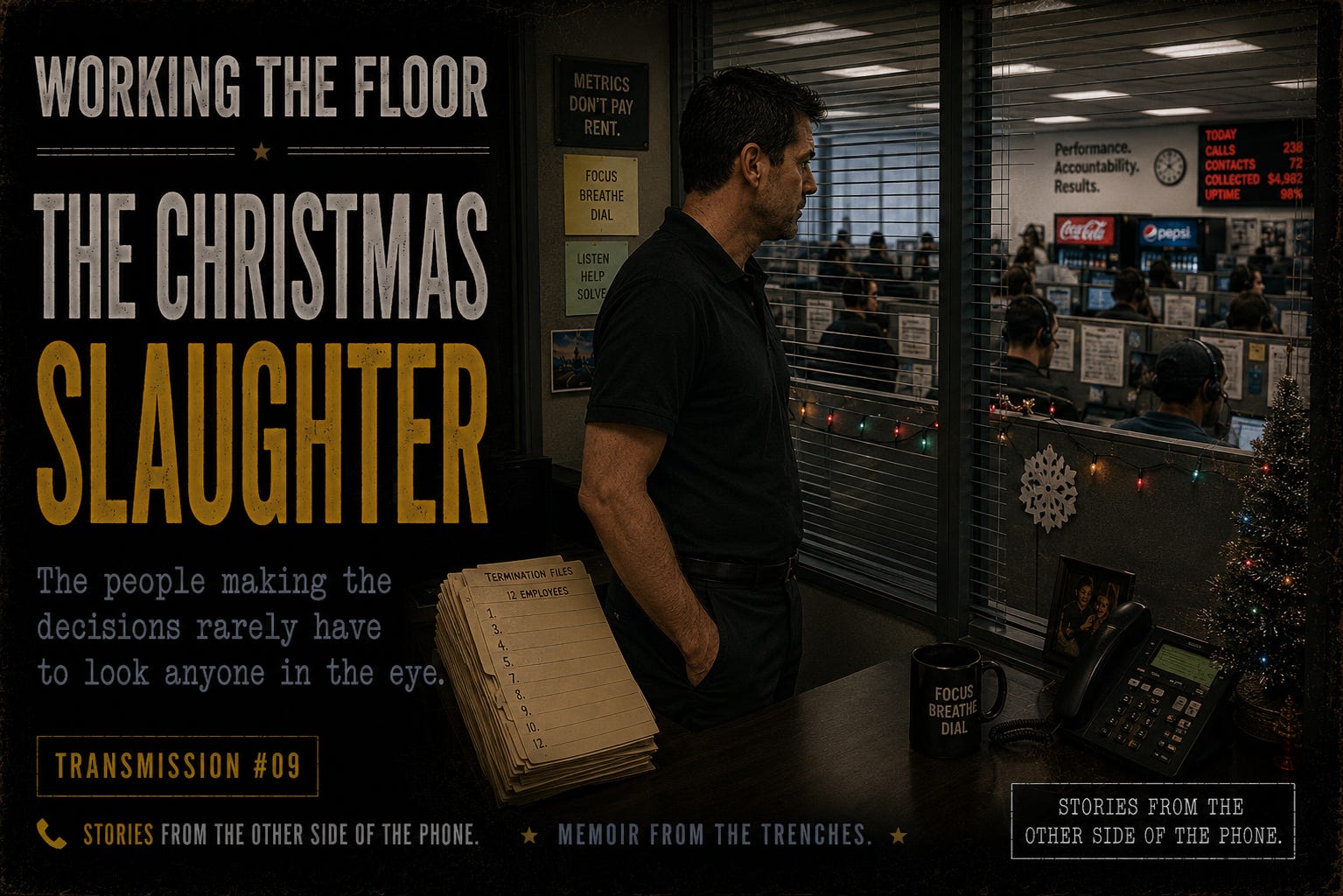
The week before Christmas, my boss handed me a list that didn’t exist yet.
Twelve people had to go.
He didn’t tell me who. That part belonged to me.
By then, I had become good at looking calm while everything underneath me burned. It was part of the job. Keep the bank happy. Keep the floor moving. Keep the chaos quiet.
That week, the mask stopped protecting me.
**Names, locations, institutions, and identifying details have been changed or fictionalized to protect privacy. Some characters may be composites. These pieces are creative nonfiction based on lived experience, memory, and reflection.**

I went from our main site to manage the bank project during its infancy—twenty collectors, give or take. This wasn’t some cushy transfer. It was an escalation. A gamble. We were a third-party vendor trying to scale faster than the bank was ready for—or maybe faster than they were willing to admit.
By December, we had thirty, maybe forty heads on that floor. I’m guessing. The numbers kept changing, and I wasn’t looped into the big-picture meetings. I wasn’t in the rooms where real decisions got made—especially not the ones about who was staying and who wasn’t.
My job was to execute the aftermath.
Keep the engine running.
Keep the bank happy.
Keep the chaos quiet.
But what most people didn’t see—and what I barely let myself feel—was how much of that job relied on the mask I wore every single day.
Thanks to ADHD and a childhood that taught me survival over self, I became a high-level masker. The calm manager. The one who always had the answer, always knew the script. Steady hands. Steady face. Even when everything underneath was fire.
And that mask?
It worked. Until the week before Christmas.
That’s when my boss came to me—calm, casual, surgical—and dropped the order:
We needed to cut about a dozen people.
No warning. No prep. No conversation about who or why. Just: “Make it happen.”
These weren’t slackers. These weren’t write-ups waiting to happen. These were working-class people trying to make rent. Some rough around the edges, sure. Some not great at metrics—especially the ones who’d never been trained to chase them in the first place. But they showed up. They hustled. They held that floor together in the only way they knew how.
And now I had to look across forty faces and decide which twelve didn’t get to come back after today.
A week before Christmas.
I kept the face on. Smiled where I had to. Nodded, shook hands, gave the company line.
But inside?
That day broke something.
My boss never stopped riding me about metrics—especially once the bank started breathing down his neck. It didn’t matter that our people had never been held accountable to those numbers before. It didn’t matter that people like Dre were just starting to get their footing. Dre made it, eventually. Became a supervisor. Fought for that spot. Earned it. But at the time? He was on the bubble like everybody else.
And me?
I became the guy.
Hatchet man.
Over the next eight months, I fired more than 60 collectors.
Sixty.
And I wore it like armor. Like a badge. I leaned into the image because if I didn’t? I might’ve cracked in half. I let people think I liked it. That I was built for it.
But the truth?
Each one tore something out of me.
I try not to think about the individuals. Not because they didn’t matter. But because too many of them did.
Too many faces of good people, coming in one day and being told:
“The bank has asked us to cut staff—and unfortunately, you’ve been chosen.”
Like it was a lottery. Like there wasn’t a whole system stacked against them before they even sat down.
There was no time for conversations. No explanation that would’ve made it okay. Just: get in, get out, move on to the next. Survivors went back to their desks. Cut ones walked out without a fight.
And I had to keep going.
Every day.
Smile still painted on.
Unless someone made a deep impact—like Dre—I’ve forced myself not to remember the names.
Because if I did? If I let myself carry them?
I wouldn’t have made it out either.
I didn’t save anybody that day.
I just made the cuts and kept the mask on.
And that’s what they remember.
The ones who walked out remember me.
Not the bank.
Not the system.
Me.
The bank made the decision.
I became the memory.

For years, I let people believe I was built for that work.
It was easier than explaining what it cost.
The people I fired never met the executives who wanted the numbers lowered. They never sat in the meetings where someone decided the floor had become too expensive. They sat across from me.
I gave them the company line. I shook their hands. Then I watched them leave.
Somewhere along the way, the mask became part of my face.
Working the Floor is an ongoing Bent But True memoir series about collections, survival, dark humor, and the people forced to carry decisions made somewhere above them.
No posts
Comments
Nothing yet. Say the first thing.
Sign in to join the conversation.