
There are essays you write because you have something to say, and then there are essays you write because you’re finally tired of staying silent. This is the second kind.
The Accommodations You Can’t See
I’ve opened this document more times than I care to admit.
Not because I didn’t know what I wanted to say. That part came surprisingly easy. The problem was deciding whether I wanted to live with whatever happened after I said it.
Some essays make you wonder whether people will agree with you.
This one makes you wonder whether they’ll still see you the same way.
For months I’ve carried this around, always finding another reason to wait. Maybe people aren’t ready for this conversation. Maybe I should leave well enough alone. Maybe the work should simply speak for itself.
The funny thing is, this isn’t really a secret.
I’ve talked openly about using artificial intelligence in interviews. It’s mentioned in my bio. I’ve never hidden it. But I’ve learned something about readers over the last year. Most people don’t read your bio. Most people don’t watch interviews from months ago. They meet you through a single essay, enjoy it or don’t, and then move on with their lives.
So every time someone compliments something I’ve written, a familiar thought quietly wanders into the room.
They probably don’t know.
The truth is, they probably do.
Or at least they could.
The voice doesn’t care.
For most of my life, I thought I was lazy.
Not lazy enough to stop dreaming. Just lazy enough to wonder why everything seemed harder for me than it appeared to be for everyone else. I had notebooks full of ideas, folders full of unfinished stories, outlines that never became essays, and titles that waited patiently for words that never arrived.
I wasn’t running out of ideas.
I was drowning in them.
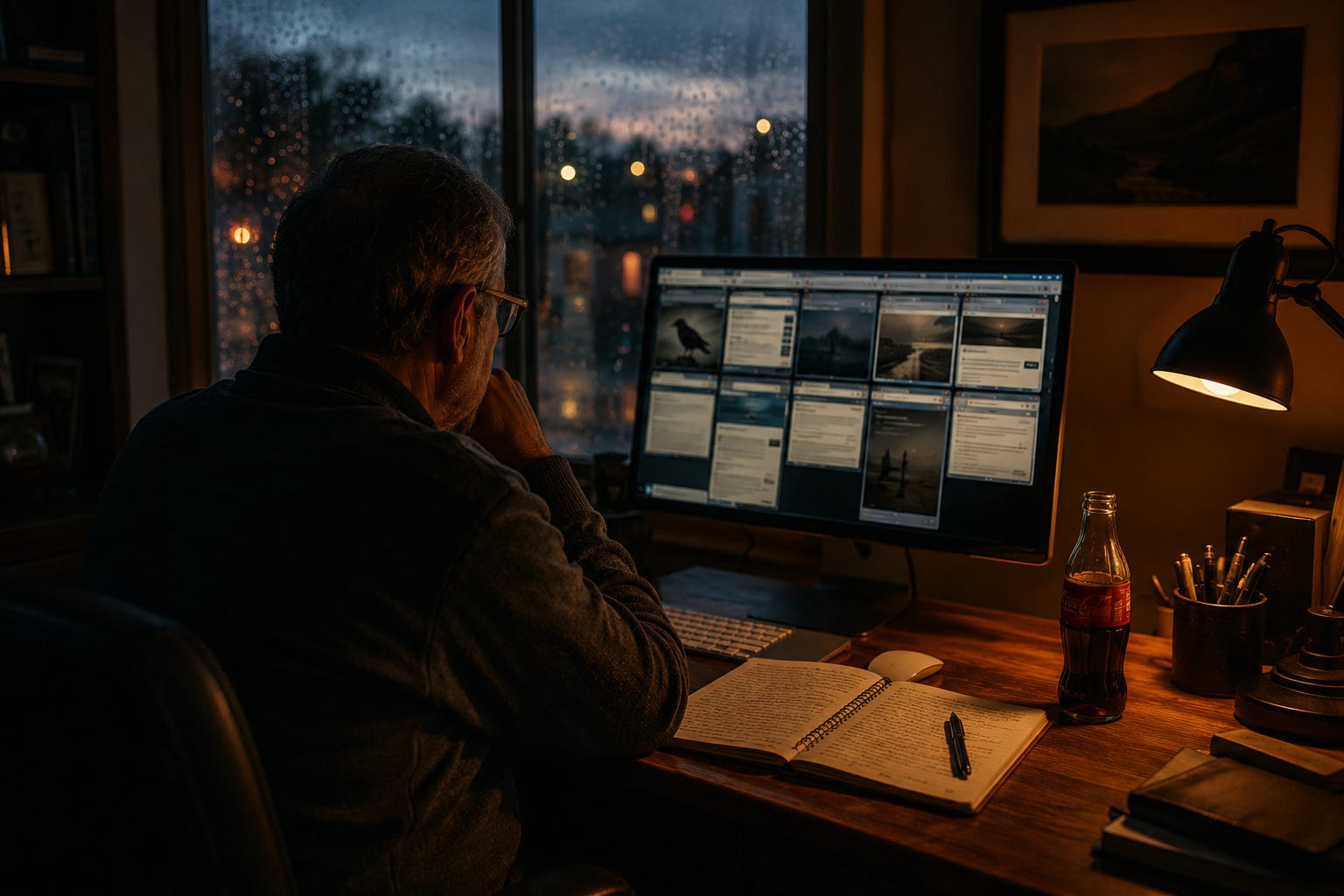
I’d sit down with an ice-cold Coke and a blank document convinced that today was finally the day. I’d spent the entire week thinking about the essay. I’d rehearsed parts of it while driving. I’d rewritten sentences in my head while standing in the grocery store. By the time I sat down, I already knew what I wanted to say.
Forty-five minutes later I’d have twelve browser tabs open.
I’d started writing about homelessness. Somewhere along the way I’d remembered a conversation from my collections days, which led me to addiction, which naturally led me to trauma, which somehow ended with me reading about crows because one article happened to mention how remarkably intelligent they are.
Every step made perfect sense.
The essay didn’t.
For years I blamed discipline. I admired people who could simply decide to finish something and then…finish it. I assumed they possessed some quality I’d somehow missed along the way. More focus. More determination. More self-control.
So I kept trying harder.
It never worked.
Looking back, I realize how easily we confuse invisible disabilities with character flaws. We see someone struggling to stay organized and call them lazy. We watch someone forget a conversation and decide they’re careless. We see the symptom because it’s visible. We never see the energy it took just to get that far.
It’s strange how often we judge people by the things they’re spending the most energy trying to overcome.
Eventually I was diagnosed with ADHD.
At first, it explained a lot.
Then it frustrated me.
Having a name for something doesn’t automatically tell you what to do about it. It doesn’t suddenly make your thoughts line up politely and wait their turn. If anything, it made me realize how much of my life had been spent trying to solve the wrong problem.
I wasn’t broken.
I was exhausted.
Somewhere along the way, artificial intelligence entered the conversation.
Not as a writer.
As a listener.
That’s an important distinction.
People sometimes imagine AI as a machine that spits out finished essays while someone else takes the credit. I understand why they picture it that way. That’s the version they see in headlines and social media arguments.
It isn’t the version I know.
When I first started using AI, the last thing I felt was excitement.
I felt relief.
Almost immediately followed by guilt.
The guilt surprised me because AI wasn’t writing anything I actually wanted to publish. More often than not, it was asking questions.
“You keep coming back to this idea. Why?”
“This paragraph feels different. What changed?”
“Is this essay really about homelessness…or is it about hope?”
Those questions slowed my thinking just enough for me to notice patterns I’d been racing past my entire life. It wasn’t replacing my ideas. It was helping me untangle them.
One afternoon I finally found the words I’d been looking for.
The problem was never imagination.
It was traffic control.
That single sentence explained decades of frustration better than anything else I’d ever heard. My mind wasn’t empty.
It was crowded.
The ideas weren’t missing. They were arriving all at once, each one convinced it deserved the runway first. By the time I’d turned toward one, three others had already taken its place.
For the first time in my life, I wasn’t spending all my energy directing traffic.
I could finally start writing.
That realization should have felt freeing.
Instead…
It made me wonder whether I’d been cheating all along.
For a long time, I assumed the guilt came from using the tool.
I’m not so sure anymore.
I think it came from needing the tool.
There’s a difference.
I’ve noticed something over the years. We tend to celebrate accommodations we can see because they make sense to us. A wheelchair ramp makes sense because we can see the stairs. Closed captions make sense because we can imagine not hearing the dialogue. A white cane tells us something before a single word is spoken.
The accommodations of the mind are different.
They don’t announce themselves. They simply remove barriers that most people never realize existed.
I don’t think people are intentionally unkind. Most of us simply judge other people’s work through the lens of our own experience. If you’ve never watched your thoughts scatter in six different directions before you’ve finished the first sentence, it’s understandable that organizing them doesn’t seem like work. If writing has always been a straight road for you, it’s difficult to imagine someone else’s road looking more like a maze.
That’s why conversations about AI often miss each other completely.
One person is talking about replacing creativity.
The other is talking about accessing it.
Those aren’t the same conversation.
The stories I’ve written over the past year didn’t come from artificial intelligence. They came from years of working collections, from ministry, from grief, from friendships, from mistakes, from standing on lonely beaches wondering why the ocean seems to answer questions nobody asked out loud. They came from every strange job I’ve ever had and every person who unknowingly left fingerprints on my life.
No software lived those moments.
No prompt remembers them.
Those stories belong to me.
They always will.
What AI helped me do was something far less dramatic.
It helped me hold onto one thought long enough to introduce it to the next.
That’s it.
Maybe that doesn’t sound revolutionary.
To me, it was.
For the first time, I wasn’t spending so much energy trying to organize my thinking that I had nothing left for the writing itself. I wasn’t wrestling my own brain before I ever reached the page. The ideas had always been there. I simply found a bridge sturdy enough to carry them across.
And maybe that’s why this essay has taken me so long to write.
Not because I was hiding AI.
I wasn’t.
It’s been sitting in my bio. I’ve mentioned it in interviews. Anyone curious enough could have found it months ago.
What I was hiding was something much harder to admit.
I still hadn’t convinced myself it was okay to need the bridge.
That realization surprised me.
I’ve written before about masking. About spending years learning how much of myself was acceptable to show the world. I always assumed those masks lived in conversations, relationships, churches, workplaces, and crowded rooms where I was constantly trying to figure out the right ratio of me to everyone else.
I never expected to discover one sitting at my keyboard.
Maybe that’s what this essay has really been about all along.
Not artificial intelligence.
Acceptance.
Accepting that accommodations don’t become shortcuts simply because other people don’t need them. Accepting that struggling longer doesn’t make the work more authentic. Accepting that there is no prize waiting for the person who refuses every form of help just to prove they could.
I’ve spent a lifetime believing my greatest obstacle was my character.
Maybe it was access.
I don’t expect everyone to agree with me. Some people will read this and decide AI has no place in writing. That’s a conversation worth having, and I suspect it will continue for years. Others will disagree with my conclusions entirely.
I’m okay with that.
What I hope doesn’t get lost is the person sitting behind the conversation.
The one trying to make sense of a brain that has never followed straight lines.
The one who spent decades believing he was lazy when he was really exhausted.
The one who still wonders, from time to time, whether needing help somehow makes the work less his.
I don’t have every answer.
In fact, I’m not sure this essay was ever meant to provide them.
I only know that the words you’ve just read came from my life. They came from my memories, my failures, my curiosity, my joys, and my scars. They passed through a tool that helped me organize them, but they didn’t begin there.
They began with a little boy who always asked too many questions.
With a man who never stopped.
And with someone who is finally beginning to believe that needing an accommodation doesn’t make his voice any less authentic.
It simply helps him stop losing it halfway through the sentence.

If this essay resonated with you, I’d love to hear your thoughts. Whether you agree, disagree, or simply recognize pieces of yourself in it, the conversation matters. Sometimes understanding begins not with having all the answers, but with being willing to tell the truth about our own experience.
Comments
Nothing yet. Say the first thing.
Sign in to join the conversation.