
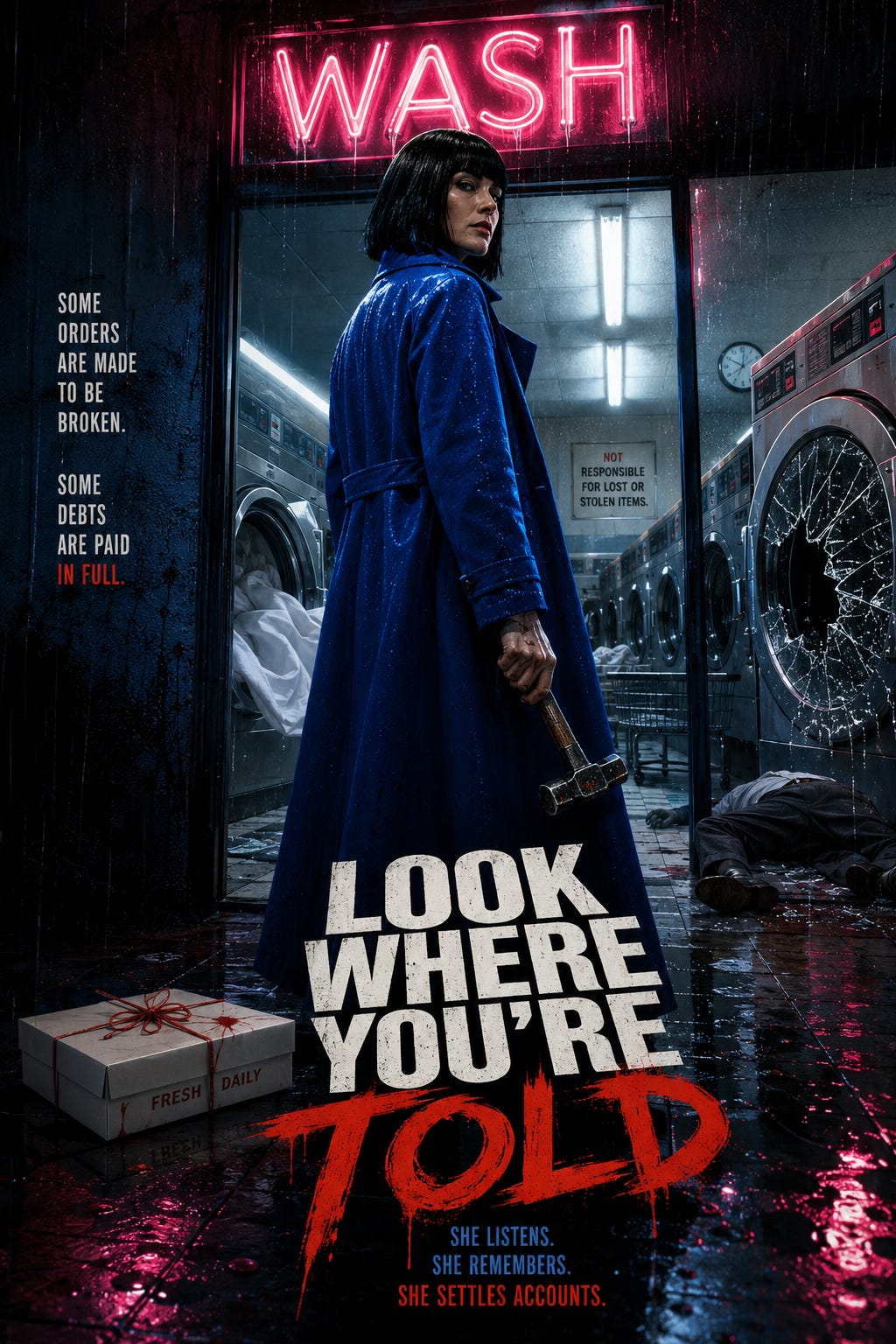
Author’s Note
I wanted to step completely outside the kind of writing I usually do and try something built almost entirely around image, movement, sound, and atmosphere.
The goal was to create a scene that felt less like reading a description and more like watching a movie unfold in real time—to make the reader see the fluorescent light, hear the dryers turning, feel the tension in the room, and understand the violence spatially as it happened.
This piece was an experiment in cinematic prose: not simply telling the reader what occurred, but trying to place them inside the scene while it did.
The laundromat had been built during a decade when people believed fluorescent lighting was an improvement. The tubes overhead bleached everything they touched. Skin turned gray beneath them, stainless steel lost its shine, and even blood seemed diminished in their glare.
Jack Myers sat at the end of a folding table with his left hand spread beneath the light. A dark crescent of blood remained beneath his thumbnail. He had washed his hands twice in the restroom, but it had settled into the narrow seam between nail and skin and refused to come free. It belonged there now. He worked at it with the corner of a lottery ticket, drawing the paper back and forth until the edge softened and began to pill.
Most of the dryers behind him were dark. Two still turned in the upper row, their motors producing a low mechanical hum that filled the empty room. In the third machine from the end, a white bedsheet lifted, collapsed, and lifted again. Every few seconds it spread itself across the glass before the drum pulled it back into darkness. Jack kept his attention on the lottery ticket.
Rain had covered the parking lot outside in black water. A shopping cart lay on its side near the curb, and beyond it Jack’s Cadillac waited beneath the failing neon sign. Half the letters had burned out, leaving only WASH glowing pink above the windows.
The sign held for several seconds and then faded. As the glass darkened, Jack’s reflection emerged in front of him: broad shoulders beneath an expensive coat, silver at his temples, one hand resting near the pistol concealed inside his jacket. From the sidewalk, he might have looked like a man waiting patiently for his laundry to finish.
The neon returned, and his reflection disappeared.
A woman stood on the other side of the glass.
Jack’s hand stopped with the lottery ticket pressed beneath his thumbnail. He had not seen her cross the parking lot. One moment there had been nothing beyond the window except rain striking the Cadillac; the next she was standing beneath the pink light, looking into the laundromat.
Her coat reached almost to her ankles and was the blue found at the center of a gas flame, vivid enough to make the rest of the night appear colorless. Rain ran from the hard line of her shoulders and gathered at the cuffs. Her black hair ended bluntly against her jaw, and she stood with her head lowered, watching the water spread around the toes of her boots. In her right hand, she carried a white bakery box tied with red string.
Jack set the damaged ticket on the table and slipped his hand inside his coat. He closed his fingers around the grip of the pistol without drawing it. The familiar weight steadied him. A gun reduced a room to measurements and a person to distance.
When the woman raised her head, the revolving dryers reflected across the window behind her. For an instant, their round doors appeared to turn across her body.
Jack knew her.
The face had changed. The softness was gone, her hair was shorter, and a narrow scar entered her hairline above the right temple. But he remembered the shoulders. The girl he had known folded inward whenever a man raised his voice. The woman outside stood perfectly straight.
She opened the door, and the bell above it gave a bright, foolish chime. Warm air from the dryers moved through the wet wool of her coat, carrying the smells of rain, detergent, hot metal, and mildew buried inside the old machines. She stopped on the rubber mat and surveyed the room without haste.
The folding tables divided the laundromat lengthwise. Jack sat at the far end of the nearest one, with the dryers behind him and the front windows at his right shoulder. An empty wire laundry cart stood in the aisle between them. The woman looked at the bolted plastic chairs along the wall, the soap machine, the convex security mirror fixed high in the corner, and finally the cart. When her attention reached Jack, her expression did not sharpen.
“You’re late,” he said.
His voice came out the way he intended: mildly irritated, almost bored.
She glanced at the clock above the restroom door. Its red second hand trembled between the twelve and the one. “No. That clock stopped yesterday.”
Her voice was lower than he remembered. Jack looked at the clock before he could prevent himself.
“You still do that,” she said.
He returned his eyes to her. “Do what?”
“Look where you’re told.”
His fingers tightened around the pistol. The bakery box had held his attention from the moment she appeared. She knew it. She had counted on it.
“You came a long way to be clever.”
“I came a long way to see whether you’d gotten old.”
“And?”
Her gaze moved across his face, his shoulders, and the coat pulled tightly over his stomach. “You have.”
Behind Jack, the white sheet rose inside the dryer and spread itself against the glass.
He pulled the pistol.
The woman did not flinch. She released the bakery box, allowing it to fall between her boots. One corner struck the tile and buckled. The red string loosened as the box tipped, sliding through the water beneath her coat before coming free. The lid opened to reveal a machinist’s hammer.
Its square steel head had blackened with age. Electrical tape covered the handle so completely that no wood remained visible, and the wrapping had been worn smooth where a hand had closed around it again and again.
Jack stared at the hammer, then at the woman. “You found it.”
“No,” she said. “You kept it.”
He felt the old weight of it before she ever touched it. The pull of the head against the wrist. The roughness of the original wooden handle beneath his palm. He had forgotten neither, though he had spent fourteen years pretending otherwise.
“You never did like getting your own hands dirty,” she said.
Jack glanced at the blood beneath his thumbnail.
She saw him do it.
His elbow began to rise.
She moved before he fired.
The pistol discharged into the space she had occupied an instant earlier, and the room disappeared inside the white flare of the muzzle. The bullet struck the dryer behind her, bursting the round glass door inward. Fragments scattered into the drum and joined the turning sheet as the gunshot struck the storefront and returned from the glass twice as loud.
Jack swung the pistol toward her new position, but she had already planted one boot against the lower frame of the wire laundry cart. She drove it down the aisle. Its wheels shrieked across the tile, and the cart passed beneath the open edge of the folding table before striking Jack across both shins. His knees folded. The second shot tore through the ceiling, releasing a pale veil of plaster dust into the fluorescent light.
He caught himself against the table without releasing the gun. The woman kicked the fallen bakery box aside, sending the hammer sliding across the wet floor until it stopped near her boot. She pinned the steel head beneath her heel and rolled it. The taped handle tipped up into her waiting hand.
The sight of it opened something inside Jack that he had kept closed for fourteen years.
A locked door. A bare bulb hanging from a cord. Hands striking the wood from the other side. The hammer resting in his palm for only a moment before he placed it into another man’s hand.
Make her stop.
The woman crossed the remaining distance. Jack forced the pistol toward her, but his fingers had begun to weaken.
The hammer came down on his wrist.
His hand changed shape beneath the steel.
The pistol dropped from fingers that could no longer hold it and slid beneath the nearest washer. Pain reached him a breath later, driving through his arm and climbing into his jaw as his knees struck the floor. A sound escaped his throat before he could contain it. He had heard that thin, involuntary noise from other people many times, and he had always despised it because it contained neither threat nor language.
The woman stood over him while water continued to fall from the hem of her coat. One drop struck the back of his damaged hand, and another landed on the crystal face of his gold watch. Beneath it, the second hand continued its steady movement.
Jack looked up at her. “You don’t know what you’re doing.”
She crouched in front of him, the blue wool gathering around her boots. Jack searched her face for anger and found nothing he recognized. Whatever remained in her had been built after rage was finished.
She lowered the hammer until its steel head rested on the tile beside his ruined hand. “I need a name.”
“Whose?”
“The man who paid you.”
Jack swallowed, tasting metal. His eyes shifted toward the convex security mirror in the corner. Its curved surface held both of them beneath the fluorescent lights: Jack on his knees, the woman crouched before him, her blue coat stretched tall by the distortion.
Behind them, the broken dryer continued to turn. The sheet rose against the shattered door and disappeared again into the drum.
For fourteen years, Jack had remembered a girl trapped behind a locked door. He had never allowed himself to imagine what she might look like standing on the other side of it.
The sheet rose once more against the broken glass.
Before it fell, Jack began to speak.
No posts
Comments
Nothing yet. Say the first thing.
Sign in to join the conversation.