
For twelve transmissions, I’ve been telling you about the people who made up that strange little world we called the floor.
Some made me laugh. Some drove me absolutely insane. Some taught me things about managing people that no corporate training ever could. I hired them, fired them, fought for them, fought with them, and spent more hours with some of them than I did with my own family.
Eventually, it ended.
The bank changed. Corporate came in, third-party companies were pushed out, and I was the first to go. A few months later, every one of those damn people was gone too. The floor that shouldn’t have worked finally didn’t exist anymore.
I didn’t understand then how much of myself I’d tied to that place, or how much losing it would become part of everything that came later.
But this story isn’t really about losing the floor.
It’s about one of the people who walked out of it with me.
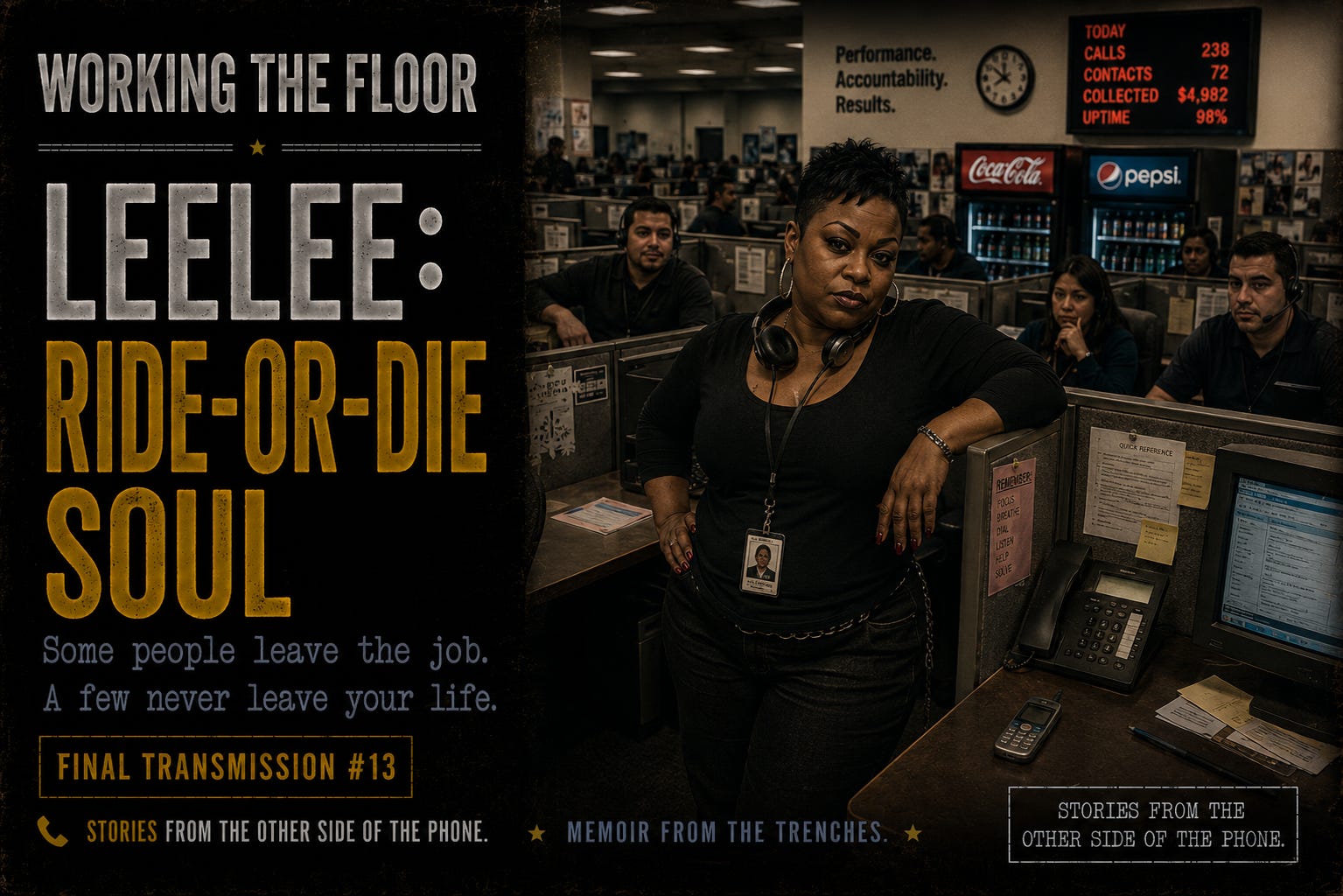
Her name was LeeLee.
And if you’ve ever met a five-foot-two Oakland woman who made you wonder whether you could actually be shanked with office supplies, you already have some idea what you’re in for.
**Names, locations, institutions, and identifying details have been changed or fictionalized to protect privacy. Some characters may be composites. These pieces are creative nonfiction based on lived experience, memory, and reflection.**

Times were changing by then.
The bank had been slowly tightening things up for years. More corporate oversight. More rules. More people who had never worked our floor deciding how our floor was supposed to work. We had always been temporary in their eyes anyway. Third-party collectors sitting at their desks, using their phones, collecting their money while trying not to remind anyone too important that we existed.
Eventually they decided they didn’t want third parties there at all.
I was the first to go.
There’s probably some irony in that after everything you’ve read here. I had walked so many people into Conference Room A and told them their time was up. Eventually somebody else made that decision about me.
A few months later, it didn’t matter anymore. Every one of those damn people was out of a job. The floor we’d built out of borrowed desks, bowling alley parking, duct tape, caffeine and whatever else we could find was gone.
I don’t think I understood at the time how much of myself I had put into that place.
It wasn’t just a job anymore. That would have been healthier. I had invested years of my life in those people. I worried about them when I wasn’t there. I fought for them when I probably shouldn’t have. I fired some of them when I didn’t want to. I watched people come and go and somehow convinced myself that keeping the whole ridiculous machine running meant something about who I was.
Somewhere along the way, being needed became part of my self-worth.
Losing the floor didn’t break me by itself. I don’t want to rewrite my own history that neatly. Life kept happening. Other things piled on. By 2013 there were cracks everywhere, and after we moved to Washington those cracks eventually became something much worse.
Which brings me to LeeLee.
LeeLee was short—maybe 5’2”—but she carried herself like she was 6’4” with steel-toe boots and a crowbar in her purse. Black, from Oakland, voice like gravel and a gaze that cut straight through bullshit. She had that West Coast don’t-fuck-with-me stance. Didn’t matter what room she walked into—she owned it.
She was abrasive as hell. The kind of woman who made you check yourself before you said anything stupid. She didn’t raise her voice often because she didn’t have to. You felt her presence like static in the air—heavy, electric, and just this side of dangerous.
We used to joke that if someone crossed her, they’d end up with a pencil between their ribs by the vending machine. Not because she ever did it—but because you just knew she could.
And yet…
Underneath that concrete-hard exterior was one of the most loyal, ride-or-die human beings I’ve ever known. If you earned her trust—really earned it—she’d back you up in ways that went beyond the job. She’d cuss you out one minute and cover your shift the next. She wasn’t soft, but she was solid.
That didn’t end when the floor did.
That’s the thing about LeeLee I don’t want to lose in telling this story. She wasn’t somebody I worked with twenty years ago who happened to send me one lucky message. She stayed my friend. Jobs changed. States changed. Lives changed. LeeLee was still LeeLee.
After the call center days, she got her CDL and started driving a truck cross-country. Still out there now—seeing the country, probably flipping off bad drivers from a big rig. She messages me once in a while from the road, usually something blunt like, “You alive?” or “That bullshit still following you?”
That’s LeeLee.
No Hallmark card. No inspirational quote. My short little Oakland thug checking to make sure I’m still breathing.
But there’s one message I’ll never forget.
It was late. I was in a dark place—the dark place. The “I could actually do it tonight” place. I hadn’t told anyone. No posts. No texts. Just sitting there, done.
And out of nowhere, a Facebook Messenger ping.
From LeeLee.
“What you doing?”
I stared at it like it was a message from God. Or luck. Or something in between. I don’t know what made her check in that night. Maybe it was dumb luck. Maybe something bigger.
But she reached me. At the exact right moment.
And I’m still here.
I’ve thought about that a lot while putting these stories back together.
For years I thought I was the one holding that floor together. I was the manager. I hired people, fired people, fought with the bank, dealt with whatever insanity showed up that morning and tried to get 125 people through another day. When it all disappeared, I lost more of myself with it than I understood at the time.
But the floor wasn’t the desks. It wasn’t the bank. It sure as hell wasn’t the metrics.
It was the people.
Dre. Yvette. Mateo. Jenna. Loretta. Marlon. James. LeeLee. And a hundred others whose stories I haven’t told.
Some I haven’t spoken to in fifteen years. Some I probably never will again. Some may remember me fondly. I’m quite certain others don’t. That’s what happens when you’re the guy who sometimes hires people and sometimes walks them into Conference Room A.
But that strange little world we built left pieces behind.
LeeLee is one of mine.
She might’ve made you feel like you could get shanked in the breakroom, but if you cracked that shell, she’d carry your weight like it was hers. No questions. No drama. Just presence.
Twenty years later, she still does.
I spent a lot of years believing those people needed me.
Turns out, I needed some of them too.
And I’m damn lucky to still have her as a friend.

That’s it.
Thirteen transmissions. A handful of people out of the hundreds who passed through that floor, and a few stories from a place that probably never should have worked as long as it did.
There are more stories. Of course there are. You don’t spend that many years surrounded by that much chaos without accumulating enough material to fill a book. Maybe someday I’ll put all of this together properly. Maybe there are people I’ve forgotten who will come roaring back into my memory at three in the morning and demand their own chapter.
But for now, this is where I want to leave it.
Not with the bank. Not with the numbers we collected or the bonuses somebody else earned because of us. Not with Conference Room A, corporate decisions, or the day they finally decided they didn’t need us anymore.
With LeeLee.
With one of those damn people still being there twenty years later.
Because after going back through all of this, I think that’s the part I understand now that I couldn’t have understood then.
The floor disappeared.
The people didn’t.
Thanks for working the floor with me.
Working the Floor is a Bent But True memoir series about collections, survival, dark humor, and what happens to the people on both sides of the desk.
No posts
Comments
Nothing yet. Say the first thing.
Sign in to join the conversation.