
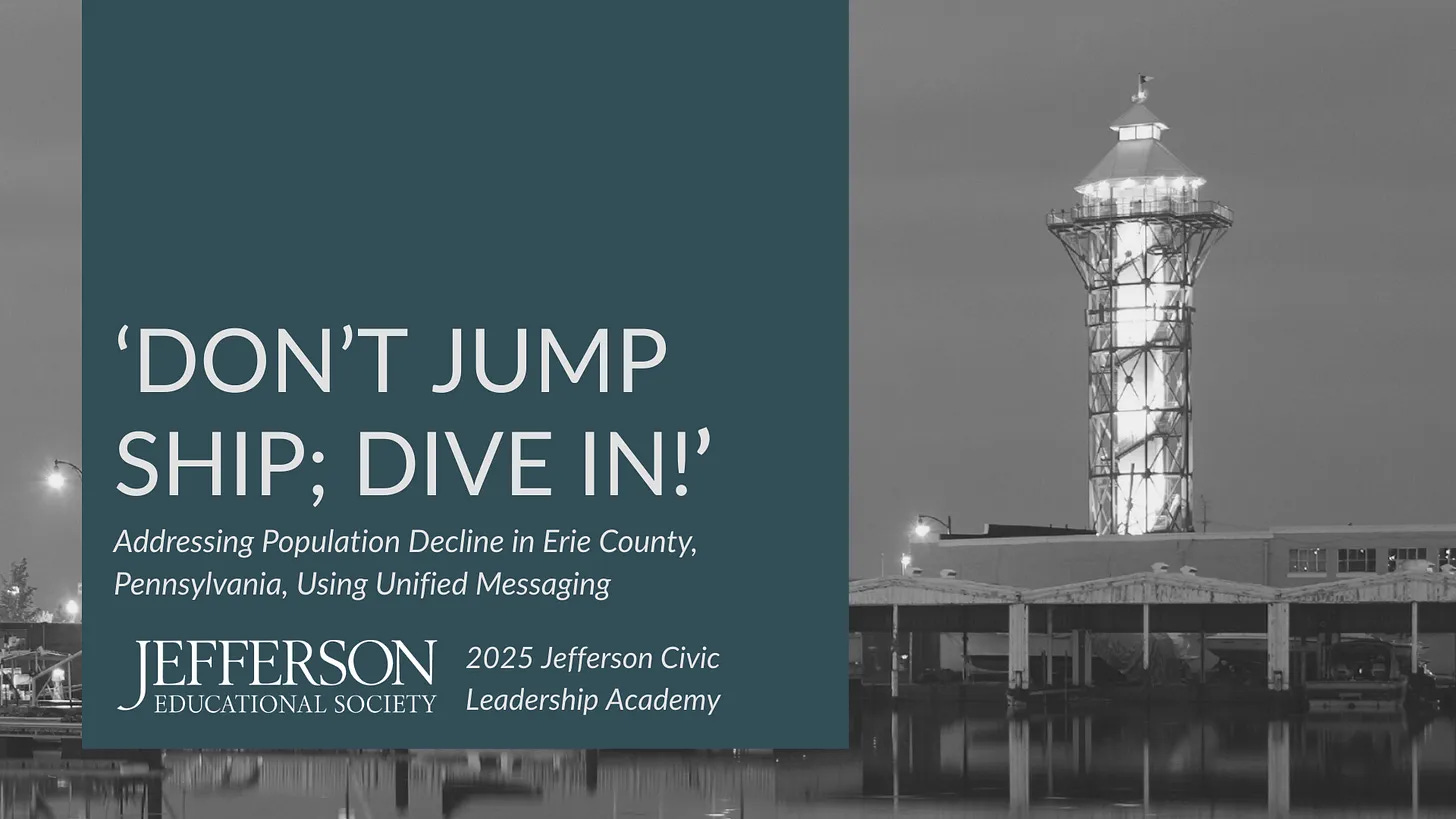
Not burying the lede, there is a new report out that I am recommending that you read: “‘Don’t Jump Ship; Dive in!’ Addressing Population Decline in Erie County, Pennsylvania, Using Unified Message.”
In the spirit of full disclosure, I played a role with this report — helping to edit it, working closely with the 29 contributors associated with it. That’s because those folks are members of the 2025 cohort of the Jefferson Educational Society’s Civic Leadership Academy cohort, which I directed and facilitated along with my JES colleague, Chelsea Oliver.
But that’s not why I’m sharing it.
I’m sharing this report, written by non-subject-matter-experts bound together by the nine-month-long experience that, thanks to the JES, annually immerses a new set of participants in a hands-on learning opportunity to explore the form and function of local government and how it relates to state government while tasking the individuals to come together as a whole to produce meaningful research and clear-eyed recommendations of how to address a critical issue facing the region with national implication, because I believe it to be valuable to residents and leaders in Erie and beyond.
Residents and civic leaders alike in Erie, Pennsylvania, like many metros, have been wrestling with the question, “What do we do about population decline?” The county, on the whole, and more pronounced in places like the city of Erie, have, following a swelling wave of population increase thanks in 20th century industrial growth, like other “post-industrial” metros, been — and continue to be — experiencing a receding of the tide recede as economies shift and evolve.
Why do people leave, stay, or return? This report addresses all, including interviews with a range of folks — some who’ve never left, some who’ve left and returned.
If a place like Erie is retain, and perhaps attract, population, what would drive that? This report addresses that, too.
“What started as a concern over population decline has evolved into a vision for renewal,” the authors note, highlighting the important role a shared sense of place, story, and community pride play.
Creating a unifying “brand” for a place has proven successful elsewhere. The report details examples, like that of Allentown, Pennsylvania, and of Buffalo, New York. The lessons they teach stand to be studied — just like this report.
I’m sharing this report, too, in my continued effort to show that young people do give a damn. And are willing to work — including on shared initiatives like this one — to the betterment of the places in which they live, work, play, and connect.
When I talk with folks from communities small and large and ask about concerns they have for their town or city's future, often the youth lands toward the top of the list. From "brain drain" to apathy and lack of engagement, people worry about younger people leaving (and never coming back) or failing to find ways to become more engaged in and connected to their community.
When I have the chance to say, “Yes, but…,” it’s followed by “there’s this Civic Leadership Academy I think you’d be interested in.”
Since the JES’s Civic Leadership Academy launched in 2015, there have been more than 250 people participate and graduate. And applications are already coming in for the 2026 cohort — much to the chagrin of naysayers who told me and others and the frontend of getting this going, “you’ll run out of young people in three years!”
Outcomes we’re seeing: Folks are better informed, are more civically active and engaged, and are producing research that actually ‘moves the needle’. Then, they continue to be engaged and contribute to their communities — some successfully grasping the professional rungs ahead, others working to support political campaigns, and some running for — and winning — elections.
In other words: These young people care. They’re connected and connecting. And they’re working to change present to make a better future.
That is a vision for renewal if there ever was one.
Comments
Nothing yet. Say the first thing.
Sign in to join the conversation.