
I am sharing several pieces on two topics for recommended reading. There are numerous pieces linked here; the specifically recommended ones are bold (all are worth a click).
The theme weaving them together: Connectivity.
During a reporting trip in August 2022, Michelle Ellia, my fiancée, and our 13-year-old rescue pup, Remi, found ourselves in South Carolina’s “Upcountry.” We were there to see the workings and impact of Community Heart & Soul, a community-development model we had been reporting about for Our Towns.
On the list of places to visit: Great Falls, where a nature-based tourism effort decades in the making now finalizing materializing caught our attention; and Kershaw, where we saw a vibrant downtown being reimagined with new ideas in old spaces.
Both are worth reading about, and visiting, and we hope to revisit them sooner rather than later.
The third town — the last we visited before an evening dinner with folks from the Arras Foundation, a health legacy foundation in the region promoting community development — was Fort Lawn.
In my reporting on Fort Lawn, I wrote:
Earlier along our tour, we had discussed safety – one of the areas of interest the Heart & Soul process highlighted. We’d learned about a pilot study for a citizen police academy that Community Center volunteers participated in, and residents’ increased involvement in neighborhood watches, among other initiatives.
“But what was their greatest concern around safety?” I asked at the lunch table.
“We do not have an ambulance stationed in this entire ZIP code,” Libby ( Sweatt-Lambert, the executive director of the Fort Lawn Community Center) told me.
She explained that a 911 call made in the area most often dispatches an ambulance from Chester, nearly 20 miles to the west. Two Community Center volunteers at our table shared that they had lost loved ones before an ambulance arrived. Would fewer miles to go, fewer minutes to count before receiving a response made a difference? We don’t know. But that it is about a half-hour drive from Chester to Fort Lawn remains front of mind.
We took a lot away from that trip. But what Libby told us about the lack of timely access to emergency first responders is something I’ve continued to think often about.
So I was heartened to see recent reporting by The Daily Yonder on this topic.
In “Rural Residents Five Times More Likely to Live Far from Ambulance Station,” Liz Carey reports on a first-of-its-kind study, published by the Maine Rural Health Research Center, and led by Yvonne Jonk, a deputy director of the center and an associate research professor at the University of Southern Maine.
As Carey explains:
When health researcher Yvonne Jonk lived in North Dakota, she got a piece of information from the state’s emergency medical service director that shaped her work for years to come.
Then director Tom Nehring told her there were parts of the state where it was more dangerous to have an accident because there wasn’t an ambulance service nearby to respond quickly.
“He was talking about how those ambulance services are in crisis,” Jonk said in an interview with the Daily Yonder.
The two-year-long study mapped out ambulance stations, and researchers then compared those locations with population data from the U.S. Census Bureau. There are states yet to be mapped and included and more will need to be done, but having this data front-and-center is a strong step in the right direction.
What’s to blame? Carey gets into that, which is why I recommend reading the report.
What to do about it? Like many challenges, there isn’t a silver-bullet answer to this complex crisis. But as Jonk tells Carey:
Now that the scope of ambulance deserts has been identified, the next steps will be to determine what kind of an impact ambulance deserts have on rural communities, how many of those ambulances have paramedics on them, and what can be done to fund ambulance services better.
In Fort Lawn, residents were taking matters into their own hands, as I wrote in March:
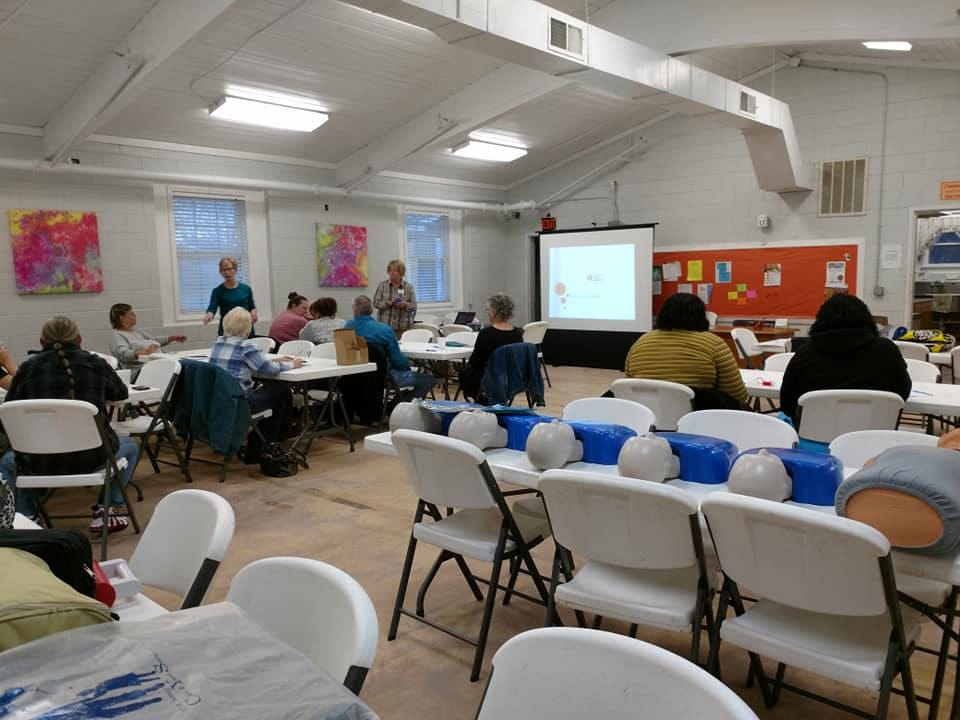
As a stop-gap measure, Libby secured funding from South Carolina’s Capital Project Sales Tax, or “Penny Tax” for AEDs, which she now has in both buildings at the Fort Lawn Community Center, and several more have been installed in other high-traffic buildings through the area. Her entire staff, along with two dozen residents, have all received training on how to use them, and how to perform CPR.
As someone who grew up in a small town where ambulances were stationed nearby, and as someone who now lives in a larger metro area where I know if I do have to dial 911 there’s a good chance help will be on its way quickly, I don’t take that for granted. With Jonk’s work, and Carey’s reporting, I am encouraged that more people will be paying more attention to our nation’s Ambulance Desert problem and work to create equitable access and connectivity.
One of the most powerful pieces of writing I’ve read this year has been by Jeffrey Bloodworth, published by The Free Press. It begins:
My best friend Mike died alone. That was how he lived, too. He ate alone. He slept alone. Aloneness was his natural state. At age 50, it was sepsis that officially did him in. But really, it was solitude.
Like Mike, America’s white working class is alone. Like Mike, it is being crushed by its isolation.
Its middle, and ending, are just as powerful. It is a piece of writing I’ve thought often about ever since it was published back in March.
I know Jeff. He teaches at the university I attended, and where I once taught. We have a chance to work together because Gannon University is a partner with the Jefferson Educational Society (where I am a vice president) on the think tank’s Global Summit speaker series. I also consider him a friend.
Despite all that, I didn’t know this side of Jeff — both his background (which, in some ways, is similar to mine) and his moving way with words. I was gutted to have read his account of his friend, Mike, and stirred by his deeper thoughts and reflections on America’s isolation epidemic and subsequent rising rates of deaths of despair. I am grateful that he had the courage to share the former through the latter.
“My Best Friend Died from Loneliness” is an important read, and I hope you give it the time it deserves.
Equally important and powerful is a new report, published by New America, by Hollie Russon Gilman andAmy Eisenstein. It begins:
Put simply, social isolation is killing us.
What to do? The answer is in their title: “The Remedy for America’s Loneliness Problem? Restoring Our Civic Health.”
Following the clarion call from the U.S. Surgeon General in April noting the loneliness epidemic, the risks it presents, and the need to do something about it, Gilman and Eisenstein write:
The evidence is indisputable: Our physical health is inextricably intertwined with our civic health. Good civic health translates to building meaningful connections with neighbors, local leaders, and institutions — and working together to identify and solve public problems. And how we engage with our neighbors and networks directly impacts our own well-being. People who feel socially connected have stronger immune systems, live longer, and experience 70 percent less cognitive decline and dementia.
Their report highlights several examples of organizations doing this kind of work — an important reason to read it to discover them for the first time or learn more about them than you might’ve already known. (CivicLex, in Lexington, Kentucky; Vitalyst; Reimagining the Civic Commons.)
But the solutions aren’t just coming from the bottom up. The federal government can support from the top-down.
The federal government can also bolster investment in civic infrastructure at the hyper-local level. The Commission on the Practice of Democratic Citizenship, a part of the American Academy of Arts and Sciences, offers one example. The Commission explores challenges facing American democracy and proposes solutions to strengthen it in the twenty-first century. Their Our Common Purpose report recommends establishing a national Trust for Civic Infrastructure to invest in the “places, spaces, leaders, organizations, and networks” that facilitate a culture of connection and commitment to one another.
And, they note the “once-in-a-generation commitment to communities” the federal government is making to support civic infrastructure. (I wrote earlier on this Substack about the federal government’s unprecedented funding when it comes to place-based investments.)
Through my work with the JES, Our Towns, Community Heart & Soul, and beyond, I’ve seen the power of providing spaces for people to connect firsthand. It is encouraging to see such a bright light being shined on others, and to see a federal-level response, too.
No posts
Comments
Nothing yet. Say the first thing.
Sign in to join the conversation.