
Hazard Ratio is a reader-supported Substack. Consider backing my work and becoming a paid subscriber today, which will gain you access to all the WPATH conference videos I have published and will publish going forward.
There is an interesting undercurrent beneath the World Professional Association for Transgender Health conferences wherein presenters might never question the basic tenets of pediatric gender medicine itself, but they are more than willing to vocally undermine and challenge WPATH as an institution. Among the more radical of the pediatric gender medicine advocates, those who have been pushing colleagues to liberalize their practices even as the field at large has been subject to an onslaught of criticism and political scorn for allegedly being reckless, this often means openly criticizing WPATH’s treatment guidelines as egregiously cautious and conservative.
You see this in Canadian transfeminine jurist Florence Ashley, who has been the most outspoken and radical force in the movement to deconstruct gatekeeping around gender-transition interventions for minors. Despite presenting at a WPATH conference (in which she railed against gatekeeping), she has since made abundantly clear that she loathes the institution itself. “Half of us hate WPATH,” she posted on Bluesky earlier this year in opposition to the notion in my reporting that the presenters are at least de facto representatives of the organization.
The conference presentation in this particular Substack, posted above, is from the 2022 WPATH conference. It was inspired by the presenters’ collective concern about the adolescent chapter in WPATH’s Standards of Care, Version 8, known as SoC 8, which had emerged in draft form earlier in the year and was published just days before the conference.
It is abundantly clear that the team was pushing the field toward treatment on demand for minors. Like Ms. Ashley, they are suspicious of anything that reeks of gatekeeping and that mighty delay access to gender-related medical interventions. In a telling turn of phrase, they expressed disdain toward what they labeled as “adultism bias,” lamenting that restrictions that have been removed from adult trans care of late have since been placed on minors. This term appears to advocate for the legal notion of the mature minor—that people under 18 are capable of making life-altering medical decisions.
Given this team is on the bandwagon of disparaging psychosocial assessments for minors seeking gender treatments, it should come as no surprise that they routinely advocated for conceiving of these treatments as in service of young people’s “embodiment goals,” rather than to treat gender dysphoria or related mental-health problems. Some version of the term was uttered two dozen times during the hour-long conference session.
Treatment, they said, could be paused or stopped at any time. They did not acknowledge that these treatments nevertheless can cause permanent changes to the body, such as a deepened voice among natal girls.
The session was prerecorded, so the presenters were working under the assumption at the time, based on the pre-released draft of the guidelines, that the SoC 8 would retain all age limits on gender-transition interventions. Those limits were controversially removed the day the guidelines were published. But the authors did maintain a recommendation against minors receiving phalloplasties. On that point, the team in this video still scoffed at such an obstacle. Meanwhile, this is a disfiguring operation that requires taking a substantial sample of flesh from the forearm and thigh to make a faux phallus that lacks much of the basic form and function of a genuine penis. It has a remarkably high complication rate. But for this team, it’s a-okay to give one to a minor.
The session featured:
Laura Kuper, a psychologist at UT Southwestern Medical Center and a coauthor of the WPATH trans-care guidelines’ nonbinary chapter
G. Nic Rider, an associate professor of family medicine at the University of Minnesota
Amelia Brewer, an Oklahoma counselor
Sean Moundas, a psychologist
Dr. Colt St. Amand, who has an MD and a PhD, and is a licensed psychologist and family medicine physician in New York State.
This team, which is part of a larger collective, was later behind a 2023 conference presentation in which they furthered similar arguments about preparing minors for gender treatments, including the notion that a single assessment session “may be sufficient” for some youth.

Benjamin Ryan@benryanwriter
Sean Moundas, a psychologist, at the 2022 WPATH conference asserted that age limitations on youths' access to gender-transition drugs represents “adultism bias.” To read my article in @compactmag about the 100s of videos I obtained from the World Professional Association for
3:29 PM · Apr 2, 2026 · 6.83K Views
5 Replies · 8 Reposts · 76 Likes
This is the broader membership of their collective:
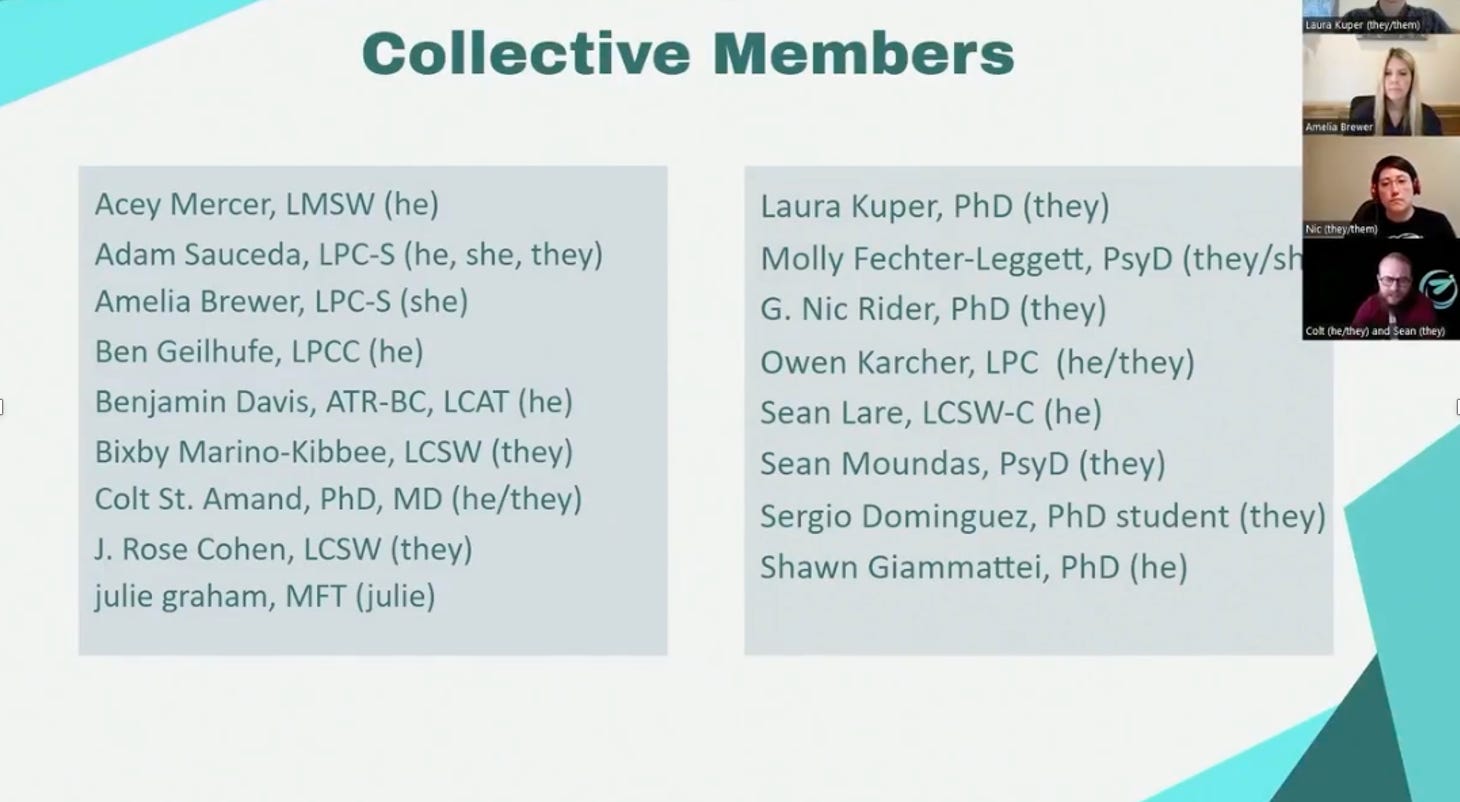
Given the group’s concerns about SoC 8’s adolescent chapter, Dr. St. Amand said, “We wanted to make sure we could create our own assessment that would follow the guidelines, but still be rooted in our particular values and principles.” He cast shade on the authors of the chapter for, he said, not having a “personal connection to the work” like everyone in their collective does.
Taking the decolonizing stance that is so in vogue in academic circles these days, Dr. St. Amand said, “We acknowledge the gender binary as a project of colonialism, as a product of colonialism, with a focus on pathologization and diagnosis.”
The field, he said, has seen “incredible strides to decrease restrictions on access to gender care for adults. However, unfortunately, we are seeing these same restrictions that were lifted for adults now being placed on youth that could also be seen within the context of adultism bias.” He never did define the term, although its meaning was indeed self-evident enough to suggest to the observer that the team conceives of minors as small adults, as opposed to individuals who have not yet attained full cognitive maturity.
Following a common theme among leaders in pediatric gender medicine, such as UCSF child psychiatrist Dr. Jack Turban, Dr. Kuper emphasized that it is problematic for care providers to presume “they have an ability to discern someone’s true gender identity beyond what that person is articulating.”
Addressing arguments that many youth who believe they are, or should become, the opposite sex are merely misinterpreting their homosexuality for a transgender identity, Dr. Kuper challenged what he said was another problematic belief: “And then also this idea that someone can’t understand their gender if they first don’t understand their sexuality.” Such a “focus on identity,” she cautioned, “can take away the focus on embodiment goals.” Care providers, Dr. Kuper said, “can help youth articulate and navigate their gender. But it’s only appropriate when it’s aligned with what the youth is desiring.”
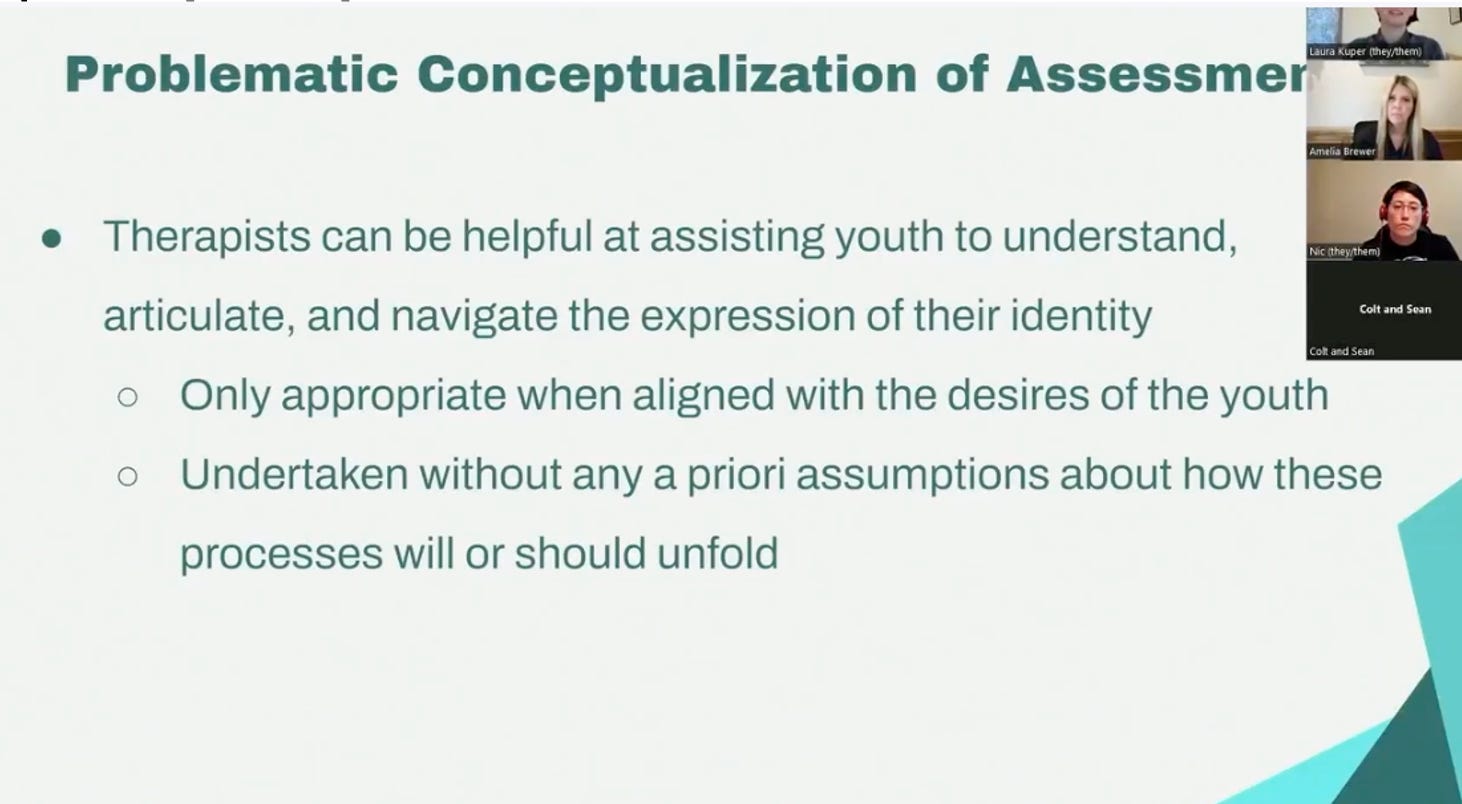
Dr. Kuper further advocated against providers seeking to identify a “root cause” of the youth’s identity, suggesting that it as not possible for there even to be such a thing. She disparaged the notion that being transgender is a disfavored outcome, without acknowledging that living as the opposite sex and undergoing gender-transition interventions nevertheless come with a litany of risks and burdens that living as one’s natal sex does not.
It is wrong, Dr. Kuper said, for providers to presume that they can anticipate whether a patient will later experience regret over their gender-transition interventions. “Instead of focusing on predicting regret,” she said, care providers should focus “on helping the client articulate their goals and supporting them with affirmed informed consent.”
“And keeping in mind that treatment can be paused or discontinued at any time,” Dr. Kuper said. “So it’s not an all-or-nothing kind of forever decision.” She made no mention of the fact that gender-transitions can have permanent impacts that are not altered by simply stopping the treatment.
Dr. Moundas expressed his concern that the adolescent chapter of the SoC 8, compared with other chapters, was particularly colored by language expressing “fear and anxiety.” For example, he said, the chapter advocated a “careful assessment.” He was leery of the suggestion that if concerns about the patient arose during an assessment that the response from care providers, under the aegis of the SoC 8, should be to simply provide more assessment. This, he said, is “by its nature gatekeeping.” Gatekeeping, if it wasn’t clear, is bad in the minds of these youth gender advocates.
(I myself noticed a similar phenomenon in a presentation by the lead author of the chapter, child psychiatrist Dr. Scott Leibowitz, in which his only recommendation for ethical quandaries when weighing whether to put a child on gender-transition drugs was to provide more informed consent. He described no scenario in which treatment would simply be unethical.)
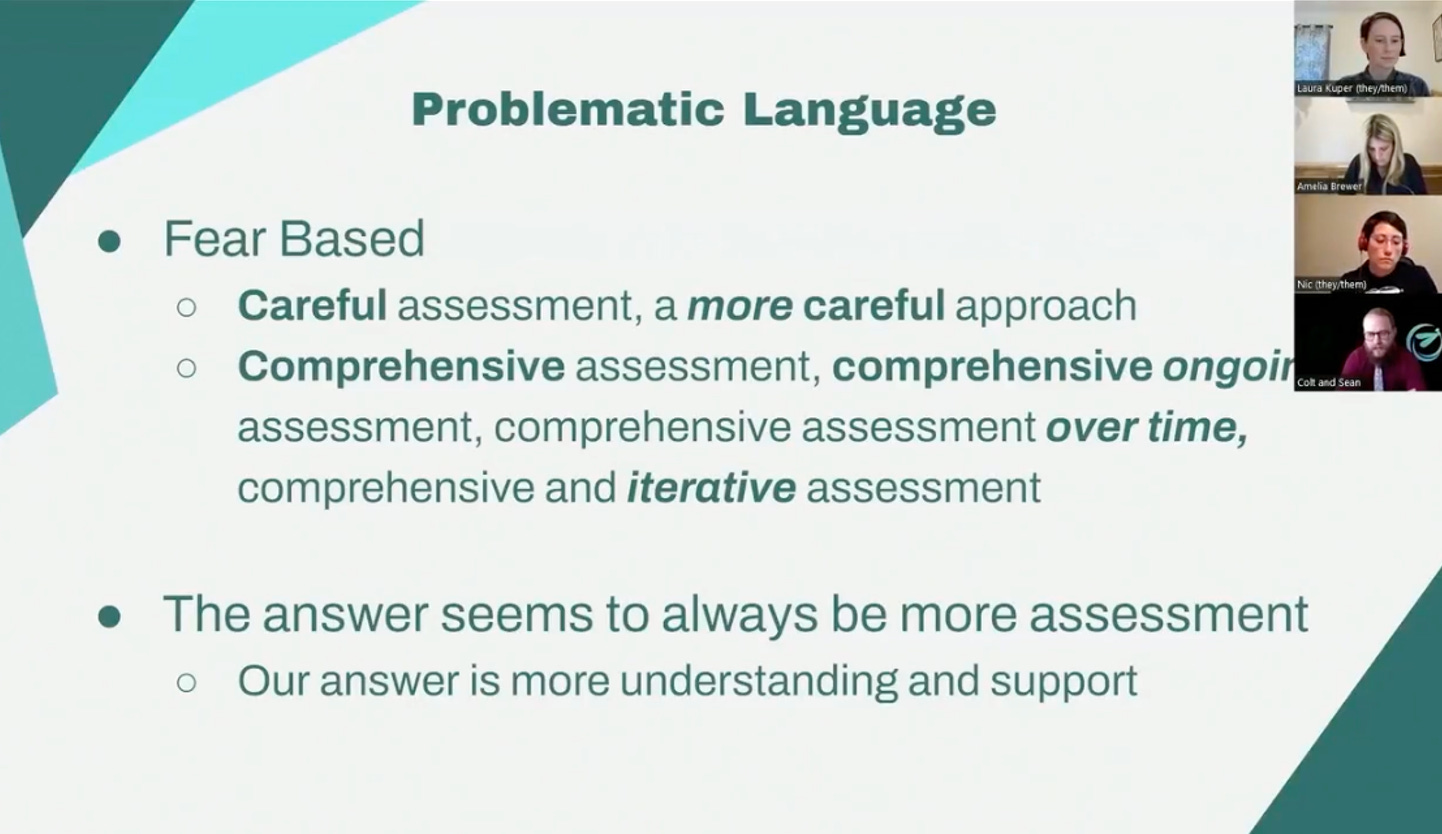
A better option than gatekeeping, Dr. Amand said, would be “more understanding and more support.”
Ms. Brewer addressed what the team saw as a contradiction: the fact that the SoC 8 said that gender dysphoria was not a requirement to access gender care, while having gender dysphoria does not mean someone requires care. “The way that these statements are written communicates that though the absence of dysphoria should not preclude them from accessing treatment, it is required for treatment, so it lends to confusion,” she said.
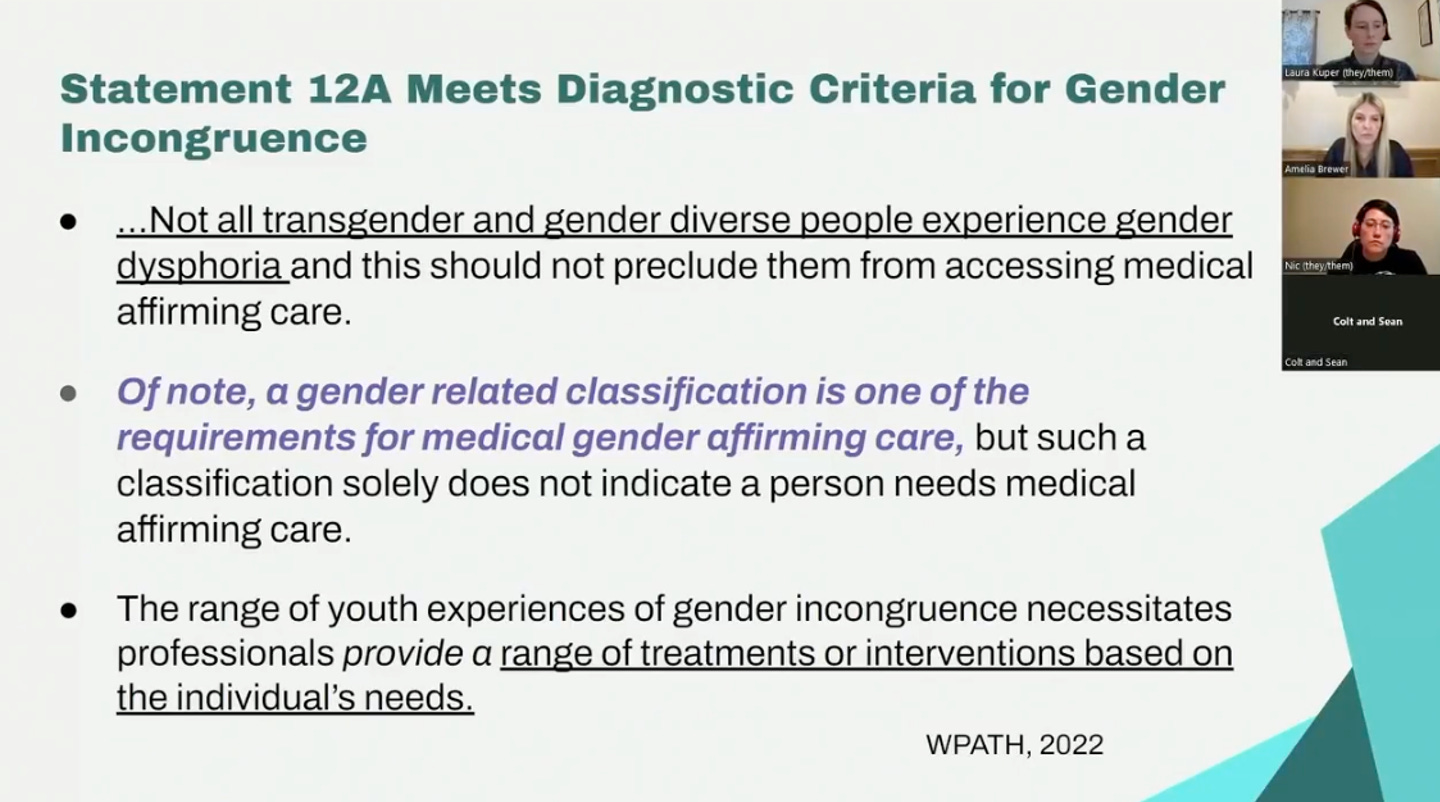
“This is a larger systemic issue that there’s still a heavy focus on classification, rather than the validity of a wide range of individual experiences of gender identities, as well as embodiment goals,” Ms. Brewer said. The group’s proposed solution was to drop the focus on dysphoria entirely in favor of addressing embodiment goals.
Dr. Moundas expressed unease with the SoC 8’s suggestion that youths needed to have “several years of persistent” cross-sex identification. This, he said, reeked of the foundational, conservate concept from Dutch researchers of youth needing to be “consistent, insistent and persistent” in harboring a transgender identity before they could get gender treatments. “Not everyone’s gender journey follows that path,” he insisted. “Requiring a sustained identity experience before suppressing puberty can be a harmful practice.” Acknowledging youth who come to realize that gender-transition interventions are not for them, he said: “We affirm that gender development is a journey and can certainly evolve over time.”
“The collective also wants to reiterate our recommendation that the focus of assessment for medical interventions be more on embodiment goals than identity,” Dr. Moundas said, as if the point wasn’t already abundantly clear.
In an interesting Freudian slip, after noting that the SoC 8 advised care providers get patients to consider “the level of reversibility” of gender treatments, Dr. Moundas truncated the expression and said, “We agree that the reversibility of interventions should be communicated.” He seemed to emphasize how reversible, not how irreversible, the treatments are. He continued: “However, as said before, consideration of what the youth’s embodiment goals are is more important than their particular gender identity.”
Addressing concerns about the intersection of trans identity and neurodivergence, Dr. Moundas cautioned against favoring caution over action when working with autistic patients. “So we appreciate that executive functioning and varying mental health experiences are mentioned,” he said. “However, we imagine that these ideas could lead to disproportionate delays in access to care for neurodivergent youth and youth with other mental health difference.”
Dr. St. Amand expressed considerable disdain toward age limits on gender treatment and surgery, including phalloplasty. An age limit of 18 for that surgery, he said, would put youth “in college and away from parents who’d be willing to help with a more able to help with recovery from surgeries.”
Getting to the meat of the presentation, Dr. Kuper described how to address a patient’s embodiment goals. Given the term may be new to youth, she said, “I think the most basic 101 way to describe this is what primary and secondary sex characteristics a person is desiring. More hair, less hair, larger boobs, less boobs, no boobs, hips, voice changes, etc.”
Presuming that a youth simply wants the precise body of the opposite sex, Dr. Kuper warned, is “incredibly problematic.” She said: “Historically, we have over focused on stability and certainty of identity, and then just made the assumption that if they’re saying they're a boy, then they’ll want, quote unquote, a boy’s body. Which is by its nature an endocisheteronormative framework.” She advocated providing youths with the space to “open up that creativity and imagination” about the body they desire.
Dr. Rider addressed the importance of counseling patients and their families about fertility preservation. “A lot of the times there’s a lot of adults that are involved in those conversations, and the adolescent doesn’t get much say and what they want for themselves or their bodies,” Dr. Rider said. “And so that is very important for informed consent and assent. And I really want to emphasize that assent piece.”
I am an independent journalist, specializing in science and health care coverage. I contribute to The New York Times, NBC News, The Free Press, UnHerd and The New York Sun. I have also written for the Washington Post, The Atlantic, The Guardian and The Nation, among many others. Follow me on X: @benryanwriter. Visit my website: benryan.net
Comments
Nothing yet. Say the first thing.
Sign in to join the conversation.