
COVID arrived as a revelation of the future that came to some people before others.
I was one of those people. In late 2019 I was in the part of Twitter where I saw posts about a new disease in China. It sounded bad. There were videos of people collapsing. By the end of January I had seen enough to know with certainty this disease would be everywhere fast and I was freaking out. I stockpiled food. I bought n95s. I changed how I spent time with people. I set myself up for months of total isolation and I had a bug out plan just in case the city got too crazy. So, when the social contagion really hit in March and we locked down I was “ready.”
It turned out though that, while it was bad, COVID was not the end of the world. In fact, it wasn’t even close. And I was so early to the wave and so wrapped up in what was happening that later I became part of the problem. I had thought there was a high likelihood this deadly novel virus was going to fundamentally reshape the world, kill vast numbers of people, and potentially lead to complete societal breakdown. So, when it came to it I was unprepared to recognise the exceptional costs of crazy long lockdowns.
It also turned out that a lot of the stockpiling etc. that I did wasn’t really that helpful. The people I know who really suffered from COVID were elderly and the virus was a serious threat — or, more commonly, because the lockdowns impacted their livelihood.
However, the posture of fear that I adopted had real costs. It impacted how close I was with my family and friends and it made me care just a little bit less about my character. I asked myself: If the world is about to end, what does it really matter to practice virtue at the margins? What really matters if society as I know it is going to disappear?
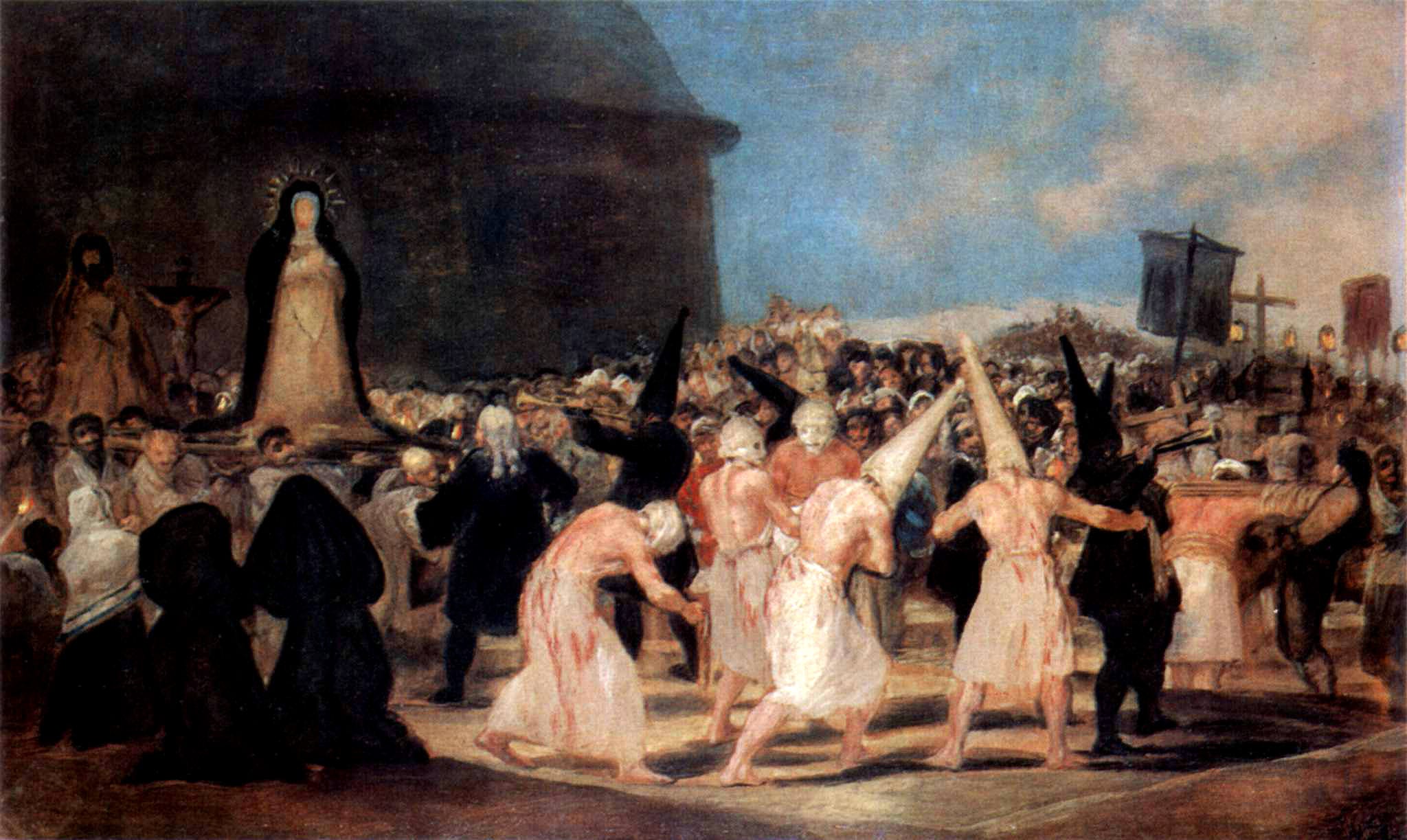
The Crisis at the Ending of the Age
An apocalypse, ἀποκάλυψις, is a genre of narrative from the Jewish tradition following the exile from Babylon. Literally, it means a disclosure or a revelation. It is a story about the future, commonly about the end of the world, that comes from a prophetic and authoritative source.
If you have read the Book of Revelation you know that an apocalypse is a complicated thing. Visions of a cataclysmic future mapped out partially and intensely create a powerful hypnotic grip. It’s easy to be whipped up into panicked, cult-like behaviour, and people still are every day. Waco, Texas. The Tokyo Sarin gas attacks. QAnon.
In the Middle Ages in Europe though this wasn’t an edge phenomenon. From before the year 1000 through the Reformation the world was filled with an apocalyptic air.
“Prophets” regularly gathered tens of thousands to announce the eve of the end of the world and usher in a changed society. The Taborites in Bohemia burned down monasteries and tried to build a communist paradise ahead of the Second Coming. Flagellant armies massacred Jewish communities they believed were working with the devil to prevent heaven on earth. The Anabaptists seized an entire city believing it would become the New Jerusalem.
The thinking that led to these revolts, though extreme in these cases, also permeated the top social strata and was part of political debate. After Charlemagne’s reign, he became enmeshed with stories of the sovereign who would unite Christendom at the end times. Later, German emperors including Frederick II were referred to as the “Emperor of the Last Days” while supporters and enemies fought about whether they were the messiah or the antichrist.
Apocalyptic literature was everywhere. Even the most famous theologians, the thought leaders of the day, including Roger Bacon, and Hildegard of Bingen believed that they were living in the end times and called for people to act accordingly.
Why did this happen?
For Medieval Europe the idea of apocalypse was like a key that perfectly fit the lock of the story they understood themselves to be part of. At the time they lived under a particular set of assumptions, what Charles Taylor calls background beliefs. Ideas around what is self-evident about the world.
They believed that history had a clear beginning, middle, and end and the middle point had already been passed with the life of Christ. They believed that social and personal unrest like the frequent plagues and rebellions they experienced were exactly what you would expect to see at the end times. They recognized the supernatural as an essential part of how the world operated, meaning events outside the realm of their everyday experience were not only possible but likely. And they were certain that the best source for understanding what the future would look like was existing texts with prophecies laid down long ago.
In the milieu of these background beliefs the idea of a millenarian moment tied to a particular monarch, war, or celestial sign that could be interpreted as fulfilling a prophecy of the end times was irresistible. People were stoked into a panic that the end was nigh because they couldn’t imagine any other way that the future would unfold.
Today once again we are approaching the end of time.
People asking if AI is going to take their jobs is like an Apache in 1840 asking if white settlers are going to take his buffalo
It is no exaggeration to say we are gripped by an apocalyptic vision. We are “Near the end of the exponential”. The kingdom to come may be a paradise but it seems more likely to be a catastrophe. Noted leaders working on AI both as an engineering and philosophical problem have repeatedly warned that: “If anyone builds it, everyone dies”, “we are summoning the demon,” and this will create a “bloodbath.”
Just as it was for people in the medieval world, it is impossible for us to see it any other way. We have a set of background beliefs about the way the world works and a story has come along that fits those beliefs so perfectly it feels like it must be true.
We believe history has an arrow of progress. This progress is mostly determined by technology, and over time this has taken us from hunter gatherers to our current way of life.
We understand this progress, and the creation of our technologies, to be the result of intelligence. A way of seeing the world objectively and making calculations about it. As a corollary the more we strip away the messy “human” and biological parts from this rational process the more effective it will be.
We know that everything is reducible to material causes. We suppose even our minds work this way and we believe all problems will ultimately be addressable by a machine.
Into this mix comes the idea of a superhuman Artificial Intelligence, a machine for creating intelligence, fully disembodied from the messy biological substrate, able to work on itself to continue to improve its ability, eventually generating the machines that can solve every problem. It will improve exponentially, bringing us, in a matter of years, to history’s technologically driven end point “the singularity”.
Humanity’s place in the cosmos will recede like a scroll being rolled up and every thing that appears stable will be moved from its place.
We even have a prophetic mysterious figure from an island realm — Nick Land the Elder — who saw all of this coming.
It is irresistible.

The Great Revelation
In Hindu and Buddhist cosmology there is an idea of time called a kalpa.
Take the largest mountain you could possibly imagine—dozens of miles in diameter. Now imagine a bird that flies by this mountain once every hundred years and brushes the tip of the peak with a thin piece of cloth it is holding in its mouth. A kalpa is the amount of time that it takes to wear the mountain down into nothing.
Later scholars have tried to calculate what this image could possibly equate to in human terms and one Hindu tradition arrived at somewhere between four and five billion years, about what we believe to be the age of the Earth.
Current AI systems work by adding up many simple calculations. The numbers are staggering. A state-of-the-art Large Language Model has billions if not trillions of parameters. Each time a single token, a tiny chunk of text, is added to the end of a response from one of these chatbots it activates billions of these parameters.
This means a more complex query like asking a coding agent to build a basic web app will activate hundreds of quadrillions of parameters. This is the equivalent of solving a simple calculation every single second for an entire kalpa. This is already happening thousands of times a day and that number is expected to only increase from here.
To be clear, this is an apocalypse in the sense of disclosure. We are unveiling the extent of the power — the breadth and depth — of mathematical representations of the world. We have created embedding spaces of language and hyper-dimensional vector objects that contain magnitudes beyond anything that could have even been conceived by pre-modern people pushed to their limits.
It is possible that this time we have the right background beliefs and some people have called the end of the world correctly. Right now there is nothing that can prove that they haven’t. I know I certainly feel the pull of the revelation and it would be absurd to not notice the shocking capabilities that this technology has produced in just a few short years.
But we shouldn’t kid ourselves that we “know” that these are the end times — for good or ill. If it is a horizon that we cannot see beyond, that says more about us than it does about the horizon.
How to live in an apocalypse
“The devil has fear only, but his fear has no strength. Fear him not, then, and he will flee from you.”
— Shepherd of Hermas
Much of the breathless discourse for how to act in our current apocalypse is fear driven and foolish in the worst possible ways. Some things are always wise advice as part of being prepared for the future. Be frugal. Maintain your health. Try to be watchful for disruptions.
But beyond this any advice to profoundly change the way you live should be suspect. In particular one of the most common pieces of advice is to drop everything to integrate AI everywhere and make it an essential part of how you do your job — regardless of what it is.
It is good to know that this technology is changing fast. I think it probably makes sense for everyone to experiment with what AI can do and try to understand how it could make you more productive. Personally though, I don’t want to throw myself into something wholesale just because it’s “the next big thing”.
I use AI all the time. I used it in writing this piece for research and editing. I love what it allows me to do. I build apps, write documents, and I’m experimenting with other workflows. I’m able to learn things I couldn’t have imagined and build things that would have been impossible a couple years ago. But I am also hyper-aware of the costs to my own abilities from leaning into it too much.
There’s emerging scientific evidence that ties AI use to the decline of mental skills and ability. My clear anecdotal experience is that when I write just with AI, I get sloppy. I need to do more reps of difficult activities to win back those skills. I expect that this experience is shared by many.
Part of this is about the unclear relationship between different levels of abstraction. Think about it this way: Let’s say you “write” primarily by thinking about the kinds of things you want to say and then prompting an AI rather than typing it directly. You have become an architect and reviewer creating the ‘structure’ of an argument abstractly but letting the machine fill in the details.
But how good can your architecture be if you don’t ever sweat over correctly placing each paragraph, sentence, word, and letter? If you never do the work at the contact point with reality how good can the model of reality you are using to do your architecting really be? It’s an open question but I’m disposed to assume it won’t be as good as it could be.
This particular risk is not a reason to not figure out all the ways this magic technology will be useful to us. But it’s likely that as we start to use these tools there will be many more questions like this to grapple with and rushing headlong into adoption at random is not a good way to answer them.
The best way to integrate AI into our society will emerge over time. In the meantime though the bigger issue is that this fear driven response to our impending doom is likely to make us foolish in much bigger ways. If you really believe the world as you know it is going to disappear forever what does that do to your day-to-day, moment-to-moment moral choices? Are you likely to devote your efforts to a way of life that may require decades of practice to master? Are you going to push for a government that cares less about the debt if you think we’ll grow our way out of it? Are you willing to sell out your friends because you see it as the only path to exit the “permanent underclass”? This doesn’t seem like a recipe for success. I think we can hold ourselves to much higher standards of wisdom when it comes to navigating these things well.
The solution cannot be to try not to believe in what is being revealed. It is impossible. It is happening. But, in some ways it has always been happening. The way to move past it is to realise that there are bigger things at stake. We need to focus on the things that matter most beyond mere continuation of our existing way of life.
This is how C.S. Lewis puts it in one of the best meditations on this subject On Living in an Atomic Age
We must resolutely train ourselves to feel that the survival of Man on this Earth, much more of our own nation or culture or class, is not worth having unless it can be had by honourable and merciful means.
The sacrifice is not so great as it seems. Nothing is more likely to destroy a species or a nation than a determination to survive at all costs. Those who care for something else more than civilization are the only people by whom civilization is at all likely to be preserved. Those who want Heaven most have served Earth best. Those who love Man less than God do most for Man.
If we wish to see beyond our current horizons we must understand ourselves to be more than we appear. It is only when we can get behind our background beliefs that we will be able to see the future beyond their termination point.
This is a special week. The world’s largest migration is happening in the Middle Kingdom for Chinese New Year. Muslims around the world will begin fasting for Ramadan and Lent begins on Wednesday to mark the trials of Jesus in the desert. This is a unique opportunity to spend time with family, practice virtue, think about the character you want to develop, and reflect on what really matters. Don’t spend the rest of it thinking about matrix maths.
Thanks to Sherry Ning for reviewing and commenting on a draft of this essay.
No posts
Comments
Nothing yet. Say the first thing.
Sign in to join the conversation.