
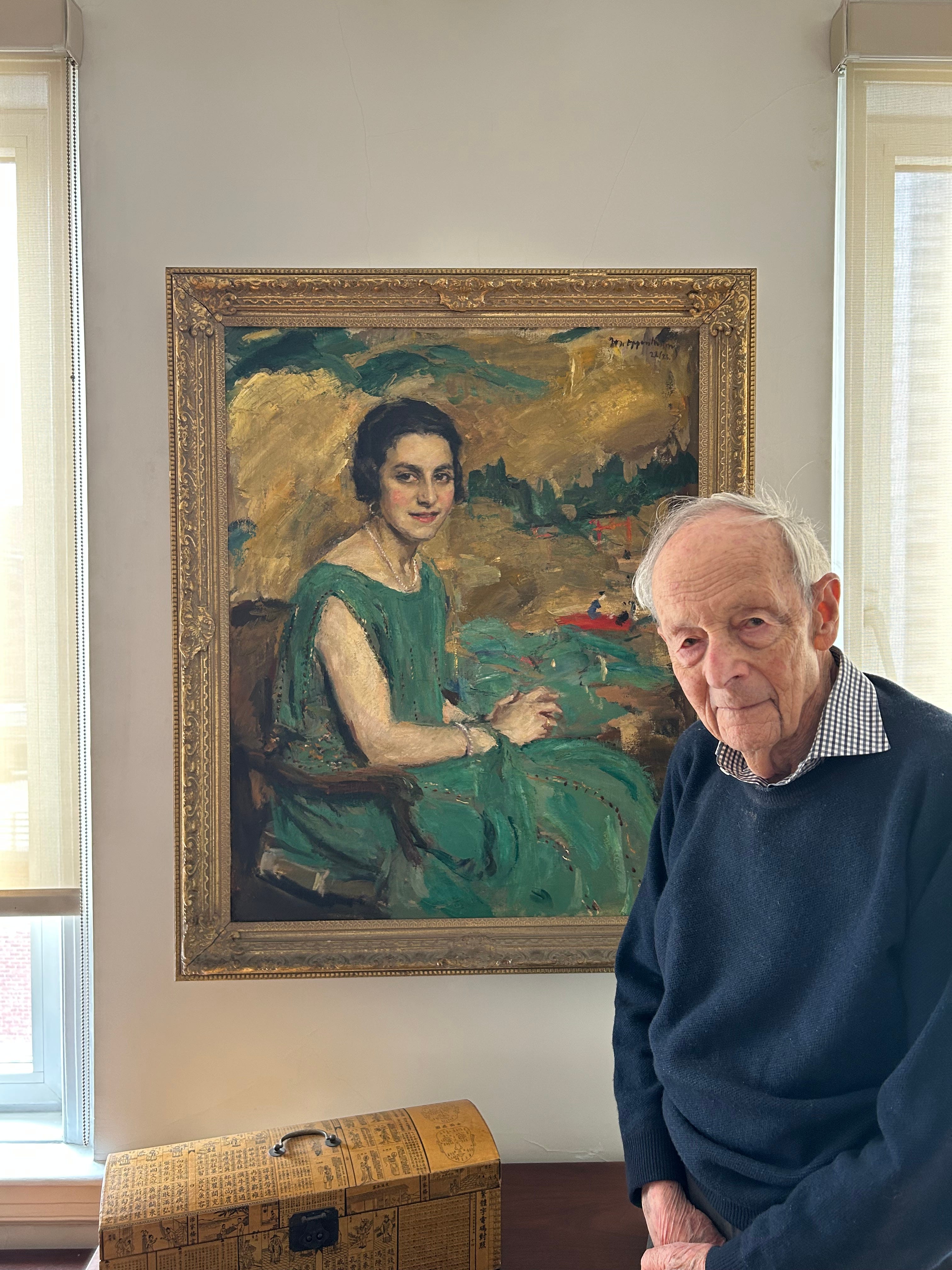
Georges Borchardt was a small, thin man with a heavily French-accented English, tinged with irony and wry wit. He had seen it all. We first met in his offices in mid-town Manhattan two decades ago. A novelist friend, one of his clients, Alan Lelchuk, had recommended me. It turned out less a test than a lively conversation, and he became my agent, eventually turning into a long-distance friend. Meeting up with Georges and Anne, his wife, was always a high point in Leah’s and my infrequent visits to New York City. We would always lunch or dine in his apartment or in a nearby restaurant, French, Japanese, Italian, where he was a much-welcomed habitue.
Sadly, he died last week at 97 after a career spanning almost eight decades – a “renowned” literary agent, in the words of the New York Times obituary - his agency eventually representing, among others, five Nobel Prize- and eight Pulitzer Prize-winners, not to mention a host of other luminaries, including Charles de Gaulle, Jane Fonda, Hannah Arendt, Tennessee Williams and Edward Said.
Borchardt was born in Berlin in 1928, and four years later, fleeing the Nazi ascension, the family moved to Paris. His father managed the Polidor record company, which handled, among others, Edith Piaf. His father died and the Nazis arrived. Borchardt and his mother, Anne, and two sisters, Marguerite and Ingrid, somehow survived the years in occupied Paris and then fled to the Vichyite south. Borchardt and his sisters made it through but his mother, rounded up by French militiamen or gendarmes, was murdered in Auschwitz.
Last February Borchardt told me about those years and, once in New York, the somewhat fortuitous start of his career as a literary agent.
“My mother was a typical housewife of the time, her world [before the Nazis] consisted mainly of making sure there would be no garlic in the food. There was a cook, a laundry woman, a governess and a driver (my father didn’t know how to drive).”
“[In Paris during the first years of the German occupation] we just went on living normal lives. I’m not sure I even knew I was Jewish. I think I had been in a synagogue only once, for a wedding. [But eventually] I put on a yellow star. I must have been fairly nervous. My school was five minutes down the street, we lived in a bourgeois neighborhood alongside foreign diplomats and the famed Aga Khan [the Isma’ili Shi’ite spiritual leader and millionaire].”
“I used to sell raffle tickets, door-to-door, along our street. One day I was walking to school when this very well-dressed black gentleman crossed the street and shook my hand [in a show] of sympathy. Neither of us belonged, I suppose. [But] he couldn’t take off his skin, so we weren’t exactly in the same boat, but, of course, he wasn’t threatened in any way. France had always been very welcoming [to black people]. Yes, they felt much freer in France than in their own country [the United States?].
“One day my sister’s boyfriend, who worked in the police prefecture, told her that the Jews were to be arrested the next day. [So Borchardt and his mother and two sisters fled to the unoccupied “Free Zone,” ruled by the Nazi-aligned Vichy regime.] I remember crossing a bridge in schoolboy uniform, on foot, I had the shortest legs of the four of us, eventually settling in Nice. [To avoid identification as a Jew] I attended a private school. [But] mother was [eventually] arrested, shipped to [the French internment camp] Drancy, and then deported to Auschwitz. [When she was rounded up], we didn’t know where she was [or where she was] going. I don’t think we knew that the Germans were murdering the Jews. Or we didn’t want to know. Later we found her death recorded in documents. [For a long time] I didn’t know she was dead and for a long time I would walk down a street and from afar spot someone who looked like my mother ...”
When did you actually learn that she was dead?
“I don’t know, [it was certainly after the liberation of Paris by the Allies].”
“[One day] the concierge [told me] that my mother had been arrested. I didn’t know what to do. Then I met a student from my school who wanted to become a priest, and told him what had happened. [With the help of another student] my sisters were moved to a village in the hills. They had to go to church every Sunday and make the sign of the cross. [Georges later learned that the student asked girls he rescued to sleep with him.] I thought this was a bit strange but I was a very innocent 14-year-old. I didn’t know much about real life.”
Georges himself was placed in the hands of a local priest and then, when the Americans invaded southern France in summer 1944, Georges joined his sisters “in the farmhouse where they had been hiding. The farmer had lost an eye in First World War and I remember he kept his fake eye in a glass on the table. He had served in the war under Petain [the head of the Vichy government] and he regarded him as a saint. He must have known that we were Jewish, that he was hiding Jews, [but] of course we were paying him for that.”
How did you have money?
“My mother had taken her jewelry with her, and whenever we needed money [she] sold something. Anyway, I’m sure we weren’t paying [the farmer] very much for the room in the outhouse. There was no bathroom and no running water. [But Provence] was very pretty. I used to get water out of a well. There was a pail but it was all rusty.”
Eventually the three made their way back to Paris and managed to reclaim the family apartment. “But it was totally empty. The furniture had been taken by the Germans, not by the neighbors.”
But in the concierge’s apartment he spotted objects he remembered from their home. “I would look at the vase and she would say ‘your mother was so generous. She gave me this for my 50th birthday.’ I don’t know if my mother was particularly generous, but I’m sure she never gave her the vase. Anyway, we got the apartment back and stayed there for two years and I went to law school. I hated it.”
George’s sisters, who back in Provence had briefly worked in an American field hospital, wanted to go to America. “They had met these gorgeous-looking GIs, with blond hair and blue eyes, who were busy handing out delicacies, like wonder bread and spam and even chocolate and nylon stockings. They had come from paradise. We had two cousins in America and [visas were arranged. Georges decided to ship out with his sisters]. I thought it might be a good idea just to learn the language. I had had six years of English [in the French schools], also six years of Latin, but I had never heard either spoken. All I could recite were one or two poems about daffodils.”
Stopping over in London on the way to the US, they stayed in a hotel where “they served eggs in a silver eggcup. It was amazing. On the liner to the US I only remember being seasick all the time.”
“I was 19 and in New York and looking for a job. But I had no English or work experience in the US. An acquaintance helped me write and place two classified ads in the New York Times. All they said was that I was 19 years old, fluent in French and looking for a job.
A few days later “there were two letters waiting for me in the mail, each responding to one of the ads. Both were from Marion Saunders, described as an ‘authors and publishers representative.’ One said ‘call to make an appointment;’ the other invited me for an interview ‘next Monday at 10’.”
Saunders was the daughter of a British Civil servant, had been brought up in Germany and France, and was multilingual. So, on the Monday she interviewed Georges, in French. “At the end she said: ‘I think you’ll do.’ She added that she hadn’t yet heard from the other person who had advertised. I said: ‘I’m that other person’.”
“And that’s how I became an [assistant] literary agent, without really knowing anything. I received 35$ a week,” a minimal salary, “and at first ran errands, to the bank and post office, made coffee, packed books, which I became very good at. I learnt a lot from her about what one should not do.”
But also much else. She represented some French publishers in America “and [eventually] my role was to read the books that came in from France. Marion had just sold Knopf [a leading American publisher] Albert Camus’ first novel, The Stranger. I was supposed to spot other [promising writers]. Pretty soon, two novels and a play landed on my desk. They were by Samuel Beckett [an Irishman who lived in Paris and wrote in French] – Molloy, Malone’s Death and Waiting for Godot.“ American publishers turned them down serially. “I got replies like ‘unreadable prose.’ But eventually Grove Press bought all three for $1,000. Funnily enough, last week we got a check for $50,000 for Godot [from a publisher or theater company].”
“So I got a reputation in France for being able to sell the unsellable.”
But after three years with Marion Saunders, Borchardt was called up by the US Army. There was a war in Korea and America was drafting residents as well as citizens. “I was sure they wouldn’t take me. In the physical exam I was surrounded by 6-foot-tall athletes – who were rejected because of flat feet. I actually fainted when they drew my blood. But they took me.”
Most of the draftees were shipped off to Korea. But a different trajectory awaited Borchardt. He believed he was going to Bermuda – but eventually he landed in Iceland, doing guard duty at an American air base. “So I would march around the perimeter with a gun. At night I was terrified someone would [mistakenly] shoot me.”
But the base finance officer noticed that he could “multiply as well as add and subtract” and he was appointed the unit paymaster. “[Soon] I got a letter of commendation from the commanding general and was promoted first to corporal, then to sergeant (I think).”
He roomed with a sergeant from Tennessee “who said he was going to become a minister. To keep myself occupied, I made it my mission to talk him out of his religious vocation. My life was easy. Every second night I went to the movies and there were free trips on Air Force planes. Twice I flew to Paris, where I met publishers. One said that when I got out, I could represent him in the U.S.”
Back in the States in 1952, Borchardt spent a further year with Marion Saunders and then signed up to do an MA in NYU. “Arriving on the campus, I met a woman in the elevator who said that this was her first day as head of the French Department. [We talked.] She asked me if I could give a French conversation course. I said yes. I taught there for four years and ended up giving three courses.”
During the following years, Georges continued representing various French publishers and authors and in 1967 founded the Georges Borchardt Literary Agency.
“But before then, in 1958, a French publisher sent me another unsellable book, La Nuit (Night). Nobody wanted to read about concentration camps; the word Holocaust was not even in use. But Jerome Lindon, of Les Editions de Minuit, thought that, after Godot, I could sell anything.”
The book’s author, Elie Wiesel, lived near the legendary Café de Flore, behind a drug store, on a little cobblestone street in a building that once housed a brothel. Borchard said that “Jerome told Wiesel ‘you have replaced the bidets with death’.”
“So, I got La Nuit. I didn’t really feel like reading it. [I seem to remember that Georges once told me that he gave it to Anne to read first.] I didn’t really want to read about concentration camps. My way of dealing with problems was to push them under the rug. I really didn’t want to think about it. It was too painful. Yes. There was was my mother, but also a lot of other people I knew.”
“Death, I think, is always hard to accept, that kind of death is even harder. I can’t even imagine that [this kind of death] was possible, that human beings could do this to each other. Unbelievable.”
Then a lot of rejections followed. “I have a letter from Blanche Knopf [of Knopf] saying this book will never find an audience in this country. Why don’t you try and sell it in England or somewhere? He [i.e., Wiesel] was an unknown and not very promising author and I was an unknown and not very promising agent. And we were outsiders, we came from abroad, which, of course, is not that unusual in this country.”
“But eventually Night was taken by Hill and Wang. By then, Arthur Wang and I had become good friends. I don’t know whether he [published it] as a favor to me or because he thought it was important. He said he would take it if I found a British partner to share translation costs. He paid $100 on signing the contract. So I made $15 for [two] years’ of work [trying to sell it]. Now it is our best-selling backlist book. It sells between $400,000 and $500,000 [worth] of copies a year in this country [alone] because it’s read in many high schools.” Translated into more than 30 languages, the book sold some 14 million copies worldwide by 2020.
Borchardt and Wiesel became fast friends. “He always had a convertible and once, when driving us to the airport - JFK was then called Idlewild Airport – I said ‘You know, Anne has decided to change her last name and it’s now Borchardt.’ And that’s how he learned that we had married.” (Of this, more later.)
“Another time he picked us up from the airport, in Paris, and Anne complained about the café au lait and that, in their hotels, the milk was always soft, curdling. So he showed up one day with a strainer.”
“At the time Wiesel didn’t really believe in God because how could you believe in a God who had allowed these things to happen, including the killing of his father [who died beside him in Buchenwald]? But we didn’t really talk much about that … [Later, however] he became more and more kosher.”
“I didn’t even know I was a Jew when I grew up. I had never heard of the High Holidays until I came to this country. The only thing I knew was that George Steiner, who was my best [childhood] friend [in Paris], he lived a few blocks away, was getting his Christmas presents a week or two before I did [presumably for the Jewish holiday of Hanukkah]. And he didn’t have a Christmas tree, and we did. [Steiner later became a famous writer and Borchardt Agency client.]
“[Steiner and I] could be quite obnoxious, for instance by kidnapping our sisters’ dolls. But we also had serious endeavors, like we were at work on what was to be the definitive biography of Napoleon … But the ‘biography’ became another victim of the [Second World] War.”
Georges recalled that when he told Steiner that his daughter, Valerie – now president of the Borchardt Literary Agency – was getting married, he said “I hope he’s Jewish.”
Steiner, says Borchardt, was critical of Israel. “He called it a “’militaristic country. Jews should be intellectuals,’ Steiner said. ‘They shouldn’t be shooting people’.” Reflecting on this, Borchardt says: “It’s a mistake to have too strong an opinion about the politics of a place where you don’t live.”
Borchardt was far more empathetic and understanding toward Israel and its problems. He said that “the French were always criticizing America – until Obama was elected. All of a sudden we [i.e., Americans] were heroes.” And he added, mischievously: “[But] the French have never had a black president and probably wouldn’t accept one now.”
Georges described his meeting in the Fifties with Charles de Gaulle, the Free French leader during the Second World War and, later, France’s president. “De Gaulle had an office on the Left Bank. I went along with his French editor to see him. We were two very short men. [De Gaulle was enormous] and none of his aides were under six foot two or six-four … two dwarfs in the land of giants. De Gaulle didn’t say much.”
Borchardt was asked to find an American publisher for the general’s memoirs. So there was an auction. “Houghton Mifflin made the highest bid. But de Gaulle turned them down because they were Churchill’s publisher. [There had been bad blood between the two leaders during the war.] So it went to Viking Press, the second highest bidder. But it didn’t sell well because de Gaulle was incredibly unpopular in the US.” [De Gaulle resented and combated America’s post-war efforts to dominate western Europe.]
“I have probably met more interesting people than anyone I can think of,” Borchardt says. Over the years he represented dozens of leading intellectuals and celebrities, including Michel Foucault, John Le Carre (The Spy Who Came in from the Cold), Jean-Pal Sartre, Eugene Ionesco (Rhinoceros), Ian McEwan, T.C. Boyle, Tracy Kidder, Frantz Fanon, Aldous Huxley (Brave New World) and Marguerite Duras.
Borchardt was Le Carre’s American agent for two or three books. “I traveled to London to meet him, we had lunch and got along well, a sophisticated guy, well-read. When he came to New York he would bring us caviar and champagne. Then, at some point after four-five years, he simply left us.” Borchardt was informed of Le Carre’s departure by his German agent. “No letter from Le Carre. Nothing. I have no idea why he left.” (But years earlier, Borchardt told me that Le Carre left the agency in the hope of getting more rewarding contracts.)
“When a client leaves, it’s painful, like a divorce.” He supposes Edward Said (Orientalism) left the Agency partly for political reasons. “He was very intelligent, fluent in French. We had a social [relationship]. In those days you didn’t have to agree [politically], you didn’t take out a gun. Things have changed. Now, if someone disagrees with you, he’s an enemy. I think that’s sad. You see this today in the universities.”
Borchardt points out that over the years he sold books to publishers by the pro-Fascist French writer Louis-Ferdinand Celine and even World War Two collaborators. “I don’t think my job is political, it’s intellectual. There is a need [to hear] people from the opposition. Teaching has become a minefield. [University] people I now represent tell me that there are things they just can’t say in the classroom. Students have become more vocal and deeply engaged. It’s not just Arabs and Jews; it’s left and right, men and women. A few years ago I was having coffee in the Village with a woman who had written a book on Lesbians in America. Her coffee didn’t arrive so I hailed the waiter. The woman started shouting at me ‘why do you interfere; why do you think that they will listen to you more than to me?’ I apologized.” Borchardt was pointing out the absurdities engendered by Woke-ism.
“However, I now feel I can do [and say] whatever I want, because of my age. People have written me off and I don’t care. The culture has changed. In France, half of the couples who live together are not married.”
Borchardt said he doesn’t have a cellphone (though Anne does) and doesn’t like reading books on a computer.
Somewhat sheepishly he tells me: “I’ve never been to Israel. Never really had a desire to go there. I can’t explain it. Anne has been – and loved it (her only trip without me).” Georges and Anne have worked together at the Agency, reading books and manuscripts and advising authors, for half a century. “Anne was my first reader,” he says.
They met when he taught French at NYU. “She was the best-looking girl in the class but a rather irritating student. I think just to get attention she would say Prof. Noakes said so and so. And I would say ‘well, Prof. Noakes is wrong.’ I was rather arrogant.”
“But sometimes you end up doing the right thing for the wrong reasons. Anne asked if I could give her private lessons as she was planning to go to France. So, I put her in touch with someone [whom I was sure] she wouldn’t like. Then she called me and she came to my office. And we went out to have an omelette at a small restaurant called Madame Romain de Leon that served 200 different kinds of omelette (one was called “Omelet Pompidou”).
At this point Anne entered the conversation and, recalling that meal, said she had recently bought a pair of sandals, which she was wearing, “and I thought Georges had taken me there – the tables were really on top of each other – because no one would see my sandals which he said he hated. But he denies this. I still don’t believe him.”
And that was the beginning. “I gave her some advice and she went off to France and we started corresponding. I don’t know how I had the nerve to do it but I wrote her: ‘Why don’t we go on vacation for two weeks when I get to France?’ And I took her to this Mediterranean island off Marseille, where I’d never been before.” During the following years, Georges and Anne repeatedly vacationed at the same hotel on the island. “We have now been married longer than anyone else.”
(Photo of Borchardt standing by a portrait of his mother. Photo by Benny Morris, February 2025)
Comments
Nothing yet. Say the first thing.
Sign in to join the conversation.