
When people ask me about what it’s like to be an urban planner, I usually start to tell them about the economic development projects I do at work: regional economic planning for semiconductor manufacturing, workforce development planning, feasibility studies for real estate projects…
… that’s usually when their eyes glaze over.
Now this newsletter is a testament to the fact that urban planning is incredibly interesting, but recently I’ve been wondering, why does it sound so boring at parties?
To better understand this, we must turn to the meme my friend Nick sent me last week:
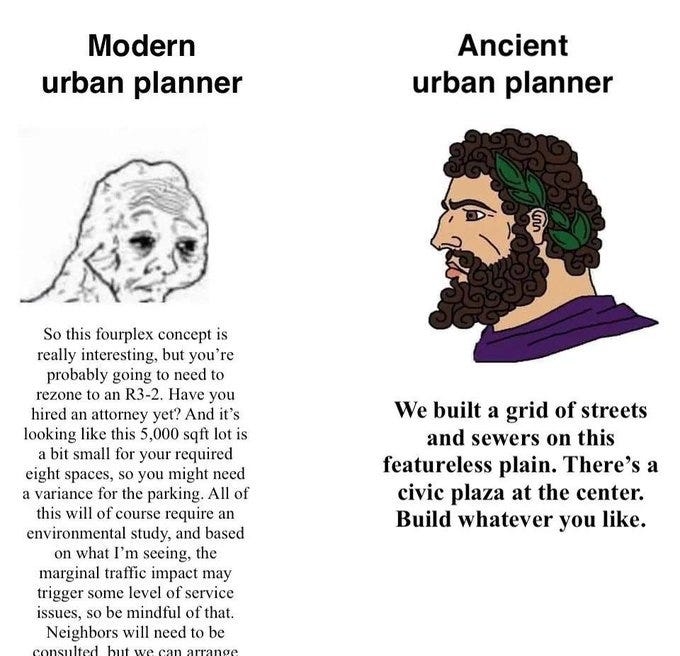
I know you’re probably thinking “oh my god is he going to use this meme as the jumping off point for this post?” and the answer is YES but please hear me out.
So you get it, the joke is that planning used to be about creating the basic space for humans to interact but now has become a technocratic nightmare. And this speaks to a tension that I feel all the time in the discipline - the line between what we may refer to as “urban studies” which refers to deepening our understanding of social interaction and its relationship with the built environment, and the professional field of “urban planning” which is the development of policy to shape urban space and programs.
Inherently, these two projects are linked: the theoretical framework for how urban life functions drives decisions about policy, and policy outcomes can be evaluated and incorporated into future theories of the built environment.
But to the point of this meme, it often feels that there is a wide chasm between these two parts of the discipline. On one hand, there are a bunch of armchair urban planners running around talking about what cities are and how they function (or worse what cities should be and how cities should function) and on the other, there are a bunch of paper pushing technocrats executing on policies that have no basis in our current reality (see: parking minimums).
However much we feel that these two halves of planning are incongruous, I’d argue that in a complex modern society, we need both. We need the big ideas that shape our cities, but we also need the systems and processes to execute them on a massive scale.
So how do we bring these things together?
At risk of turning a meme into a manifesto, I think the project of this newsletter is to develop a way of thinking about theory and policy together. While there are many ways of doing this, I rely on advice I got from my professor, Karilyn Crockett, who advised me: “when you’re trying to write about concepts that are very big, use an example that is very small.”
That’s why I’m interested in looking at everyday examples of city life and interpreting how *big* political, economic, and technological concepts are playing out in these spaces. Something as simple as a hotel bar can be an example of how cities allocate (and police) public and private space. And by evaluating hotel bars and what we do and don’t like them, we can better design future spaces where people gather.
And I hope that you, as my readers, can take these ideas and develop them beyond this newsletter. This is just a civic plaza on a featureless plain. Build whatever you like : )
Bennett
City Speak #36
No posts
Comments
Nothing yet. Say the first thing.
Sign in to join the conversation.