
In the last newsletter, we covered the basics of the NYC bus network and some of the quirks of its service types, fares, and organizational structure. In case you missed the last installment of this series on the Mamdani administration’s proposal to make buses in NYC fare-free, you can find it here:
deep dive on the nyc bus system
·
Feb 27
In my opinion, effective urban analysis is place-based, meaning it seriously considers a city's specific conditions when making claims. Therefore, as we evaluate the possibility of fare-free buses, we will focus on the effectiveness of this policy in New York City specifically, where it is currently being seriously considered. And to do that, we must u…
In 2024, the bus network cost $4.9 billion to operate - but we were left with the question - is that a lot? It sounds like a lot, but in the context of other major NYC services, it doesn’t actually seem like that much. For example, the NYC Department of Education budget for the 2025 - 2026 school year is $42.8 billion.
So my takeaway was that we need a better metric to understand how efficiently the MTA is running bus service. This will help inform our opinion on whether free bus is a smart policy for New York City.
Before we dive into this discussion, I just want to do a quick austerity mindset check to make sure we aren’t over-indexing on cost-effectiveness in our analysis. While it’s important that our public services are delivered effectively and cost-consciously, it’s important to remember that these are inherently public services, and public good and efficiency are often at odds. For example, the MTA has an obligation to provide extensive coverage as a public good - this means that the MTA has an obligation to keep fares low and routes frequent in places even where routes are not making money. Because the transportation does not exist solely to earn revenue, it exists to facilitate mobility for New Yorkers, allowing them to affordably access jobs, friends, family, fun, and the city that they love.
OK, I’ll get off my soapbox now. The transit industry has two standard metrics for evaluating the cost-effectiveness of a system: (1) the cost per mile of service provided, and (2) the cost per hour of service provided. If you’re not familiar with how transit reporting works, a single mile of service is the equivalent of a single vehicle traveling a single mile. So if an agency has 100 vehicles on the road and they all travel one mile, the agency reports 100 miles of service. An hour of service is calculated the same way (100 vehicles X 1 hour = 100 hours of service).
I dug into federal reports on NYC bus service and found that the New York City bus system currently costs $49/mile and $301/hour to operate.1 The MTA reports its different bus divisions and service types separately, so we can see how these costs break down by service:

One of the most surprising things about this table is that the cost per mile does not vary significantly between services - I hypothesized that we would see higher costs for bus rapid transit and commuter buses because they offer a more robust level of service, but they largely have the same cost per mile as the regular shmegular bus. This indicates that the factors driving bus operation costs are not really about the service itself. In other words, running better and more efficient service may allow you to optimize at the edges, but many major cost drivers are external: union contracts, political priorities, vehicle maintenance, to name a few.
So let’s see how the MTA buses stack up against other major agencies as well as rail service costs in NYC:
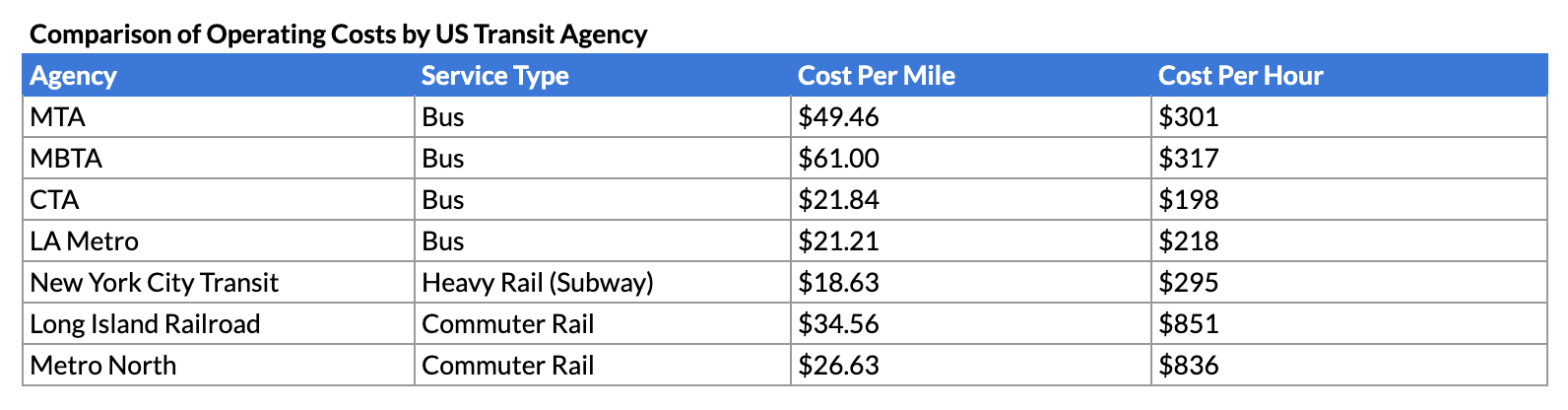
Again, I think one of the most striking takeaways is the lack of immediately clear patterns in the cost data, and some surprising findings:
New York City has the most expensive labor market in the U.S., so I expected it to have significantly higher costs per mile and per hour than other large agencies. However, Boston’s MBTA is higher on both metrics (some more writing on last year’s union negotiation here)
LA Metro and CTA (Chicago) have cost-efficiency metrics that are orders of magnitude lower despite being large systems and expensive metros in their own right.
The commuter-heavy Long Island Railroad and Metro North services mimic the patterns of the commuter bus network, where there is a low cost per mile but a very high cost per hour of service.
And perhaps the most surprising takeaway is that the infrastructure-heavy NYC subway system has a lower cost per mile and per hour than buses in the city.
So what have we learned from this investigation of cost-effectiveness on the MTA bus network? First, it’s clear that bus operations are relatively expensive when compared to other agencies and local subway service (although not the most expensive, which is surprising). Second, these costs seem to be driven by yet-undiscovered factors and cannot be easily explained by the type of service, size of the agency, and local labor market conditions. In any case, I think the high costs of MTA bus service provision weaken the argument that fare-free service makes sense for this system. However, our journey is far from over! In the next edition, I’ll be looking at the demand side - fare collection and ridership - to better understand the full financial picture for the MTA bus system.
Bennett Capozzi
City Speak #54
I’ve used each agency’s federally-reported Revenue Miles to make these calculations because it is a better measure of cost effectiveness. Therefore, these show the cost per mile of service provided and the cost per hour of service provided, not including the time and distance vehicles travel outside of service (as in from the bus depot to their first stop). In the transit industry, these are referred to as “deadhead” miles and hours.
No posts
Comments
Nothing yet. Say the first thing.
Sign in to join the conversation.