
For a confusing set of reasons I’ll broadly term ‘work,’ I recently watched HBO’s new Billy Joel documentary, Billy Joel: And So It Goes. It’s five hours of Billy Joel, explaining how every one of his songs is literally about something that happened in his life, usually within thirty minutes of him sitting down to write the song.
It’s not a very good documentary, but Billy Joel is quite an interesting figure. This is a man with 33 hits. A man with 13 albums. A man who did a 10-year, 104-sold-out-show residency at Madison Square Garden.
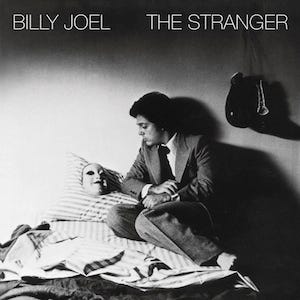
But having now watched this doc and listened through the albums, I’ve become convinced that there’s only one real Billy Joel record: The Stranger.
The film walks on eggshells around the usual Billy Joel criticisms — schlocky, literal, imitative. That last one is the most interesting to me, though. I’ve always admired Joel’s incredible melodies, but have never connected with him as an artist because half the time when I’m hearing a Billy Joel song, I can’t tell that it’s him. His career begins imitating the Beatles, then Led Zeppelin. Columbia is rumored to have signed him after hearing a show where he’s imitating Joe Cocker. This is the moment that launched his career — can you tell it’s him singing?
Early in his career as “Billy Joel,” Joel makes records imitating people like Gordon Lightfoot. Later it’s Frankie Valli (“Uptown Girl”) or The Drifters (much of An Innocent Man, as he discusses in the film) or Springsteen (“Allentown” — at one point he’s literally playing a tan telecaster with a black pickguard, which Fender should retire like a legendary athlete’s number). I’ve often found it hard to recognize Billy Joel’s voice on different songs. For much of my childhood, I thought “Uptown Girl” literally was a Four Seasons song.
At one point in the film, Howard Stern, an old friend of Joel’s, remarks that Billy Joel is a lot more psychologically complex than he’d like to believe. The film does itself no favors by letting Joel be the main voice, and he largely bears out Stern’s assessment. He is a man fundamentally incurious about himself and the tremendous font from from which his creativity pours. His songs are often so literal as to defy any psychological interpretation. And a lot of them, he sings as if he’s trying to be someone else.
And this is what makes The Stranger unique.
In 1976, Billy Joel released Turnstiles. This is his Jackson Brown record - listen to “Summer, Highland Falls” and “Doctor My Eyes” and tell me you can tell the difference between these voices. Maybe because of this fundamental, if capable, tendency towards self-avoidance, the record was not performing well. Joel’s label planned to drop him after the next record came out.
So when he began writing a new record, he dug deep. And he wrote a song about an experience he’d had a few years before, on his first tour of Europe. He knew his estranged father was living somewhere on the continent. Towards the end of the tour, he got a telegram: His father was in Vienna. He decided he’d go see him.
As the Joel documentary indicates, Joel’s non-relationship with his absent father and his father’s anger is somewhere close to the core of his art. This piece has a nice quote from Joel on the subject:
“My father was my idol as a pianist as a kid, because he was classically trained and could read music,” Joel once said. “He would come home from work at General Electric and take Chopin and Bartok pieces and work through them laboriously; this was his entertainment. He could interpret them and make them sound as good as anything that was being played on WQXR radio or the records. But he thought he was never good enough; he never gave himself any slack. He said, ‘I’m a hack, I can’t play, I’m just doing it for me.’ And he’d say, ‘This is how I make my living in America: I work for G.E., and everything is plastic, American plastic.’”
Joel tells a story about how his dad once heard him practicing a classical piece, and then riffing on it in a ragtime style. He came down and hit Joel.
In the 1970s, though, Joel Sr. was raising a new son well east of Long Island, in the most famed classical music city in the world. That kid, Billy Joel’s half-brother, would become a classical conductor. Joel met him for the first time on that trip. Then, in 1977, he wrote “Vienna.”
I’m not the only person who thinks “Vienna” is the best Billy Joel song or that The Stranger is his best album. It was his breakout hit and remains his most critically lauded record. My argument though, is that it’s the only record where he’s consistently doing something only Billy Joel can do. It’s his least imitative record. And I think it’s because it grows out of that encounter in Vienna — something that put him in touch with the psychic root of his art and seemingly insatiable drive — and his willingness to look at it directly.
“Vienna” is also a song that appears to be literal, but actually is not. On the face of it, it is about Joel going to Vienna. He later claimed “Vienna waits for you” was a meditation on the country’s generous treatment of old people.
Yeah, right.
What’s interesting about the song is its bivalence. Most of the song sounds desperate, and a little angry. It’s sung to himself — “You’re so ambitious for a juvenile / if you’re so smart / tell me why are you still so afraid” — largely in despair over his ambition and the lengths to which it’s taken him — “You’d better cool it off before you burn it out.” The lines immediately preceding the famous refrain (about the Viennese welfare state) are:
But you know that when the truth is told
That you can get what you want or you can just get old
You’re gonna kick off before you even get halfway through
I think that, given the context, the refrain is not about the nice things he saw on a visit to Vienna, or a growing comfort with getting old. Or, not only that. “You can get what you want or you can just get old” is a sphinx of a line — it could either suggest that getting what you want comes at the cost of getting old. It could also communicate the inverse — that just getting old in Vienna means you never got what you wanted. In that case, it’s more like the song a man about to lose his career would write — about the fear of failure, of giving up on ambition the way his father did (“kick off before you even get halfway through”).
I don’t know the sequence in which Joel wrote the songs on the album, but it seems like they follow the feelings of that trip, and his close contact with whatever it is he’s running from when he sings like he’s anyone other than Billy Joel. And so for one pretty great record, we get a number of truly singular Billy Joel songs — “Movin’ Out,” “Just the Way You Are,” “Only the Good Die Young,” “She’s Always a Woman.” “Everybody Has a Dream” sounds a bit like he’s aping gospel-Paul-Simon but it’s still good. My point is: This is the record on which Billy Joel sounds, to me, the most like himself. And I think it has to do with the confrontation with his father that kicks it off.
Is this unfalsifiable pseudo-psychoanalytic blather? Yes. But do I believe it? Also, yes.
Why have I, a person who knows basically nothing about Billy Joel, written at such length about him? Because I find a lot of my reactions to art have something to do with the feeling of authenticity, and I find that feeling is usually impossible to pin down and critically useless. Authenticity is a vexed concept, and one Billy Joel, unsurprisingly, dislikes.
But just like you can hear someone’s smile when they speak, I really believe you can tell when someone is singing an honest song. Leave it to a chameleon to write his most honest record about feeling like a stranger.
No posts
Comments
Nothing yet. Say the first thing.
Sign in to join the conversation.