
Months ago, a musician named Xania Monet went viral on TikTok with a song called “How Was I supposed to Know?”
In short videos, women in plaid shirts mouthed along to its mournful chorus under captions that read: “Pov: you found that one song that speaks for your soul.” Three-year-olds in the back seat of cars fumbled their way through its lyrics about growing up without a dad and falling in love with the wrong men. Listeners wept, alone in bathrooms.
“How Was I supposed to Know?” made its way to radio, rose up the charts and just landed at No. 30 on the Billboard Adult R&B Airplay chart. Its success prompted Billboard to run an article marking the historic moment:
“The first known instance of an AI-based act to earn a spot on a Billboard radio chart.”
There is no Xania Monet. She is a digital avatar created by a 31-year-old woman named Telisha Nikki Jones from small-town Mississippi. Jones, an affable entrepreneur and a self-described creator, has been writing poems since she was 24, and about four months ago she began teaching herself how to use artificial intelligence tools such as CapCut and fal.ai to create a digital persona. She uploaded her poems to an app called Suno, which set them to music. Other than Jones’ words, everything — from Monet’s voice to the melody it sang to the piano chords accompanying it — was computer-generated. Jones began to share the songs.
In short order, she was famous. Or Xania Monet was. Soon, Jones had a $3 million record deal, prompting some human musicians — including R&B stalwarts Kehlani and SZA — to cry foul. But Jones sees the whole situation in historical terms.
I wrote about the battle over the historical interpretation of technology in music for MSNBC — you can read a bunch about John Philip Sousa (the march guy), fear of the player piano, and where I think all this is headed over here.
If you’re inclined to think this is a flash-in the pan, it’s worth noting that since I wrote that piece last week, an AI country musician has topped Billboard’s Country Digital Song Sales chart. The song is “Walk My Walk” by Breaking Rust — a ‘verified’ artist on Spotify, raising questions about what, exactly, counts as a verified artist on a platform that has already dabbled with substituting fake artists for real ones via its Perfect Fit Content program.
I don’t believe AI music will replace human music for most listeners. But its champions suggest it’s just going to be just another ‘tool’ like the synthesizer or the drum machine. I think that’s wrong. I think it’s going to be a low-margin path toward profits for a segment of the music industry, and I think the endless stream of slop on the horizon is only going to make life harder for real musicians.
Speaking of musicians with hard lives, I saw Springsteen: Deliver Me From Nowhere last week. The film retells the famous story of how a depressed Bruce Springsteen wrote Nebraska, his critically-acclaimed left turn in between the commercial heights of The River and Born in the USA.
Two things struck me about the film given our moment. First, as with last year’s Bob Dylan film, it valorizes a difficult, strenuous human creative process. The very opposite of writing a prompt and pressing the ‘create’ button.
And second, it too is a story about technology.
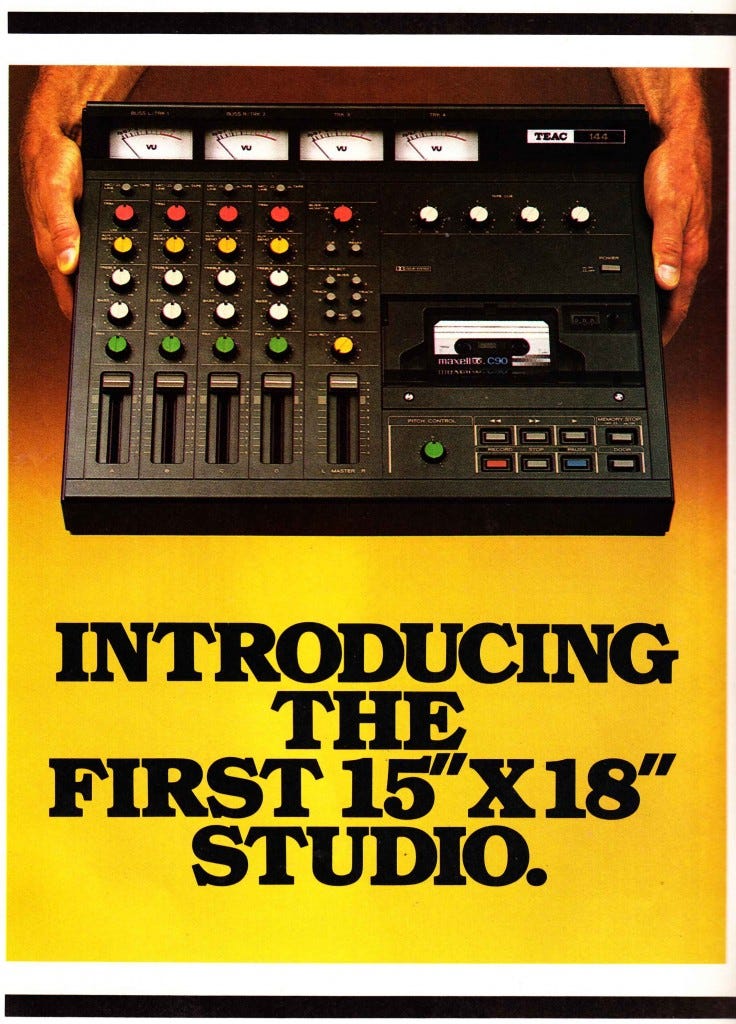
While writing the record, Springsteen buys a Tascam Portastudio 144. Released in 1979, it’s the first true portable home recording set-up. Springsteen got one in 1982 to make demos for what became Born in the USA. Actually, Springsteen just recently released the Nebraska-style demo of “Born in the USA.” It’s wild to hear what a difference the E Street band made while interpreting it in the studio — adding, for example, its iconic synth line. This would never have been a hit:
But, as the film details, a certain subset of the songs resisted interpretation. Springsteen had one of the first cases of demo-itis, a term for falling in love with the raw unadorned sound of a demo. He insisted on releasing those tracks in their unpolished form, and was richly rewarded for it.
This, I think, is a helpful way to distinguish between the music technologies of old — the tools — and the music technologies arriving now. The replacements.
The Portastudio did reduce the number of people required to make a record. Springsteen didn’t have to pay for studio time; there wasn’t really an engineer; and he didn’t have his band with him. But it enabled an entirely new form of human expression, an even more immediate, auteur-style record from a songwriter pushing his form. And because of the way the record industry worked in the 1980s, his label rallied behind his creative risk. A new form was created as a result.
Writing a prompt and pushing ‘create’ is never going to make something comparable. But now that that’s an option, how many embattled record labels will be willing to rally to a future Springsteen’s aid?
No posts
Comments
Nothing yet. Say the first thing.
Sign in to join the conversation.