
Gm,
Breaking format this month. Instead of the usual short thesis up top, this issue leads with a full piece on private credit, RWAs, and adverse selection.
TLDR: the biggest capital stack in TradFi is leaking, and crypto looks like it’s going to be the exit liquidity. The standard deal flow digest funding data follows below.
Fair warning: this one is long, and Gmail will probably clip it. If it cuts off, hit “View entire message” or read the whole thing on the web.
Private credit built a $2.1 trillion asset class on opacity, and that opacity is now failing. Redemption gates are up across the industry. Marks on the same loan differ by ~14 points depending on who you ask. The real default rate is triple the headline number. And right on cue, the industry has found its next marginal buyer: crypto.
“Real world assets (RWAs)” are the hottest narrative in of the crypto market. Terrible name, but part of the ongoing chant of: “Tokenize everything, bring TradFi on-chain.” The numbers are large: $16 trillion by 2030.
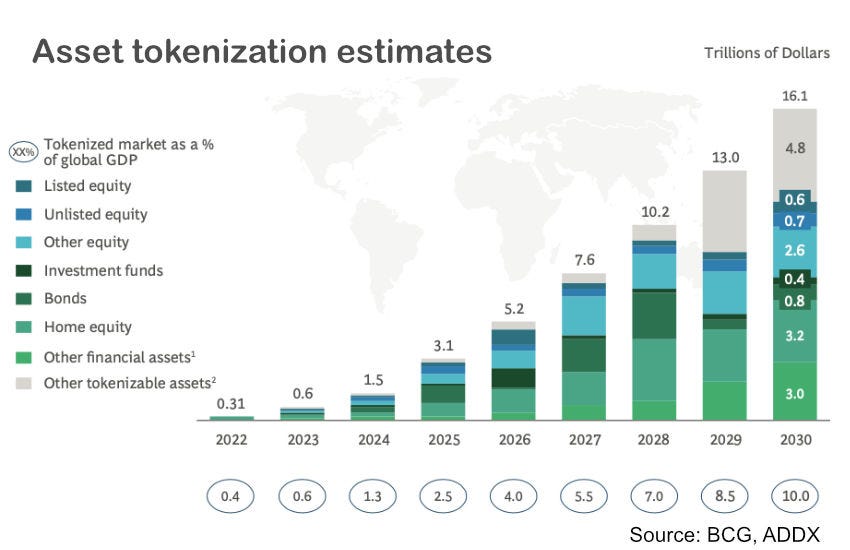
My worry is that the first trillion dollars of credit that wants to come on-chain is possibly the trillion that can’t find an exit anywhere else.
If you only read one section, read the adverse selection one.
Private credit didn’t start as a scam. Post-2008, Basel III made it expensive for banks to hold leveraged loans to mid-sized companies. Direct lending funds filled the gap. In 2008 this was a ~$30B cottage industry: locked-up institutional capital, senior secured first-lien loans at ~40% loan-to-value, realized losses under 1% annually. Boring, defensible, real.
Then ZIRP. Pensions and insurers needed 6-8% yields and couldn’t find them in public markets, so capital flooded in. Then came the phase that changed the risk profile entirely: the retail wrapper era. Semiliquid evergreen funds sold through wealth channels, promising quarterly liquidity against 3-7 year illiquid loans. Blackstone’s BCRED. Blue Owl’s OCIC and OTIC. Evergreen AUM went from roughly zero to $644B in a decade. Total private credit hit $2T by 2024 and sits around $2.1T today.
Conveniently all the graphs I found end in 2023… (2023>2026: roughly flat). After 32% compound annual growth from 2008-2020. The asset-gathering machine has stalled. Less capital flowing in is how these things start to break.
The original pitch for private credit was “we removed the dangerous parts of banking.” No deposits, no runs, no maturity transformation. Every growth channel since 2020 reintroduced exactly the risks the asset class claimed to have eliminated:
Retail evergreen wrappers reintroduced run risk (quarterly redemption promises against illiquid loans)
The insurance/annuity channel reintroduced household liabilities (retiree annuities backing the loans)
Bank credit lines to private credit funds reintroduced banking system exposure ($1.4T and counting)
Covenant-lite mega-deals stripped out the loan-level protections that made the original version defensible
Private credit’s advertised low volatility is substantially an artifact of self-marking (Cliff Asness calls it “volatility laundering”). It used to be unfalsifiable. Now it’s measurable, because the same loans sit in multiple public BDCs that file marks with the SEC.
The Medallia loan is the canonical example. Same loan, same quarter (Q3 2025): an Apollo fund marked it at 77 cents, a fund co-managed by Future Standard and KKR at 91, and Blackstone, which led the original $1.8B loan, at 82. A 14-point spread on the same credit at the same moment. BlackRock marked a loan to Renovo at par through September 2025, then zero by November. Par to worthless in eight weeks. And Medallia got its ending: in June 2026, the lender group took the keys from Thoma Bravo in a recapitalization. Loan-to-own. The marks converged the hard way.
The FSB’s May 2026 vulnerabilities report spelled out why this matters systemically: stale marks create a first-mover incentive. Early redeemers exit at inflated NAV, paid out with cash that belongs to whoever’s left. That’s a run mechanic wearing a quarterly-liquidity costume.
If the NAVs are fiction, everything downstream is fiction: leverage ratios, insurance capital adequacy, redemption pricing. All of it.
Headline default rate: 2-3%. Sounds fine. Fitch’s monitor of 302 private credit borrowers recorded a record 9.2% default rate for 2025, following a record 8.1% in 2024.
(Caveat: Fitch’s sample skews small and already-watched, and Lincoln International’s median fund still shows non-accruals around 1.4%. The right read isn’t “the average loan is dying.” It’s that dispersion is exploding, and the weak tail is exactly where the redemption pressure and, as we’ll get to, the tokenization pressure concentrate.)
Why the gap between headline and reality? Covenants. Fewer than 10% of private credit loans above $500M carry meaningful maintenance covenants. Without them, stress doesn’t trigger defaults. It triggers amendments. The amendment of choice is PIK, payment-in-kind: convert cash interest into more principal. As of Q1 2025, 11% of Lincoln-valued investments carried PIK, and 57.2% of that was “bad PIK,” added post-origination because the borrower couldn’t pay cash. Up from 36.7% in Q4 2021.
Every bad-PIK amendment is a hidden default. The company is insolvent on a cash-flow basis. The lender is just deferring loss recognition while the debt balance compounds. Roughly 40% of private credit borrowers now have negative free cash flow.
A loan’s real protection isn’t the interest rate. It’s the covenant package. Not because maintenance tests predict anything (they don’t; they test trailing EBITDA, reported weeks late), but because a tripped covenant is a technical default that hands the lender acceleration rights years before payment default, while the company still covers its interest and recovery is still 85-90 cents. Strip the covenant and the first real conversation happens at 50-60 cents.
Why did lenders agree to give this up? Covenants were the price of money when money was scarce. Free money made lenders the ones bidding, and you don’t set terms when you’re the one bidding. Cov-lite looked fine for a decade for one unspoken reason: rates only went down, so every stressed borrower could refinance. It was never tested by a hiking cycle. Until now.
Now layer AI on top. Software is ~25% of BDC portfolios, and per a Congressional Research Service note, private credit exposure to SaaS alone was estimated around $500 billion. Loans underwritten on the assumption that SaaS revenue is annuity-like are watching AI compress their borrowers’ pricing power in real time. That shock would be survivable in a system with tripwires, early workouts, and honest marks. The system we actually built does none of those things.
Floating-rate borrowers who were 4-5x levered at 2% money are now 5-6x levered at 5%+ coupons, and more than a third of BDC portfolios mature by 2028. Borrowers with EBITDA <$25M posted a 15.8% default rate in 2025. Borrowers at >$100M: 4.0%. Nearly a 4x differential based purely on who can access refinancing markets.
Q1 2026: Blue Owl’s flagship OCIC received redemption requests for 21.9% of shares outstanding, up from 5.2% the prior quarter. OTIC: 40.7%. Both capped at 5%. Across the industry, investors asked to pull roughly $13.2 billion from non-traded BDCs in Q1 alone, per Robert A. Stanger & Co.; sponsors returned a record $6.8 billion and left an estimated $6.4 billion unfilled.
Then Q2 made it industry-wide. Blackstone restricted BCRED redemptions for the first time. Morgan Stanley capped its $7B fund. Ares gated for a second straight quarter. Apollo’s largest non-traded retail fund saw 16.8% of shares requested back. Blue Owl’s requests eased but stayed absurd: OCIC 18.8%, OTIC 38.1%, caps still on.
Sit with the mechanism for a second. Gates protect the fund but poison the sales channel. These vehicles need continuous inflows to fund both new lending and redemptions. When inflows stop, managers become forced sellers of loans into a market with no natural bid. Which finally price-discovers the marks from the section above.
Remember that “no natural bid” phrase. It’s the setup for everything in Part III.
Terrifying, and the closest thing to true systemic risk touching ordinary households. The Apollo/Athene playbook, now copied industry-wide: a PE firm buys a life insurer; the insurer sells annuities to retirees and deploys the premiums into private credit originated by its own PE parent, capturing the spread plus origination and management fees at every step. Then the trick: the insurer “cedes” blocks of annuity liabilities to a reinsurer it owns itself, in Bermuda, books capital relief, uses the freed capital to sell more annuities, and repeats.
Scale: US life insurers had $928B of reinsurance with Bermuda entities last year, up from $205B in 2014 (AM Best data). American Banker’s June investigation puts nearly $2 trillion of policy liabilities in offshore and captive structures. Every checkpoint that’s supposed to be independent (the originator, the valuer, the asset owner, the regulator) has been collapsed inward or moved offshore. If that structure sounds familiar, you’ve read about AIG. Treasury called a meeting with insurance regulators in May 2026. Regulators don’t schedule those meetings about things that are fine.
Originally touted as private credit moving risk out of the banking system. The FDIC data: US banks have lent $1.4 trillion to non-depository financial institutions (NDFIs), up 2,320% in 15 years, plus $987B in unfunded revolving commitments that get drawn precisely when stress hits.
The NAV facility is where it gets circular. The bank’s borrowing-base covenant tests portfolio value, and the portfolio value is computed by the fund. The same manager slow-walking marks for LPs is the one reporting collateral values to its lender. Medallia’s 14-point spread is a 14-point fudge factor in somebody’s borrowing base. So the actual capital stack is: company leverage → fund leverage → bank leverage on the fund, with the middle layer unregulated and self-marked. The Fed and FDIC made NDFI lending an examination priority in June 2026, which means banks are about to be told to shrink these lines, which forces capital calls on funds, which forces loan sales or tighter gates.
Tricolor: double-pledged collateral, Chapter 7. First Brands: receivables pledged to multiple lenders, Chapter 11, UBS out more than $500M. What these two exposed is that in an opaque, bilateral, unregistered credit market, nobody has the full picture of the capital structure until bankruptcy court assembles it. Keep that in your pocket. It’s about to become extremely relevant.
The RWA pitch to private credit managers writes itself: new capital source, 24/7 liquidity, global distribution, programmable compliance. The RWA pitch to crypto: real yield from real assets, TradFi legitimacy, the $16T tokenization TAM.
And the timing. The pitch is landing this quarter, the exact quarter when traditional exit channels are jamming. Gated funds need liquidity. Banks are trimming NDFI lines. The loan sale market has no natural bid.
Ask the only question that matters: when a manager with a gated fund and a deteriorating book discovers “on-chain distribution,” which loans get tokenized first?
This is a lemons market, straight out of the 1970 paper. Private credit functions because of opacity. Opacity lets a manager hold a portfolio that’s 20% great, 50% fine, 30% deteriorating, smooth the NAV across all of it, and let the bad stuff default quietly over years. Good loans subsidize bad loans inside the wrapper. LPs stay calm because they can’t see the dispersion.
Tokenization is transparency. Real-time pricing, verifiable collateral, public marks.
The best managers have the least incentive to tokenize. Their opacity is worth something; it’s why LPs pay 1.5 / 15 for smoothed returns. Their loans exit fine through traditional channels. Some elite shops will tokenize showcase pools for distribution (or experimentation), but their core book doesn’t need crypto’s bid.
The distressed managers have the most incentive to tokenize. A manager holding $200M of loans genuinely worth 60-70 cents faces LP redemptions if he marks honestly. Or: tokenize the pool, reference the highest mark from any co-holder (remember Medallia at 77/82/91? the on-chain version gets priced off 91), sell to yield-hungry crypto capital at 85-90, and transfer the loss instead of absorbing it.
Everyone in crypto wants CLARITY to pass. I want it to pass. But look at what it does to this specific problem.
Status check: CLARITY passed the House in July 2025, cleared Senate Banking 15-9 in May 2026, then stalled. Thune says it misses the window before the August recess. 2026 odds are fading, but even Treasury Secretary Scott Bessent is urging the Senate to pass it (and quoting Satoshi… wild).
The structural problem. CLARITY’s core move is splitting jurisdiction: digital commodities to the CFTC, investment contracts to the SEC. Section 507 doesn’t regulate tokenized credit at all; it commissions a study.
If a tokenized loan pool lands on the commodity side, its supervisor becomes the CFTC. The CFTC is a market regulator. Its toolkit is anti-fraud and anti-manipulation in trading: was the price manipulated? It has zero infrastructure, zero staffing, and zero statutory mandate to supervise credit: covenant compliance, collateral verification, borrower reporting, recovery analysis. Bank examiners do that. The CFTC has never done that, and CLARITY doesn’t ask it to.
So the pass scenario: bad paper gets tokenized into a regulatory seam where the assigned regulator polices the trading venue and nobody polices the loan.
The fail scenario is arguably worse: no framework at all, RWAs stay in gray-zone limbo, and gray zones are where dumping is easiest. An unregulated dumping ground beats a badly regulated one.
So a loan’s real protection is the covenant package: the legal tripwire that hands the lender power while there’s still something to recover. The off-chain industry already gutted those. Now tokenize the loan. A smart contract can verify a token balance. It cannot:
Read a PDF financial statement
Interpret “adjusted EBITDA” (private equity has invented roughly 50 flavors)
Detect that receivables were pledged twice (hi, Tricolor)
Count inventory in a warehouse
Judge whether an amendment is reasonable accommodation or a hidden default
Every one of those requires a trusted party that reads off-chain reality and attests to it on-chain (oracle). So the entire edifice of “trustless tokenized credit” reduces to one question: do you trust the oracle? And who runs the oracle in most current RWA structures? The originating manager. The same party with every incentive to smooth the marks.
Transparency without tripwires is spectating. An oracle that honestly reports deteriorating EBITDA accomplishes nothing if the tokenized loan carries no covenant granting enforcement rights off that data. You’d just watch the recovery value burn, in real time, with great UX. Ugh.
This is the part that actually worries me, because it’s where a TradFi credit problem becomes a crypto problem.
The RWA endgame is collateral (not buy-and-hold yield): post the tokenized credit pool, borrow stablecoins against it, loop it, build structured products on top. Money markets already accept tokenized T-bills; tokenized private credit is the obvious next collateral tier because the yield is higher.
Run the failure sequence:
A tokenized loan pool sits on a lending protocol at a 91-cent oracle mark. True value: 65.
Borrowers post it at 75% LTV against the inflated mark. Effective LTV against real value: north of 100%. The protocol is undercollateralized on day one and doesn’t know it.
The underlying loans hit the 2027-28 maturity wall. Defaults force the oracle mark down, not gradually like a BDC quarterly filing, but in steps, because on-chain marks are public and everyone front-runs each markdown.
Liquidations trigger. But the collateral is a tokenized illiquid loan pool. There is no bid. The liquidation engine dumps it at 40 into an empty book.
The protocol eats bad debt in its stablecoin. Contagion spreads to every pool sharing the collateral type, and to the ETH and SOL sitting in adjacent positions that gets liquidated to cover.
One uglier wrinkle: tokenization can recreate double-pledging at scale. Wrap the same underlying loan exposure into multiple vehicles on multiple chains, each holder believing they hold a senior claim. First Brands took a bankruptcy court to untangle. The on-chain version untangles in a single liquidation cascade, in public, in an afternoon.
Traditional private credit fails in slow motion because opacity and gates absorb the shock. On-chain credit fails at block speed because transparency and composability transmit it. We’d be importing TradFi’s credit losses into the one system with no circuit breakers.
If bad private credit comes on-chain: crypto becomes the exit liquidity for TradFi’s worst vintage. The losses get stamped into DeFi collateral, the cascade is vicious, and the post-mortem headline writes itself: “crypto blew up again.” Except we imported the blowup, gift-wrapped, from the most opaque corner of traditional finance. A decade of “crypto as transparent financial rails” credibility, torched to give gated funds an exit.
If private credit fails traditionally, without us: we don’t escape either. The Bermuda channel means retirees are exposed; the NDFI channel means banks are exposed; no political system lets annuity holders eat losses from balance sheet engineering. The losses get monetized. That’s the Dalio endgame: late-cycle credit excess in the least-regulated marginal lender, resolved through the printing press because every other resolution is politically impossible. Bullish the debasement trade eventually. But crypto often trades as high-beta risk first.
Not looking great. We don’t control whether private credit breaks. We control whether crypto volunteers to hold the bag when it does.
I’m not anti-RWA. I’m anti-indiscriminate RWA. The transparency properties of on-chain credit are real: marks every block, verifiable collateral, rehypothecation that’s cryptographically hard rather than merely illegal.
Tricolor’s double-pledging is genuinely difficult against a well-designed on-chain registry. That’s the whole point.
But those properties only help if the assets coming on-chain are ones where transparency is possible. A checklist for anyone evaluating a tokenized credit product:
Named originator with skin in the game. And be careful here, because a big brand is necessary, not sufficient. “$300B AUM manager” on the deck tells you nothing about which loans went into this pool. Adverse selection operates within a manager, not just between managers. The full test: name + a disclosed first-loss position the manager retains and can’t sell + recourse to an entity with actual capital (the issuing vehicle is usually a Cayman SPV three subsidiaries from the balance sheet you think you’re trusting) + a straight answer to “why is this loan on-chain instead of in your flagship fund?” If the firm’s evergreen funds are gated while its RWA product is growing, you have your answer. You’re the exit.
Full covenant disclosure. Maintenance or incurrence-only? Actual ratios, actual test dates, actual results. Incurrence-only on a tokenized mid-market loan defeats the purpose of tokenization.
Independent oracle with named methodology. Who reads the borrower financials, how often, and can token holders audit the attestations? Manager-run oracles are self-marking with extra steps.
Transparent loss waterfall. Who eats losses first, second, third. On-chain, not in a PDF appendix.
Honest valuation methodology. Cost, fair value, or liquidation value, and stated. A pool referencing “the highest available third-party mark” is telling you exactly what it is.
Asset types where collateral is objectively verifiable. The big filter. Trade finance with shipping documents. Project finance with metered energy revenue. Treasuries. Receivables with registry-confirmed uniqueness. These tokenize honestly because the truth is checkable. A covenant-lite unitranche loan to a sponsor-owned dental roll-up does not tokenize honestly, because its truth lives in an adjusted-EBITDA schedule no oracle can independently verify.
Red flags:
Originator is a secondary buyer or a manager with gated funds
“Consensus-based” or DAO-voted marks on illiquid credit (price discovery theater)
Pool-level leverage above ~5.5x net debt/EBITDA
Sponsor or sector concentration above 20%
Yield meaningfully above what the named risk explains. The excess yield is the adverse selection premium, paid to you for holding what nobody else would.
The honest version of the RWA thesis: tokenize the assets traditional credit won’t touch because of access problems, not the assets traditional credit is desperate to unload because of quality problems. Emerging market trade finance. Small-ticket project finance. Revenue streams with on-chain-verifiable cash flows. Those assets face a distribution constraint, and distribution is what crypto is actually good at. Middle-market LBO paper faces no distribution constraint. It faces a truth constraint, and blockchains don’t fix lying oracles.
Ok, but what’s the other side? The “it’s fine” case is not stupid, and it had a genuinely decent Q2. Fitch’s 9.2% comes from 302 monitored, mostly small borrowers; median-fund data still looks benign. Blue Owl’s redemption requests fell quarter-over-quarter, ~90% of OCIC holders stayed put, and OCIC reportedly holds enough cash and borrowing capacity to fund the 5% cap for roughly twelve quarters without selling a single loan. Institutional drawdown capital, still most of the market, is locked and genuinely cannot run; the base case may just be LPs earning 6% instead of 10% over five years, with no event at all. And if inflation breaks and the Warsh Fed cuts 200bps by mid-2027, floating-rate borrowers get instant relief, refinancing reopens, and bad PIK converts back to cash-pay. Extend-and-pretend worked in 2010-2014. Everyone forgets that. (Tokenized dumping may also never scale: secondaries desks pay 90-95 cents, no oracle required. This piece is deliberately preemptive. The checklist matters before the flow arrives.)
So that the thesis is falsifiable rather than vibes, here’s what would make me wrong, in writing: two more quarters of declining redemption requests, no forced loan sales at material discounts to marks, and default rates rolling over as maturities get refinanced through 2027. If all three print, the wrapper critique failed.
What survives every objection is the structural claim: the funding architecture reintroduced the risks the asset class was built to exclude, and tokenization, done carelessly, inherits the worst of it while adding speed.
For the DeFi builders and token holders: the protocols that survive the next cycle treat collateral onboarding like underwriting, not like BD. Every gated fund in Manhattan is about to discover your TVL. The decks will say “democratizing access to private credit yields.” Read: seeking exit liquidity.
For us at Bankless Ventures: we’re avoiding anything with tokenized private credit as a core mechanic, particularly mid-market LBO paper in an on-chain wrapper. If the yield doesn’t have a clean explanation, the excess is the adverse selection premium. What we want to fund is tokenization where the truth is checkable and the real constraint is distribution (hint: we’ve been funding it already).
For allocators: if the unwind comes, it resolves inflationary, not deflationary. Retiree annuities and bank balance sheets are in the blast radius, and those losses get socialized through the currency. Position for the response to the credit event, not the event. Hard assets, quality equities with pricing power, BTC on the other side of the air pocket. Same barbell I’ve been writing about all year.
Ultimately, I want on-chain finance to win, that’s part of the whole thesis of the fund. Which is exactly why sequencing matters….. If crypto’s first trillion of real-world credit is TradFi’s worst trillion, we don’t get a second chance at the narrative.
Not everything that can be tokenized should be. Underwrite the asset, not the wrapper.
Now on to the rest of the crypto fundraising :)
Crypto.com | Unknown | CEX | $400M | 2026-07-16 Crypto.com pulled a $400M raise with Citadel Securities as investor. Details are sparse, but Citadel’s involvement signals serious market-making ambitions and recognition that crypto exchange infrastructure is graduating from “retail” into something TradFi wants a seat at. The Cronos ecosystem and zkEVM build-out give this more strategic optionality than a pure exchange play.
Ionic Digital | Private | AI/Infrastructure | $400M | 2026-07-02 Ionic Digital raised $400M to repurpose its West Texas Bitcoin mining sites for AI and high-performance computing leasing. Ionic is betting its mining infrastructure is more valuable as AI data center capacity than as Bitcoin production.
Augustus | Series B | AI/Banking | $180M | 2026-07-21 Tiger Global led a $180M Series B into Augustus, an “AI-native digital bank” positioning itself as the clearing bank for the AI era. The pitch: as AI agents start moving money at scale, they need financial infrastructure that speaks their language -- deposits, stablecoin issuance, programmable payments, institutional services.
Alpaca | Unknown | API/Trading | $135M | 2026-07-16 Peak XV Partners (ex Sequoia India) led a $135M round into Alpaca, the commission-free trading API that’s become infrastructure for a generation of fintech startups building on equities and crypto. Elefund and Opera Tech Ventures participated alongside the lead.
Gauntlet | Unknown | Analytics/Risk | $130M | 2026-07-09 Gauntlet raised $130M with SBI Holdings participating to expand its blockchain simulation and risk-modeling platform. DeFi protocols use Gauntlet to model parameter changes before deploying them, and as RWA collateral types enter protocols, the demand for rigorous risk simulation grows with the complexity. This is picks-and-shovels infrastructure that becomes more valuable the messier on-chain finance gets.
EDX Markets | Series C | CEX | $76M | 2026-07-07 SBI Holdings led a $76M Series C into EDX Markets, the institutional-grade non-custodial exchange with Citadel, Virtu, Fidelity, and Schwab on the founding cap table.
Venice AI | Series A | AI/Privacy | $65M | 2026-07-01 Dragonfly Capital led a $65M Series A into Venice AI, a privacy-first AI platform where user inputs are encrypted client-side and models run on Venice’s own hardware. Coinbase Ventures and North Island Ventures co-invested.
World (ex Worldcoin) | Unknown | Identity | $52.5M | 2026-07-24 Pantera Capital led a $52.5M round into World, the iris-scan proof-of-personhood network, with Bain Capital Crypto, Selini Capital, and Susquehanna alongside. World ID is the most-scaled attempt to solve the “is this a human?” problem on-chain.
ADI Chain | Unknown | Infrastructure/RWA | $50M | 2026-07-14 ADI Chain raised $50M to build the first institutional Layer-2 for stablecoins and RWAs in the MENA region, with government backing and AI-generated architecture. Gulf sovereign funds have real appetite for digital asset infrastructure, regulatory relationships matter more than technical differentiation in that market, and region-native infrastructure built on trust beats trying to onboard MENA institutions onto permissionless chains.
Velocity | Series A | Finance/Stablecoin | $38M | 2026-07-14 Dragonfly and FirstMark co-led a $38M Series A into Velocity, a stablecoin treasury and settlement platform for enterprises and payment providers.
Click here to see all of July’s funding rounds
Paradigm | Fund IV | $1.2B | July 8 Paradigm’s fourth and largest fund signals an explicit expansion beyond crypto into robotics and AI.
Jump Capital | Fund VII | $350M | July 29 Jump Capital’s seventh fund is its largest ever, and the firm is explicitly repositioning crypto from secondary allocation to primary focus.
Psalion | Fund III | $50M | July 27 Singapore-based Psalion closed its third and largest fund at $50M, structured as a Singapore VCC and targeting pre-seed and seed-stage blockchain infrastructure startups.
SBI/gumi Crypto Fund I | $18.3M | July 29 Japanese financial giant SBI and gaming firm gumi jointly launched SBI Crypto Fund I targeting Bitcoin and altcoins in a structured institutional vehicle.
As a reminder, if you are interested in learning more about Bankless Ventures Fund II, please fill out this form and we will be in touch!
Ongoing and Upcoming
ETHGlobal ETHOnline 2026 | Sep 04 - Sep 16, 2026 | Online | $100K+ | Details ETHGlobal Tokyo 2026 | Sep 25 - Sep 27, 2026 | Tokyo, Japan | $100K+ | Details
Recently Finished
ETHGlobal Lisbon (Jul 24-26) Results.
Upcoming
Alliance DAO | New York City | Website a16z CSX | San Francisco / New York | Website Colosseum (Solana) | Virtual | Website Outlier Ventures | London / Virtual | Applications open | Website Binance Labs | Virtual | Website Hack VC | San Francisco / Virtual | Website Tenity | Singapore / Zurich | Website
Outlier Ventures | Check website | 12 weeks | London / Virtual | Apply
That’s a wrap for July!
Thank you and good luck out there!
Ben Lakoff, CFA https://twitter.com/benlakoff
No posts
Comments
Nothing yet. Say the first thing.
Sign in to join the conversation.