
Gm!
Welcome to the April Deal Flow Digest, your snapshot of every crypto / web3 funding round we tracked last month, plus some reckoning on the worst stretch DeFi has had in a long time.
This month we lost ~$600M to two hacks in 18 days. So the thesis essay this month is on hacks….what happened, why it’s different now, and what it means for how we underwrite DeFi exposure going forward.
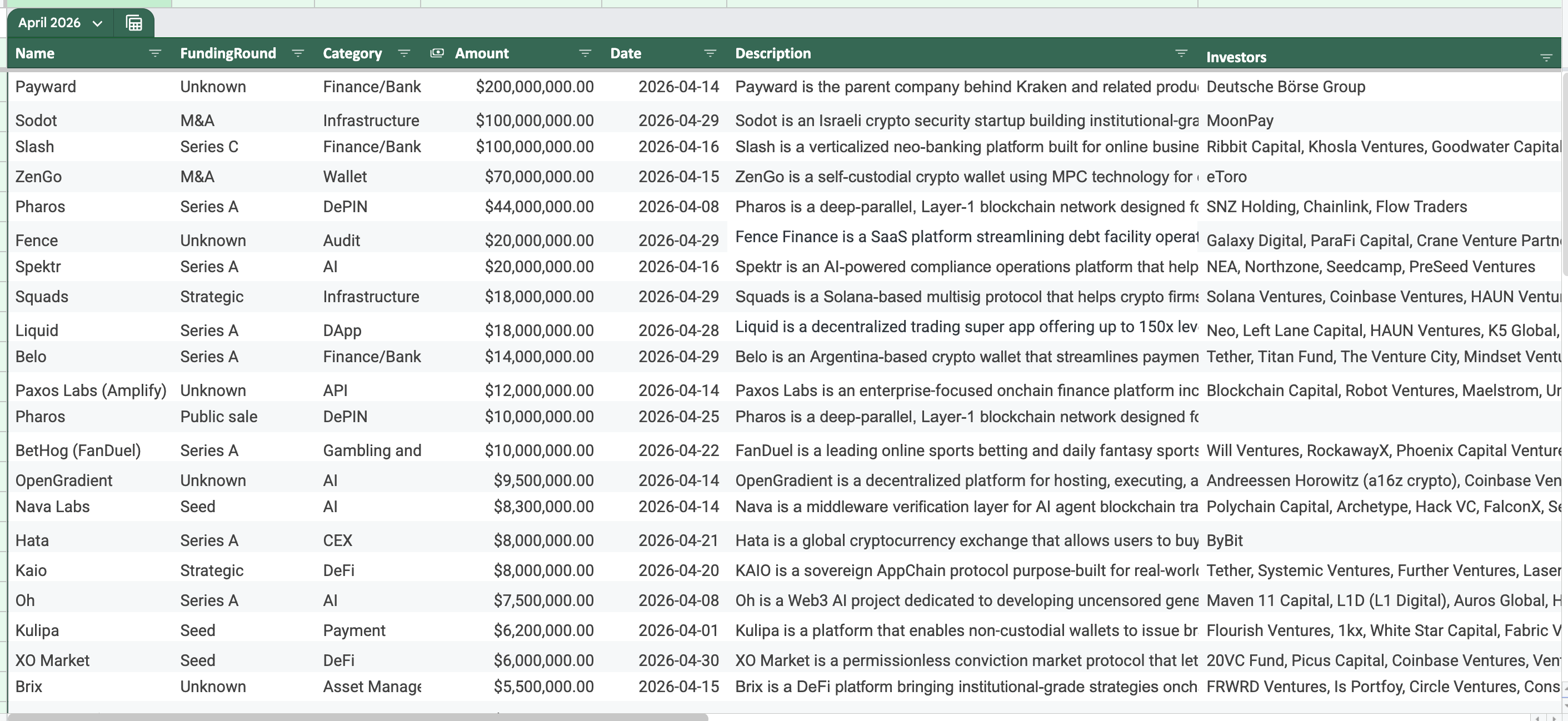
At the bottom, be sure to check out the sheet below with ALL the deals, and the recent hackathon/demo day results (in the links).
The Honeypot Problem
$606 million. Eighteen days. Two protocols you’d heard of.
That’s where DeFi sat halfway through April. Drift drained on April Fool’s. KelpDAO drained on the 19th. Bridge aggregator Dango, lending protocol Silo, DEX aggregator CoW Swap, Russia-linked exchange Grinex… all smaller hacks but… Significant
By month-end, DeFi had lost ~$770M to hacks YTD. And it’s only April. And Mythos isn’t even released (publicly) yet. Oof.
The CoinDesk headline that landed after Kelp captured the mood: “DeFi is dead.”
Fortunately. It’s not. But the framing matters because the way DeFi is breaking has changed, and the old playbook for thinking about smart contract risk is no longer the right map.
Drift: when “audited” isn’t the question
Drift Protocol, the largest perps DEX on Solana, got hit on April 1 for ~$285M. The attackers, linked to North Korea’s Lazarus Group, did not exploit a smart contract bug.
They posed as a quant trading firm. For six months. Long enough to embed, build trust, and engineer a transaction-signing trap using Solana’s “durable nonces“ feature. Members of Drift’s Security Council unknowingly pre-signed transactions that, when executed, handed over admin control. The attackers whitelisted a worthless token (CVT) as collateral, deposited 500M of it, and walked out with $285M in real USDC, SOL, and ETH.
Read that paragraph again. No audit catches that. The vulnerability was people, processes, and a Solana primitive used in a way most teams don’t model. The contract didn’t fail. The humans did, with help from a feature working exactly as designed.
Kelp: the bridge problem, again
Eighteen days later, Kelp DAO got drained for $293M, the biggest DeFi exploit of 2026 to date. Same alleged crew (DPRK-affiliated Trader Traitor). Very different vector.
The attackers found a misconfigured security setting in Kelp’s LayerZero bridge, minted 116,500 unbacked rsETH tokens, then used the fake rsETH as collateral on Aave to borrow $230M in real assets. Wrapped ether is now stranded across 20 chains, Aave has bad debt, and the LRT category has a credibility problem.
Liquid restaking is concentrated risk masquerading as yield (and not even that much additional yield). Stake → restake → wrap → bridge → lend. Every step adds composability. Every step adds a configuration that has to be perfect across multiple deployments and multiple chains. Get it wrong on one chain and the whole thing leaks. Composability is something we love in crypto / DeFi… this shows how complicated it can make things.

The pattern
Two things to notice across the April incidents.
One: it’s not your code anymore. It’s your humans (Drift), your bridge configs (Kelp), your DNS (CoW Swap’s domain hijack), your oracle setup (Silo). The attack surface has moved up the stack. Pure smart contract bugs are still happening, but the headline-makers are operational.
Two: state-level adversaries are picking the targets. Lazarus didn’t randomly fuzz Drift. They studied it for 6+ months. The asymmetry between a six-month embedded social engineering op and a typical Web3 ops team’s threat model is staggering. We are bringing audit reports to a counterintelligence fight.
The Tether trade
The most interesting subplot of April: Tether stepped in with $147.5M to make Drift users whole… a $100M revenue-linked credit facility plus ecosystem grants and market-maker loans. The catch: Drift is replacing USDC with USDT as its core settlement layer.
Translation: Circle wouldn’t freeze the hacked funds, Tether will pay to make users whole, and the price of admission is replacing your stablecoin rail with theirs.
That’s a competitive flex. It’s also a glimpse of what the post-GENIUS Act stablecoin landscape actually looks like: issuers competing on distribution and rescue capital, not just float. The protocols that take the rescue capital trade trust for survival. Hard to argue with the math when your users are out $300M.
What this means for investing
Three things shift after a month like this:
1) Security/ops becomes a real diligence item, not a checkbox. “We’re audited by [name]” tells you almost nothing about whether the team can survive a six-month social engineering campaign. We need to ask about admin key custody, signing procedures, council composition, bridge config monitoring, and DNS/domain controls. If a team can’t answer those crisply, that’s the answer.
2) LRT/restaking exposure should be priced like a basket of bridge risk. Because that’s what it is. Every chain you deploy on is another config that has to be perfect forever. The yield premium has to compensate for that… and right now it doesn’t.
3) The institutional adoption story has a prerequisite. Every chart that ends “and then the next $10T of TradFi flows in” assumes operational risk is solved. April just reminded us it isn’t. The teams that build credible institutional-grade operational security …not theatrics, real procedures… will eat. The teams that don’t will be honeypots.
DeFi isn’t dead. But the next wave of winners will look less like “the team that wrote the smart contract” and more like the team that runs the protocol like a bank actually runs a bank (I know… I know): paranoid, layered, and boring.
Boring and safe is the bull case.
Now on to the rest of the crypto / web3 fundraising :)
Top 10 Crypto Funding Rounds
Kraken (Payward) | Strategic | Centralized Exchange | $200M | 2026-04-14
Deutsche Börse acquired a 1.5% stake in Kraken via secondary, valuing the exchange at $13.3B. Deepens a partnership announced last December and signals serious intent from a major TradFi exchange operator to plug into crypto rails ahead of Kraken’s expected IPO.
Drift Protocol | Strategic | DeFi | $147.5M | 2026-04-16
Tether ($127.5M) and partners ($20M) backstopped Drift after its $285M April 1 exploit. Structured as a $100M revenue-linked credit facility plus ecosystem grants and market-maker loans. Drift is replacing USDC with USDT as its settlement layer in exchange.
Stablecoin Development Corp (SDEV) | PIPE | Stablecoin / RWA | $134M | 2026-04
Tether Investments led a $134M financing for NYSE-listed SDEV, a public-market vehicle for stablecoin infrastructure exposure. Framework Ventures and R01 Fund LP participated. Continues the trend of public-market wrappers for the stablecoin economy.
Slash | Series C | Payments | $100M | 2026-04-16
Ribbit Capital led with Khosla Ventures and Goodwater co-leading. Valuation hit $1.4B. Slash crossed $1B in annualized stablecoin payment volume within nine months of launching the product — one of the cleaner stablecoin-as-rail stories in fintech right now.
OpenFX | Series A | Payments / FX | $94M | 2026-03-31
Late-March announcement that didn’t make last month’s cut. Accel, Atomico, Lightspeed Faction, M13, Northzone, and Pantera led, with Flybridge and Hash3 returning. $500M valuation. OpenFX uses stablecoins as the settlement intermediary for FX, and is doing $45B in annualized payment volume — up 10x year-over-year.
Pharos | Series A | Infrastructure | $44M | 2026-04-08
Largest standalone crypto Series A of the first week of April. Protocol-grade infrastructure layer for compute and verification.
Fence | Series A | RWA / Credit | $20M | 2026-04-28
Galaxy Digital led, with Parafi Capital and Crane Ventures. Fence uses smart contracts as back-end plumbing to automate the manual workflows behind the $6T asset-backed credit market. Already $1.5B in assets across the platform with BlackRock and Fortress as users — the boring tokenization story is real.
Spektr | Series A | Compliance / Infrastructure | $20M | 2026-04
NEA led with Northzone, Seedcamp, and PSV Tech. Copenhagen-based AI compliance infra serving both crypto wallets (Phantom, Mercuryo) and traditional banks. Read this through the April thesis lens — this is exactly the “ops as a service” layer DeFi just got reminded it needs.
Liquid | Series A | DeFi / DEX | $18M | 2026-04
Co-led by Neo Global Capital and Left Lane Capital, with Haun Ventures, K5 Global, SV Angel, Antifund, and Sunflower Capital. Mobile-first leveraged trading in the Hyperliquid ecosystem. Hyperliquid eco deals continue to attract top-tier capital.
Squads | Series A | Payments / Stablecoin | $18M | 2026-04-29
Solana Ventures led, with Coinbase Ventures, Haun Ventures, and L1D. Squads now secures over $10B across its Solana multisig standard, and is scaling its Altitude product — a stablecoin-native “financial OS” for businesses that’s done $200M+ in payments since launching last December. Real revenue, real users, real thesis.
Click to see all of April’s funding rounds here
April Crypto VC Fund fundraise Announcements
VCs are continuing to announce their new raises — though the tone has shifted noticeably toward “smaller, faster cycles” given how quickly crypto narratives turn.
Blockchain Capital | Funds VII + Growth II $700M | April 2026
San Francisco-based Blockchain Capital is in market with two new vehicles — its seventh early-stage fund and second growth fund — targeting close in the next 5–6 months. Portfolio includes Coinbase, Circle, and Tether. Notable for being a balanced early/growth book rather than a pure stage-specialist fund.Paradigm | Fund III $1.5B | April 2026
New fund expanding mandate beyond crypto into AI and robotics. The mandate expansion is the story — the largest crypto-native VC officially diversifying away from pure crypto.Breed VC | Fund II ~$13.6M first close | April 2026
Early-stage crypto-focused fund continues to close commitments through April. Smaller fund, but worth watching as the seed bench-strength specialist segment quietly stays active.
As a reminder, if you are interested in learning more about Bankless Ventures Fund II, please fill out this form and we will be in touch!
Hackathons
Ongoing
Solana Frontier Hackathon | April 6 – May 11, 2026
Online. $2.5M+ deployed by Colosseum’s venture fund into winners, plus pre-seed funding and acceptance into Colosseum’s accelerator program.
Upcoming
ETHPrague 2026 | May 8–10, 2026
Prague, Czech Republic. Builders’ summit + hackathon at Municipal House.
ETHGlobal New York | June 12–14, 2026
New York City, in-person.
ETHGlobal Lisbon | July 24–26, 2026
Lisbon, Portugal, in-person.
Finished (results in links)
ETHGlobal Cannes | April 3–5, 2026
Cannes, France. Top 10 finalists announced: ENShell, DIVE, maki, Défi, ALMA, npmguard, VEIL VPN, PaintGlobal, EVM PORST, and Corpus. Themes skewed heavy on AI agents, privacy infra, and prediction markets.
Demo Days
Upcoming
Solana Frontier Demo Day | mid-May 2026
Online. Final demos from the Frontier Hackathon cohort.
Finished
Cointelegraph Accelerator x Inspira Labs / Yellow Capital Web3 Demo Day | April 2026
Showcase of early-stage Web3 startups from the Cointelegraph Accelerator program.
RWA Demo Day Hong Kong | April 2026
Hong Kong, in-person. Real-world asset tokenization track demo day, part of the broader Hong Kong April Web3 events calendar.
Open Accelerator Applications
Alliance DAO (ALL18) | Open / Rolling
Virtual + IRL retreats. ALL18 cohort starts Sept 7, 2026; interview decisions within ~2 weeks of application. ~5% acceptance rate; median graduate raises $3.5M at $25M post.
Solana Incubator (Cohort 5) | Opens May 2026
Virtual. Grants and developer resources for Solana-native teams.
Techstars Web3 | Open
Virtual + in-person. 2026 applications currently open.
That’s a wrap for April! Strap in… May is going to be busy, and the security bar for everyone just got raised.
Thank you and good luck out there!
Ben Lakoff, CFA
https://twitter.com/benlakoff
Comments
Nothing yet. Say the first thing.
Sign in to join the conversation.