
There are still a few spots left for The Unfinished Metropolis book launch party in Brooklyn on the evening of October 21! RSVP here.
This article originally appeared in Planetizen. It is republished here with permission.
It’s a difficult time to be a big city transit agency. Many transit providers across the country are facing huge deficits in the coming years leaving them with stark options: Find new revenue sources, or massively cut service.
Philadelphia’s SEPTA is facing a $200 million annual shortfall. TriMet, in the Portland, Oregon, area, is looking at a $300 million deficit. Chicago area transit agencies are staring down a deficit of nearly $800 million that could result in up to 40 percent of service to be cut. The list goes on.
The question is: why is this happening right now, everywhere, all at once?
Thanks for reading The Urban Condition! Subscribe for free to receive new posts and support my work.
A perfect storm, long brewing
Covid, and its attendant inflation, are the main forces behind the transit industry’s fiscal cliff. But they are far from the only ones. In many ways, they simply worsened existing challenges. “It’s not like we didn’t have these problems before Covid,” said Jeffrey Tumlin, who led the San Francisco Municipal Transportation Agency from 2019 to 2024. “Covid accelerated them.”
Public transportation has always faced a structural economic challenge known as “Baumol’s cost disease,” said Yonah Freemark, a research associate at the Urban Institute. This theory, developed in the 1960s, posits that for labor-intensive industries, operating costs over time will rise faster than inflation. That’s because other sectors of the economy are able to reduce their operating costs through more efficient operations, while sectors like healthcare, education, and public transit cannot.
“This is a problem that has been true of transit agencies for decades,” Freemark said.
Tumlin watched this play out firsthand at the SFMTA. “Almost all of our operating costs are driven by the cost of labor,” Tumlin said. “And here in California, the cost of living accelerates at a far faster pace than inflation. So every year, our costs increase with the cost of living, but our revenues increase at best with inflation.”
In most industries, consumers bear the impact of these higher costs year after year. That’s why services like childcare and eldercare have gotten so expensive. But not public transit. Politicians and voters tend to resist virtually any way of closing the funding gap, whether it be higher fares, higher taxes, or higher tolls or parking fees for cars.
“The politics on the revenue side, particularly around transit fares, are also very populist,” Tumlin said. “Both policymakers and executives often want to just not deal with it.”
When the pandemic hit, that perennial budget hole suddenly got a lot deeper. The decline in ridership and fare revenue represents the biggest factor. Ridership plummeted during the pandemic, and remains below 2019 levels at nearly every big city transit agency due to changing commuting patterns. The biggest laggards include Denver’s RTD, which remains roughly 40% below pre-pandemic levels, and the Bay Area’s BART, which is about 50% short of 2019 ridership levels. While relatively low-ridership systems in mid-sized or sprawling cities only get a small percentage of revenues from fares, and have therefore been more resilient, practically all agencies that relied significantly on fares have been forced to seek new funding sources in recent years.
There were also societal changes largely out of transit agencies’ control. Fare-beating surged across the country during and after Covid, and remains elevated compared to historical rates. In 2024, New York’s MTA lost over $900 million in unpaid bus and subway fares, more than three times as much as in 2019, according to the Citizens Budget Commission.
As crime spiked nationwide following the pandemic, transit agencies spent more on policing and security to try to win back riders. While big city crime rates have since fallen considerably, homelessness remains at record levels across the country, which has led transit agencies to invest in homeless outreach and social services. In 2022, Los Angeles Metro signed a $120 million contract to employ 300 civilian ambassadors across the system.
Other transit revenue sources have failed to rise along with growing costs in recent years. Gas taxes, in particular, have been delivering lower revenues as vehicles become more efficient and electric vehicles gain popularity. In Pennsylvania, gas tax revenues in 2024 were $250 million lower than in 2019. Gas tax revenues in Oregon have declined over the past four years, even as costs have increased substantially.
Parking revenues are another transit funding mechanism that has seen a structural decline. In 2024, parking revenues in San Francisco were $282 million, down from $352 million in 2019. Those declines stem from the double whammy of remote work, meaning fewer cars in downtown garages, and the longer-term trend of Ubers and Lyfts decreasing demand for parking, Tumlin said.
Federal Covid relief funds papered over these gaps for a few years. But now, those wells are starting to run dry. What’s more, budget cuts under the Trump administration are expected to reduce federal transit grants, as well as other sources of aid to cities and states. Reduced federal funding in areas like healthcare and housing could force transit to compete with those priorities in budgeting discussions.
The stark urban/rural partisan divide doesn’t help matters, either. In the purple state of Pennsylvania, for instance, Republicans have been the main impediment to a funding deal for SEPTA.
So what is working?
Despite these challenges, some transit agencies have found a way through.
The dense urban centers of the northeast stand out. New York State addressed the MTA’s fiscal cliff largely by increasing its transit payroll tax for large businesses, the revenue from which is expected to grow 3.7 percent annually. While New York City’s congestion pricing revenues are earmarked for capital projects, rather than operations, they also helped bolster the agency’s financial outlook.
New Jersey used a similar mechanism to fund NJ Transit, raising corporate taxes. In the Washington, DC area, Maryland, Virginia, and the District of Columbia each increased their contribution to WMATA, mostly by moving gas tax revenues and other existing funding sources.
In all three of the above regions, revenue boosts were coupled with fare hikes. In New Jersey and the DC Area, agencies could once again face a challenging funding picture in a few years when current funding agreements expire. But these agencies are in a far better place than many of their counterparts.
Freemark credits WMATA’s funding deal to strong management under CEO Randy Clarke. “DC Metro has done a really good job in terms of bringing people back. The service is substantially better than it was pre-pandemic,” Freemark said. “The result has been that the states and DC have agreed to deal with the fiscal challenges that currently exist.”
WMATA is also one of very few agencies that is affirmatively taking on Baumol’s cost disease. The agency has announced plans to automate the metro system over the next two decades, which could lead to a reduction in operating costs of 10-15 percent, all while providing faster and more frequent service.
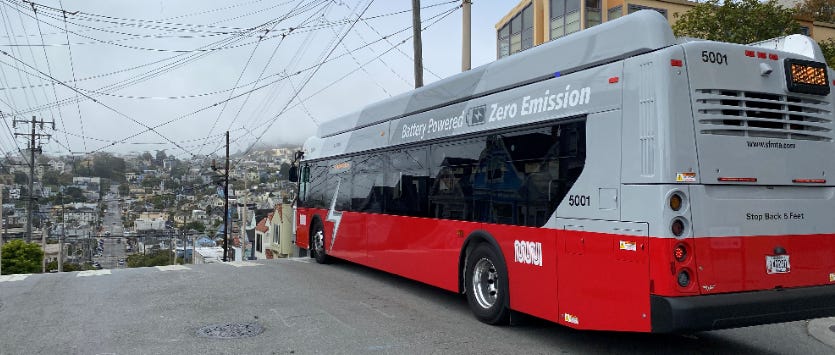
SFMTA also found ways to become more efficient during Tumlin’s tenure, including the widespread implementation of transit-only lanes. By freeing buses from traffic, the same number of buses and bus drivers can offer more service. These lanes have increased bus speeds by 10 to 30 percent, which corresponds to similar improvements in efficiency. The agency’s unique all-door boarding policy also improves efficiency by reducing the amount of time at each stop.
Still, these efforts aren’t enough to sustain the agency financially. Its long term financial health, alongside that of BART, will be dependent on a 2026 ballot measure that would raise sales taxes in the Bay Area. Separately, San Francisco is also considering a property tax increase for public transportation.
Sales taxes are an increasingly common way to fund transit at the local level, insulating cities like Los Angeles, Seattle, and Salt Lake from severe fiscal cliffs. But, this strategy is “not ideal, because it’s regressive,” Freemark said. “At the same time, it’s feasible. And in many cases, you go for what’s feasible, not what’s perfect.”
What else will it take?
Tumlin advises that transit agencies select leaders who are “unafraid of losing their job.” They must be willing to fight for politically difficult policies like increasing fares, parking meter rates, or taxes. He added that agencies should pursue diverse sources of funding, to insulate themselves from potential shocks.
“The most powerful source for raising sustained transit operating and investment funding is decongestion pricing,” Tumlin said, “because decongestion pricing allows you to think about transportation as a system.” Despite its inherent logic, decongestion pricing (or congestion pricing, as it’s more commonly known) can be politically difficult to implement.
In the Chicago area, policymakers have pursued a more unconventional menu of funding sources for the CTA and other Chicagoland agencies. They include expanding existing ride-hail taxes and real estate transfer taxes across the Chicago metro area, as well as transferring tollway funding to transit.
These revenue measures are tied to a plan that would merge the CTA, the Metra commuter rail system, and the Pace suburban bus system into one unified regional agency. Lawmakers in Illinois will decide whether to pursue these funding strategies — or enact big cuts — in a special legislative session this month.
America’s neighbor to the north could show a better way. Translink, the transit agency for the Vancouver, BC area, has a clearly defined schema for how it approaches funding conversations.
“Given that a strong transportation system benefits everyone, everyone should really contribute,” said Andrew McCurran, director of strategic planning and policy at Translink. The agency groups these constituencies into four baskets: transit users, road users, property owners, and the participants in the broader economy.
As Translink faced its own post-Covid fiscal cliff, due, McCurran said, to a temporary decline in ridership and long-term declines in gas tax revenues, it applied these principles to its funding plans. A temporary funding deal reached this spring will include increases to transit fares, increases to a parking tax, increases in property tax, and an increased contribution from the provincial government.
But even in Vancouver, more difficult funding conversations will need to happen in the years to come. Though Translink has recovered its 2019 ridership, costs have gone up significantly since that time. It needs a totally new approach to funding to close the gap, McCurran said. The provincial government is exploring new, sustainable funding sources for the agency after the current funding agreement runs out in 2028.
“If you’re going to do a rethink on what is the sustainable funding model over the long term, that’s a good opportunity to take a step back,” McCurran said. “There’s no way to just muddle through with a few incremental changes.”
Thanks for reading The Urban Condition! Subscribe for free to receive new posts and support my work.
Comments
Nothing yet. Say the first thing.
Sign in to join the conversation.