
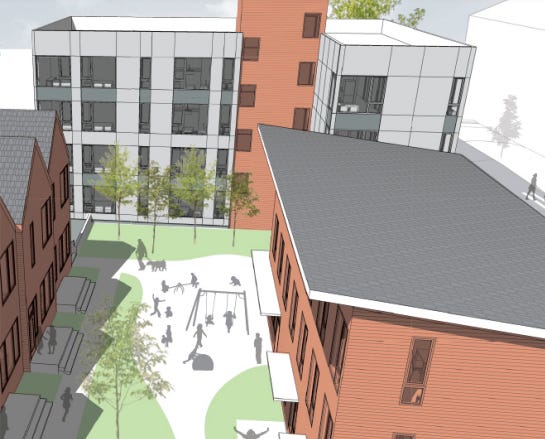
In recent years, it has become commonplace for American housing advocates and elected officials to make the pilgrimage to Vienna. They come to learn about the Austrian capital’s government housing, famous the world over for its modest rents, beautiful architecture, and popularity among rich and poor residents alike.
Despite all of the interest in Vienna’s social housing, there’s really only one American city that is seriously seeking to copy this model whole cloth.
In 2023, Seattle voters passed a ballot initiative creating a “social housing developer,” an independent public development authority that would acquire and develop housing available to residents across a wide spectrum of household income. Then, in 2025, voters passed a 5 percent payroll tax on every dollar over $1 million in salary paid out to an individual employee. Proceeds from the “excess compensation tax,” as it is colloquially known, flow directly to Seattle Social Housing Developer.
The public development authority has experienced some growing pains since then. Its initial CEO, a former non-profit housing executive in California named Roberto Jimenez, was ousted by the authority’s board in January, following criticism about his leadership style and his decision not to move to Seattle for the job. The board immediately brought on Tiffani McCoy, the architect of the two successful ballot initiatives but a real estate development novice, as the authority’s interim CEO.
With $133 million in funding from the excess compensation tax now on hand, and a supportive new mayor in Democratic Socialist Katie Wilson, Seattle Social Housing has some momentum. McCoy expects the agency will make its first property acquisition in June and will own about 300 units by the end of the year. It’s also looking to acquire multiple sites for future ground-up development projects.
In my first piece as an investigative and policy reporter for Remapping Debate, I spoke with McCoy about where things currently stand with Seattle Social Housing Developer and the challenges ahead. As McCoy readily admits, the authority is navigating uncharted territory, and many questions about how it will operate remain unanswered.
Though its governing bylaws grant Seattle Social Housing Developer a fairly large degree of flexibility, the authority is interested in remaining “conceptually rigid,” McCoy says. Full public ownership, democratic building management, and cross-subsidization are non-negotiable. The authority also hopes to build large, family-sized homes to the highest environmental standards using union labor. And it intends to do all of this while establishing a self-sustaining real estate enterprise that will ultimately own thousands of homes across every part of the city.
Another question is how much, or how quickly, Seattle Social Housing can make an impact on housing affordability. Seattle currently has a total of 411,000 homes, and has an estimated need of 156,000 additional income-restricted affordable homes by 2044. Even if Seattle Social Housing makes good on its goal of building or acquiring 380 homes per year for the next several years, it will still represent a small slice of the city’s housing stock.
Yet, if it is successful, Seattle Social Housing could represent a new template for affordable housing production and management in the U.S. that corrects for many of the deficiencies of affordable housing tax credits and public housing. For housing advocates and policymakers, it’s an experiment worth watching closely.
Read my in-depth conversation with McCoy here.
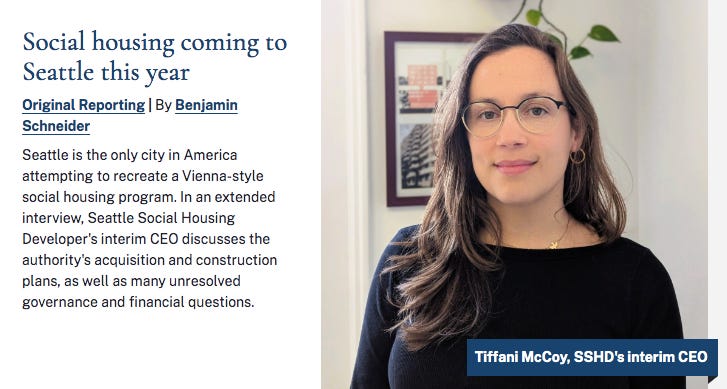
For even more context on Seattle’s program and the concept of social housing, check out my conversation with McCoy from two years ago:
No posts
Comments
Nothing yet. Say the first thing.
Sign in to join the conversation.