
The following is an excerpt from The Unfinished Metropolis. It is the second in a series of excerpts running in Planetizen, all of which will be republished here.
I’d also like to plug a couple of recent podcast appearances. The first is the “UCLA Housing Voice” podcast, where host Shane Phillips and I went deep on the themes in this article. The second is the “Who Killed the Starter Home?” podcast, where host Marina Rubina and I discussed the principles of good urbanism, California Forever, and Herbert Hoover.
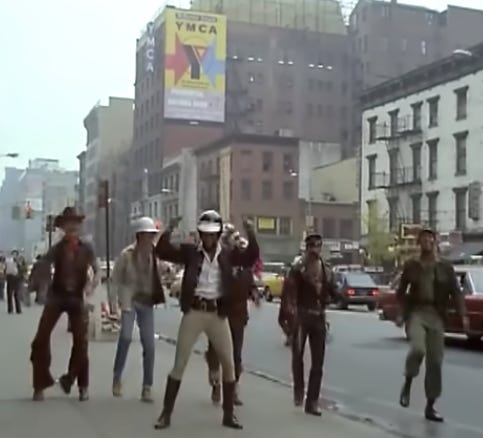
The McBurney YMCA was a happening place in the 1970s. This single room occupancy hotel, or SRO, served as a safe haven, a single’s lounge, and a gym for gay men in New York City. Some denizens of this Chelsea hotel included members of the Village People, a disco sextet that would catapult to global renown with their 1978 ode to the Y. The McBurney Y features prominently in the “YMCA” music video, which also shows the group decked out in cop and cowboy outfits on the crumbling Chelsea piers, another famous gay cruising spot.
The AIDs crisis and the gentrification of Chelsea would eventually spell the end of the swinging times at the Y and the piers. But “YMCA” will forever preserve a distinctive moment in gay culture and a different mode of living in American cities. Yes, the Y is a place “where you can hang out with all the boys.” But it’s also, crucially, “a place you can go… when you’re short on your dough.”
Single room occupancy hotels played a central role in America’s affordable housing ecosystem for decades, providing cheap, flexible accommodations without government subsidy. They are effectively large-scale boarding houses, offering small private rooms or dorm-style quarters with shared bathrooms and minimal kitchen facilities.
The YMCA was the nation’s largest SRO provider, with more than 100,000 units nationwide at its peak. The Y served an incredibly diverse clientele, not only gay men fleeing oppression and seeking community, but frequent travelers like Martin Luther King, Jr. and journalist Dan Rather.
Other SROs housed seasonal workers, people struggling with addiction, and others with very low-incomes. Shady management, unsanitary conditions, overcrowding, and conflict among residents in close quarters were all too common features of SRO life. But as with public housing, critics missed the forest for the trees.
“YMCA” would become the swan song of SRO living. Its demise was decades in the making. As early as 1930s, many cities passed zoning and parking rules that made new SROs illegal to construct.
Then, starting in the 1950s, huge numbers of SROs were leveled in the name of urban renewal. (Exact figures don’t exist, because the federal government did not treat hotels as housing, and did not count the people displaced from them.) Over 1 million SRO units nationwide were lost in the 1970s alone. New York City lost 87 percent of its SRO units between 1970 and 1983, as the city offered landlords incentives to convert their buildings to other uses.
Mainstream housing advocates, for the most part, supported this campaign: Like tenements and public housing before them, SROs were considered substandard housing that was beyond redemption. Housers wouldn’t realize their mistake until it was too late.
In the early 1980s, cities across the country woke up to a troubling new phenomenon. Seemingly overnight, legions of people had begun sleeping outside, in doorways and on park benches. The ranks of the homeless were suddenly much larger, and much more diverse in age, gender, and race than the largely white, male and middle-aged “tramps” and “winos” of previous years. This moment marked the beginning of what’s now known as “modern homelessness.” It’s a phenomenon that has only worsened in more recent years. In 2024, the U.S. homeless population hit an all-time record of 771,000.
In hindsight, housing researchers point to the mass demolition of SROs as a major factor behind the mass homelessness of today. This housing of last resort was taken away just as other alternatives, like public housing and state mental hospitals, were withering under the policies of the Reagan Administration. Meanwhile, the “downzonings” many cities had initiated in the previous years severely limited the development of all types of housing.
SROs were far from ideal, but without this form of housing or any other low-cost option, homelessness was the inevitable result. It was just as Edith Elmer Wood feared back in 1919: Housing reform had created a house famine.
The demise of SROs has received renewed attention lately as researchers, advocates, developers and policymakers cast around for solutions to the housing and homelessness crisis. On his Substack, housing analyst Ryan Puzycki described the absence of this kind of housing as the “banished bottom” of the housing market.
“We talk endlessly about the ‘missing middle.’ But the real catastrophe was the ‘banished bottom’—the deliberate destruction of the cheapest rung of the housing ladder,” Puzycki writes. “The people we now call ‘chronically homeless’ were once simply low-income tenants, housed by the private market in cheap rooms rather than by public programs.”
Alex Horowitz of the Pew Charitable Trusts partnered with the architecture firm Gensler to explore how SROs could be constructed in obsolete office buildings. This is precisely what one developer is seeking to do in San Francisco, by converting an office building into 400 “sleeping pods” that rent for $700 per month.
New York City Council Member Erik Bottcher has proposed legislation that would relegalize safe, modern SROs in the one-time SRO capital. And across the country, “co-living” developments are seeking to rebrand the concept of efficient, shared living arrangements.
SROs may be poised for a rebirth. This time around, they should have better guardrails against unsafe, exploitative conditions. New York City’s proposed SRO relegalization, for instance, mandates that no more than three tenants can share a bathroom.
While some private developers will get into the SRO game, many developers will likely be non-profits. Seattle’s social housing developer included co-living units with shared bathrooms and kitchens in a model project mockup meant to illustrate the kinds of developments it would ultimately build.
There are many models and types of ultra-efficient, low-cost housing. It goes without saying that these options are not for every household or every phase of life. But they’re an important piece of a functional housing ecosystem, a place you can go when you’re short on your dough. Right now, in expensive cities, the only such place is a park bench or a shelter. Surely, we can do better than that.
The Unfinished Metropolis is available on Amazon, Bookshop.org, and at select independent bookstores and libraries.
No posts
Comments
Nothing yet. Say the first thing.
Sign in to join the conversation.