
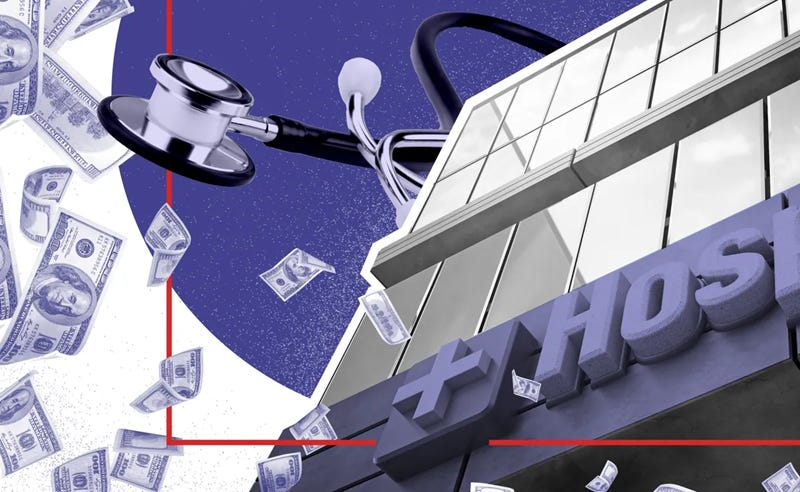
The following is an excerpt from an article by Sally Pipes, Founder & Chair of the Benjamin Rush Institute, published in Detroit News. Click here to read the full article in your browser.
Congress recently hauled CEOs from some of the nation’s largest hospital systems to Capitol Hill to answer for America’s soaring healthcare costs. And lawmakers didn’t pull their punches.
House Ways and Means Chairman Jason Smith, R-Mo., accused hospitals of building “empires” and told executives that the prices they charge patients amount to “borderline extortion.”
Thanks for reading Benjamin Rush Institute! Subscribe for free to receive new posts and support my work.
The hearing underscored a reality Washington has been slow to confront. Hospitals are the primary drivers of rising health costs. They are consolidating markets, exploiting federal programs and using their growing leverage to raise prices for patients and taxpayers alike.
According to federal data, hospital care accounted for roughly 31% of healthcare spending in 2024, totaling about $1.6 trillion. Hospitals also drove 40% of the growth in health spending between 2022 and 2024 ― more than any other category.
They’ve expanded their reach largely by eliminating competitors. Between 2010 and 2019, hospitals completed more than 1,500 mergers and acquisitions. Today, nearly half of the nation’s metropolitan hospital markets are controlled by one or two systems.
When competition disappears, prices rise. Hospital mergers within a market have been linked to price increases of 20% to 50%.
And despite repeated promises of greater efficiency, consolidation has produced no consistent improvements in quality. Some studies have even linked it to worse patient outcomes.
Click here to continue reading the full article in your browser.
Thanks for reading Benjamin Rush Institute! Subscribe for free to receive new posts and support my work.
Comments
Nothing yet. Say the first thing.
Sign in to join the conversation.