
It’s the day before Maundy Thursday and I should be working on sermons and locking down the last few readers we need for the Easter Vigil and probably a bunch of other things I’m forgetting, but instead I spent part of the morning listening to oral arguments at the Supreme Court. As self-destructive habits I’ve had go, this falls somewhere below “smoking a pack of cigarettes a day from 1999 to 2002” but comfortably above everything else. I just couldn’t stop myself today, because the subject was the 14th amendment. I’ve come to think of this amendment as our most theological, in that it makes substantive claims about humanity and national identity in the form of legal language. The government is arguing that it is, in effect, fake, that its guarantees of birthright citizenship rest on a sliding scale that can be adjusted by however the Justice Department wants to define the word “domiciled,” which doesn’t appear in it or in the principal holding of the Supreme Court that applies it, or, failing that, by whatever exigent circumstances exist inside the flickering brain of any given president. The very arguing of the case, like the presidential immunity case in 2024, is an occasion of national humiliation. But I find it hard to look away as people are trying to dismantle what's best about the fundamental structures and understandings of our nation. This time, at least, the case for rendering the 14th amendment’s guarantee into a dead letter seemed to fare poorly under questioning.
A phrase used to explain the few and narrow exceptions to universal common-law birthright citizenship caught my ear: “fiction of extraterritoriality.” This is how we explain both the immunity of foreign diplomats from certain aspects of U.S. jurisdiction and the exclusion of their U.S.-born children from automatic citizenship. If I understood correctly, it is as though they are here physically but, for legal purposes, they are extra-territorial. Their formal allegiance and their legal accountability lie elsewhere, which divides them from the many people, immigrants of all types, who are plainly subject to the laws of the United States at the time of birth and are explicitly covered by the Constitution’s guarantee of citizenship.
It has all the ugly music of legal rhetoric (say it to yourself: “fiction of extraterritoriality”) but I have kept turning it over in my mind. Present but absent. Here but elsewhere. Not protected by our laws—your sovereign can recall you any time for whatever legal penalties it wishes, unless you want to try to seek asylum—but also not encumbered by them. As though, one or more of the justices put it, a sort of bubble of foreign sovereignty surrounds one.
On my walk from the train this morning, I was remembering the second “Paschal Triduum” I ever observed, the three-day liturgy of Maundy Thursday, Good Friday, and Easter Vigil, when I was in college in 2002. Passover was the same night as Maundy Thursday, and I had received a rare invitation to a seder from some acquaintances at the Divinity School. The hostess (and her roommate?) was a Master of Arts student whose name I have utterly forgotten but whom I knew casually from the basement coffee shop. A fellow guest, who had perhaps brokered the invitation, or perhaps was the roommate in question, was another MA student who worked with me on a cooking crew. In my memory I look out at the table as if through a hotel peephole; there are others on the shadowed, distorted margins, but I can’t make out names or faces.
It was a “progressive” rite, only partly in Hebrew and with some modifications. The roasted lamb bone was absent; my hosts explained that vegetarians like themselves typically substitute a beet, but as they themselves do not pray for the restoration of animal sacrifice in Jerusalem, they had instead used an apple to symbolize the sacrifice of immortality our first parents made for the sake of knowledge. This, I hardly needed to mention, is not how Lutherans tell it, but I’ve never forgotten it, so here we are. But the bitter was bitter, the wine was wine, the charoset was sweet and nutty, the plagues and “dayenus” are still there in my wobbly memory.
It was an act of great kindness and hospitality that I received that night. It only occurred to me this morning that it bookended a year that began with an invitation from my roommate, an extraordinarily generous and critical friend to me, to attend Kol Nidre at a Conservative Hyde Park shul the previous fall. That, too, was completely new to me; in my mind I remember letting my borrowed tallit slip and touch the floor, and my friend gathering up and kissing it before she handed it back to me. Of the service itself I remember nothing other than the gravitational force of the singing. Nothing but this: We were still in the deep shadow of 9/11 at the time, and the rabbi made reference in his address to Osama bin Laden, with the imprecation “may his name be covered and his bones turn to dust.” The homey, casual Passover makes a contrast, but the two events are connected by the struts of sacred history, which is always renewed and made present in the ritual act, and by my own reserved but grateful presence as an outsider.
Perhaps an old notebook would clarify this for me, but I don’t recall if I went to Maundy Thursday first and scarpered up to the student apartments for the seder, or went to the seder first and had to excuse myself untimely to go, wine-glazed, to church. At any event, I did both, hearing a snippet of the Exodus again in a quite different context, and the tradition Paul passes on about the bread and cup which are body and blood, and Jesus washing the feet of his friends. I got my feet washed, uncomfortable as it would ever be, and did what Paul hands on and the Lord himself ordains for me and received the Sacrament. You are inside your own moment and yet in a different time and place; or your location in time and place is intersecting with something else, if only by the medium of memory and ritual action. Fictions of extraterritoriality, fictions of extratemporality: your table is also another table, and every table; this happened to them and to us; this is given for you as it ever was to anyone. Do this in remembrance of me, and become what you have remembered.
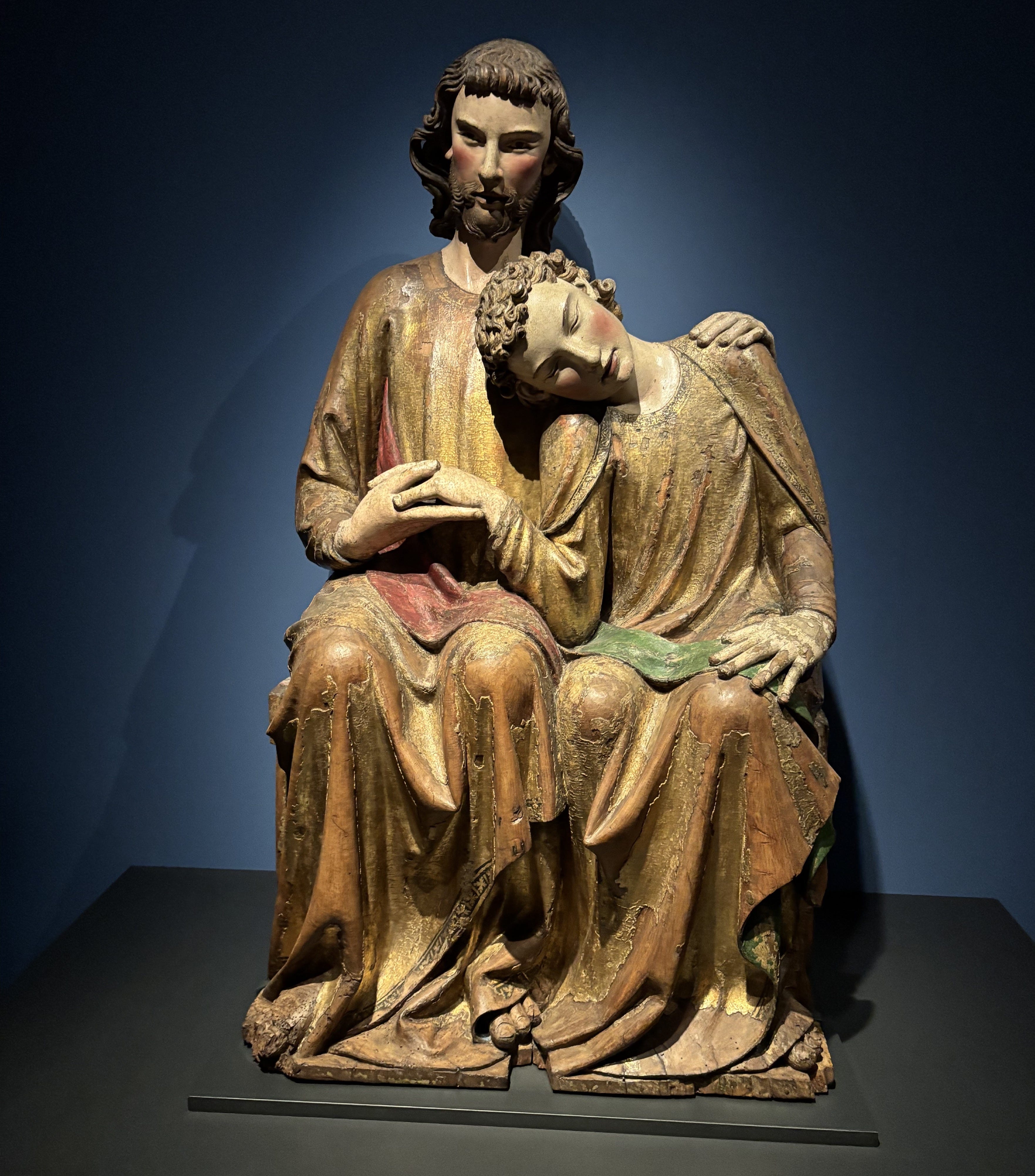
A few short years later, I was a student at the same Divinity School as those erstwhile seder hosts when my field education supervisor broke her ribs on the evening of Palm Sunday and ended up in the hospital with a collapsed lung (or two?) on the Wednesday of Holy Week. I got a call from the hospital that I’d have to preach Maundy Thursday while a pastor from the bishop’s staff would preside at the altar. I finished the call and went straight back into Jimmy’s Woodlawn Tap to start drafting my sermon. This felt overwhelming at the time, and while I’m just as glad the manuscript is no longer extant, we all survived it. Now here I am, procrastinating to the same moment. The hours ahead barrel toward me. I feel them on my own absurd scale of time and place, with the little forgettable tasks I have to do. And I feel them measuring the weight of the world in the fear, horror, and joy of the acts they represent and in which representations are ever remembered. But behind and around them, in that territory in which I am ambivalently domiciled, what should I feel but gratitude at the tables that welcomed me, the moments that sheltered me, and the communities that gave me language and the right of citizenship within the very miracle of their existence?
I wish all of you who celebrate a safe, reverent, and joyous Passover, Holy Week, and Easter.
Last year I shared my 2024 Maundy Thursday sermon here. You may find it worthwhile if you missed it:
New Writing: Thursday and Friday
Without remembering the specific turn I made in the sermon above a few paragraphs in, I got to a similar place in my column on the Maundy Thursday lectionary for the Christian Century:
There is an admonition attributed, I assume spuriously, to Francis of Assisi: “Preach the gospel at all times; if necessary, use words.” It pops up all the time in the church circles in which I’ve spent my life, seeming to suggest—even command—a way out of the discomfort of verbally proclaiming anything about Jesus, especially to anyone who might not already have a formal commitment to a Christian community. The content of the good news can be conveyed through loving and generous action instead.
That a message about the work of God in the person of Jesus Christ can, in fact, be proclaimed without words would likely have come as a surprise to the apostles, who were always talking about Jesus alongside their various miracles and acts of service. Even the best good works are inherently equivocal; they may be done for any number of reasons (even selfish ones), in service of any faith or none. They may even redound primarily to the reputation and benefit of the one doing them rather than to any god on whose unspoken behalf they are done. Using words is important. More than that, it’s necessary….
Nevertheless, Maundy Thursday confronts the preacher with passages that are all about some kind of prescribed action.
There’s a shorter online-only post to go with it:
The whole history of war and revolution confirms that humanity is at least as willing as God to exact and to pay a high price for whatever we consider freedom. That life may only rightly be taken for a cause, and that collective punishment is, at least gradually, excluded from ethical consideration, is discernible even before Exodus concludes.
I wonder how this story will come to sound in a world that is moving away from the concepts of human rights and international humanitarian law that have at least nominally governed the world for most of the last century. “On all the gods of Egypt I will execute judgments,” God says of the imminent slaughter of the firstborn. A skeptic might read this as a fantasy of comeuppance in a world ruled, as ours increasingly is, by force and coercion rather than by legal procedures.
Here’s my Good Friday essay:
I have long been haunted by Caravaggio’s The Denial of St. Peter, which shows the apostle with his accusers in extreme close-up, his hands ironically turned inward against himself and his face furrowed and turned slightly aside with dissembling. It’s as if nothing else in the whole wide world is happening.
That is one aspect of the story, particularly as John writes it. The arrest, trial, and crucifixion of Jesus are acts of high cosmic drama, pulling everyone around them and even the natural world into their narrative. For John, human beings are like graphite shavings arrayed in a pattern by the presence of Jesus’ magnetism.
It is harder to capture the other side of the story, which is how mundane it is.
And the online-only sidecar, with my guy Pieter Bruegel the Elder:
Then there’s the crowd. A swooping circular arc carries it from the city to the execution ground, where a second, smaller circle has already formed to watch. It’s not a mob welded together by anger or celebration; it’s more like a river current with eddies and tide pools. Some people watch with grief or anger. Some are flowing backward toward the city to sell goods. Children are playing. A child rides on a parent’s shoulders toward the place of crucifixion. To the right and in the background are torture wheels, one of many touches from Bruegel’s century transported back in time to connect it to the killing of Jesus.
Bruegel’s preservation of the intensity of the Passion story in the midst of a swirling social world, and his joining of the first century with his own time and place, strike me as a perfect representation of what preaching ought to do on Good Friday.
Thanks for reading The Parish Bulletin! Subscribe for free to receive new posts and support my work.
Comments
Nothing yet. Say the first thing.
Sign in to join the conversation.